


| # | User | Rating |
|---|---|---|
| 1 | Benq | 3676 |
| 2 | jiangly | 3670 |
| 3 | Kevin114514 | 3657 |
| 4 | maroonrk | 3355 |
| 5 | Um_nik | 3353 |
| 6 | squareOf105 | 3346 |
| 7 | tourist | 3343 |
| 8 | strapple | 3324 |
| 9 | heuristica | 3322 |
| 10 | jiangbowen | 3291 |
| # | User | Contrib. |
|---|---|---|
| 1 | Qingyu | 158 |
| 2 | nik_exists | 150 |
| 2 | maspy | 150 |
| 4 | AmShZ | 143 |
| 5 | Um_nik | 141 |
| 6 | Errichto | 139 |
| 7 | adamant | 137 |
| 8 | BledDest | 133 |
| 8 | maroonrk | 133 |
| 10 | qwexd | 130 |


|
+2
My solution was calculating the probability of obtaining an array of length |

|
+45
Really cool problem set! |
|
+5
(F[x] * (F[x] - 1)) / 2 should give us the number of subarrays with XOR == 0. Also (F[0] * (F[0] + 1)) / 2 = ((F[0] + 1)) * ((F[0] + 1) - 1)) / 2. So we can just increment F[0] at the beginning to handle this case. |
|
+1
If original P had the values x0, x1, x2, x3 and suppose you flip x1, then P would become Then if you flip x2, it would become So, regardless of the elements you've flipped, either the current prefix xor is correct or it's complement is correct. Knowing which one is correct does not matter since you will be comparing both of them anyway. |
 .
. .
.|
+70
We need to minimize the number of subarrays with xor==0. If we can change elements to its complement, we can try minimizing the summation. To do so, we can try breaking up a single element with large frequency to many elements with lower frequency. This will decrease the sum because of the property a12 + a22 + ... ≤ (a1 + a2 + ...)2 for non-negative integers. We can iterate over the prefix array and if x is the current element and Now, the only case left is how do we handle choosing when Suppose we choose x over Hence, the greedy algorithm would work. |

 as its complement, we choose the element with the smaller frequency until this point and increment its frequency.
  .
.|
+8
Has the distribution been decided yet? |
|
+5
I used co-ordinate compression. I got WA TC #5 when I was printing K in terms of the compressed value instead of the real value. |
|
+9
This has happened before and the rating changes of both contests were based on the rating before edu round. Edit: Looks like they fixed it this time. |
|
0
Most likely it will be held this week. Will update with finalised date/time once I get that info. |
|
On
apoorv_kulsh →
Divide by Zero 2018 and Codeforces Round #474 (Div. 1 + Div. 2, combined) Editorial, 9 years ago
+14
We apologise for the scoring issue. We underestimated/overestimated a few problems. Glad to hear you like the problem set :) |
|
0
It was a last minute decision, unfortunately. Please check the update for more info. |
|
0
Yes, there were issues which were out of our control. Please check the update. |
|
0
Auto comment: topic has been updated by Vicennial (previous revision, new revision, compare). |
|
0
Auto comment: topic has been updated by Vicennial (previous revision, new revision, compare). |
|
+25
Yes, you wouldn't be able to copy-paste the code. Although, You could try writing it manually on your system at the expense of time. |
|
0
You can assume for now that all of the contests would be unrated. |
|
+1
Hint |
|
0
Do you use tournament tree in this case because iteration is faster than recursion or is there more? |
|
+1
The time spent after skipping first 'x' classes and last 'y' classes. |
|
+3
Both Pre-calculation and main DP are O(nk^2) |
|
+3
Observe that its useless to skip any lecture which is not at the beginning or the end. |
|
+17
Calculate pre[i][j] = Minimum time spent in university on i'th day after using j skips on this day. |
|
+24
Consider ranges [3,5] and [9,12]. After [3,5] you will move the left pointer to 9 while deleting elements 3-8. But you haven't added elements 6-8. One way to fix this is to always expand the range first and then contract it. |
|
+5
Is there a CHT list? |
|
+12
Can be done in an even easier way using only vector+lower_bound. |
|
0
Another problem which can be solved by this technique: Coloring Tree One more : 932F - Escape Through Leaf |
|
0
|
|
0
99 after the plagiarism check, congrats :) |
|
+8
You can also solve it in O(M*(N/32)) in a very short code using bitset and exploiting codechef's memory limit. |
|
+29
Why does each chapter cost $29.95 when you can get all 15 chapters for $39.99 on Springer? I think it would be better if each chapter costs around $3-$4 so that those of us who cant afford the whole book can still read the chapters we need. |
|
+20
Could you delay the round by 10-15 mins ? |
|
+6
X=(A+1)*(C+1)-1 + B*D. For each type A seq, we can join it to a type C seq. We add +1 to each of these values to account for empty seq and subtract -1 finally to account for taking empty seq from both sides. For each B seq, we must combine it with some type D seq. So this contributes B*D sequences. |
|
+31
|
|
0
Oh right, answer will never be -1 in this case. |
|
0
Any idea what TC4 is in C? |
|
0
I did the same but used LCA to check if its an ancestor and it got TLE on TC10. Not sure how yours passed. |
|
+3
Lets say you need to find x! where 2*109 > x. Now, we have stored 0! , 106 ! , 2*106 !, 3*106 ! .... and so on till 2000*106 ! . Now there will exist some integer 'z' such that z*106 <= x <= (z+1)*106. Since 'z' will always be <=2000, we would have already calculated z*106! Therefore we would need to multiply the pre-calculated z*106! value by atmost 106 integers. |
|
+57
Cool. Think what you will. Here's my perception of you: "Coward". You must be so brave spouting shit about people behind that fake account. |
|
+75
You're acting like I'm shoving it down your throat. Are you so alone that you never have fun with friends? |
|
+43
How is this even related to this blog? I posted it on my own classmate's profile and the post was meant for our friend circle and it isn't even serious.
Source: Check comments |


|
0
Hey, we registered our team Phoenix under the name 'phoenixiiti' on the pantheon website because someother team had taken the name 'Phoenix' already. |
|
+14
This is mostly related to the browser. I use firefox for hacking and I haven't faced this issue. |
|
0
Hack cases for B and C? |
|
+22
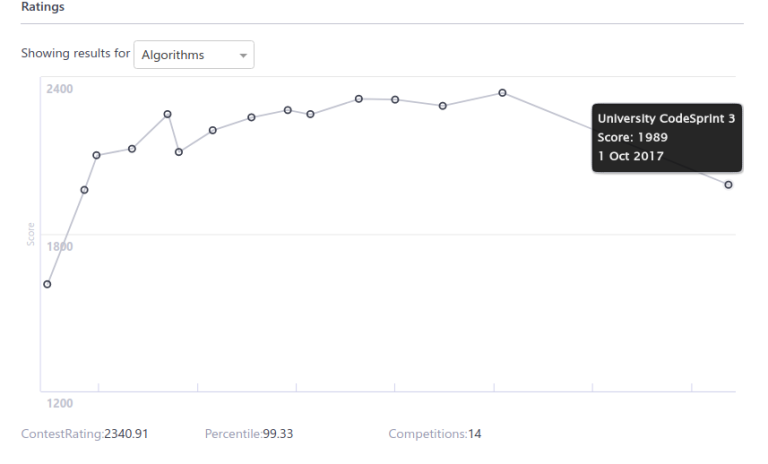
Rating Change: 2340 -> 1989 ( -351 ) Please fix... |

|
+3
|
|
+28
Am I right in assuming its top 100 from student leaderboard? |
|
+10
Because of this: On online judge, the |
|
0
How do you derive this? The concept seems similar to 844D - Interactive LowerBound but a derivation would help me understand better. |
|
+3
How do you solve The Six Thatchers? |
|
+3
Substring aacb = 3(aacb(0, 2, 3), acb(0, 2, 3), acb(1, 2, 3)) You have to find the answer for each substring and sum up the values. |
|
+1
Holy shit! Been using HR for more than a year and did not know it had a 'college contest' section :P |
|
+23
C++11 isn't always better either. Run this code in custom input using G++ 11/14: Results: Thread discussing this speed difference can be found here. |
|
-8
Yes. |
|
+13
If you're going to insult me, atleast state some reasons why you think I'm 'dumb as compared to others' and a 'shitty codr'. |
|
0
Let me state some dates first. Between the camp announcement and camp selections, there were literally 0 contests on cf. Now, Why didn't I participate in Round 419? Why didn't I participate in Round 421? Moreover, The applications considered max rating too. Me participating/not participating would have had minimal impact on the selection. |
|
+10
D can be done in O(N). |
|
+19
|
|
0
Seems like the blog author might have deleted it. |
|
0
That's where persistent segment tree comes in. |
|
+10
On the website its mentioned: |
|
+25
Maybe not. But IMO, topcoder is losing popularity and they have to do something about it before its too late. |
|
0
Btw why cant topcoder have more problems in a round? Even 1 extra problem would help decrease the massive jumps in difficulty. |
|
0
True. I'm used to using fflush(stdout); because I have this in my code: |
|
0
Change it to: |
|
+3
I'm guessing its because your program terminated before reaching end point. |
|
+3
Probably due to buggy code. |
|
+2
Its actually very easy to generate random permutation. |
|
0
Code: 27377920, http://ideone.com/wHHPs1 |
|
+1
In each node of segment tree, store the numbers in the range start-end and sort it. |
|
+5
Answer by yeputons: here |
|
+6
Always use this: http://codeforces.me/problemset/customtest when you want to check execution time. |
|
0
Because its generally known that upto 10^8 operations would fit in 1-2 secs. |
|
0
Because n,m<=10^4. |
|
0
Didnt check B's constraints and used seg tree :/ |
|
+11
Snackdown Pre-Elimination Round lasts for 24 hours and the ranklist is based only on problems solved. |
|
+1
Submissions enabled there too. |
|
0
I still think its a misunderstanding. This blog was made by the contest admin himself and I dont think he would have made this if the other one was official. |
|
+6
This is the official one whereas the one you linked is made by some random person. |
|
+24
The problems are sorted by number of Successful Submissions. |
|
0
In the 4th move, |
|
0
Check if Y is a prime number by using Miller Rabin test. |
|
+1
TFW you solve 0 problems and still get +38 rating increase. |
|
0
I did it in a clean way without any case handling: Click EDIT: Nvm , it failed systest :( |
|
+6
It also might be browser related. The same thing was happening to me in chrome but I swapped to Microsoft Edge for a sec and the page loaded. Not sure if coincidence or not since I didn't try again. |
|
+9
You neither need a BIT nor the block_cnt[SQRT_N] method which satyaki3794 mentioned. All you need is a simple cnt[N] array which you need to update every time the size of a stable block increases or decreases by 1. Example. If the current stable block of lenght x increases in length by one, just do ++cnt[x+1] or if it decreases by one, do --cnt[x]. The reason this works is because the left/right pointer in MO's algo moves by one unit every step and hence the size of a stable block increases or decreases by 1 every step. So finally, the number of blocks of order 'k' is simply cnt[k]. You can refer to my solution which used the above method here |
|
+4
Logic for Div2 C please? |
|
0
Logic for B & C in round 1A please? |
|
+3
Check here. |
|
0
I used multisets so I only had to iterate through first node+neighbours. |
|
+2
Let there be a set of nodes which have equal and maximum weight. Do this for each x in the set and calculate the minimum maximum weight. EDIT: I got a WA. The reason is that we have to consider every node rather than just the max nodes.(Imagine case where all max nodes are connected to a single smaller node) |
|
0
No, this is wrong. Answer would be m+1(4) for this. |
|
+109
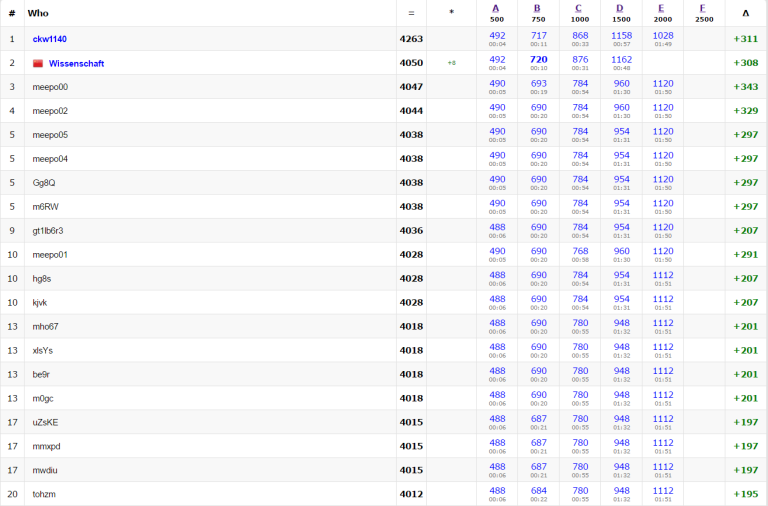
These Bots! |
|
+5
I am unable to view the solutions of other contestants even though challenge phase has started. Edit: Solutions are now visible. |
|
0
For Div 2 B, Main confusion: |
|
+53
Definitely not 2. |
|
0
Is there any way to get the solution by formula either in c++ or python while still retaining accuracy? |
|
+7
Nope, if n<=m, then ans is n. |
|
On
Vicennial →
Huge runtime difference in recursion involving strings in G++11 vs G++14, 10 years ago
0
Yes. Are you trying to say that G++14 optimises it automatically? |
|
0
Codechef is really slow when it comes to updating ratings. |
|
0
You can solve it by using sets. |


