


If you can't prove it please give an upvote so that higher ranked user can see this post.
And as this is a alt account I don't care about contribution. I just need help. Thank you.
| № | Пользователь | Рейтинг |
|---|---|---|
| 1 | Benq | 3676 |
| 2 | jiangly | 3670 |
| 3 | Kevin114514 | 3657 |
| 4 | maroonrk | 3355 |
| 5 | Um_nik | 3353 |
| 6 | squareOf105 | 3346 |
| 7 | tourist | 3343 |
| 8 | strapple | 3324 |
| 9 | heuristica | 3322 |
| 10 | jiangbowen | 3291 |
| Страны | Города | Организации | Всё → |
| № | Пользователь | Вклад |
|---|---|---|
| 1 | Qingyu | 158 |
| 2 | nik_exists | 150 |
| 2 | maspy | 150 |
| 4 | AmShZ | 144 |
| 5 | Um_nik | 141 |
| 6 | Errichto | 139 |
| 7 | adamant | 137 |
| 8 | BledDest | 134 |
| 9 | maroonrk | 133 |
| 10 | qwexd | 130 |
If you can't prove it please give an upvote so that higher ranked user can see this post.
And as this is a alt account I don't care about contribution. I just need help. Thank you.


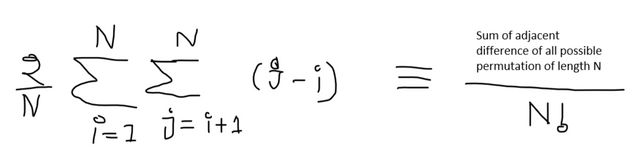
Nice drawing :D
What's that character in brackets after summations before i (?-i)
I don't know if this convince you.
Let's assume the difference is taking an absolute sign. There are $$$n!$$$ permutation of len $$$n$$$. For one permutation there are $$$n-1$$$ adjacent difference. The probability of getting one pair $$$(x,y)$$$ or $$$(y,x)$$$ , having the difference $$$|x-y|$$$ is $$$\frac{2}{n(n-1)}$$$
So the sum will be $$$N! (N-1) \frac{2}{N(N-1)} \sum_{i=1}^{N} \sum_{j=1+1}^{N} (j-i) = N! \frac{2}{N} \sum_{i=1}^{N} \sum_{j=1+1}^{N} (j-i)$$$