


| # | User | Rating |
|---|---|---|
| 1 | Benq | 3676 |
| 2 | jiangly | 3670 |
| 3 | Kevin114514 | 3657 |
| 4 | maroonrk | 3355 |
| 5 | Um_nik | 3353 |
| 6 | squareOf105 | 3346 |
| 7 | tourist | 3343 |
| 8 | strapple | 3324 |
| 9 | heuristica | 3322 |
| 10 | jiangbowen | 3291 |
| # | User | Contrib. |
|---|---|---|
| 1 | Qingyu | 158 |
| 2 | nik_exists | 150 |
| 2 | maspy | 150 |
| 4 | AmShZ | 143 |
| 5 | Um_nik | 141 |
| 6 | Errichto | 139 |
| 7 | adamant | 137 |
| 8 | BledDest | 133 |
| 8 | maroonrk | 133 |
| 10 | qwexd | 130 |


|
+21
|

|
+5
Yes. Generally,
Repeat $$$N$$$ steps, then all $$$h_i$$$ are revealed. Using Fenwick tree or Priority queues, the total time complexity is $$$O(N \log N)$$$. |
|
+5
The proof of the second observation is quite hard to explain for me. If $$$(h_1, \cdots, h_n)$$$ satisfies $$$r$$$-conditions, then:
So, if $$$i$$$-th and $$$j$$$-th are incomparable, then we can find a sequence $$$(h_1, \cdots, h_i, \cdots, h_j, \cdots, h_n)$$$, which can be modified to $$$(h_1, \cdots, h_j, \cdots, h_i, \cdots, h_n)$$$ by some shuffle operations. Therefore, if $$$i$$$-th and $$$j$$$-th are incomparable, and $$$|i-j| \lt K$$$, one of $$$r_i$$$ and $$$r_j$$$ must be increased when we swap $$$i$$$-th and $$$j$$$-th. That's a contradiction. |
|
+8
Let $$$d(i, j) := j-i$$$ if $$$i \lt = j$$$, $$$d(i, j) := N-i+j$$$ otherwise. Assume $$$N \lt 2K$$$. Let $$$i_1, \cdots, i_t$$$ are the $$$i$$$s, such that $$$r_i = 0$$$. We know that one of $$$i_*$$$ is the index of the largest $$$h$$$. Let $$$h_{i_1}$$$ be the largest. Then, $$$d(i_1, i_k) \lt K$$$ must hold. If not, then $$$d(i_k, i_1) \lt K$$$, which implies that $$$h_{i_k} \gt h_{i_1}$$$. Surprisingly, such $$$i_1$$$ is unique, so we can find the largest $$$h$$$. |
|
+27
Problem A is soooo hard... Plz help me, Worteltje What I briefly found out is:
And, I'm stuck. T.T Could anybody help for key-concepts? |
|
+26
Thank you for setting these wonderful problems. Unlike other geometry probs, E is so beautiful that I was impressed :D |
|
+34
Goal : A point $$$p$$$ and a set of $$$N$$$ points $$$S$$$ are given. We want to compute the number of triangles containing $$$p$$$. We can easily know that the answer is "$$$N \times (N-1) \times (N-2)/6$$$ — (the number of triangles which do NOT contain $$$p$$$)". If the triangle $$$s_1 s_2 s_3$$$ does not contain $$$p$$$, then there is a straight line $$$l$$$ that splits $$$p$$$ and three points $$$s_1$$$, $$$s_2$$$ and $$$s_3$$$. Thus, we can design the algorithm below:
The naive algorithm is $$$O(N^2)$$$. But you can do it in $$$O(N lgN)$$$ with sorting points $$$S$$$ about $$$p$$$ — something like ccw-sort Now, whole the problem can be solved. Just do the steps above about all the $$$N$$$ points. The time complexity is $$$O(N^2 lgN)$$$. |
|
-6
Hi ko_osaga! |
|
+46
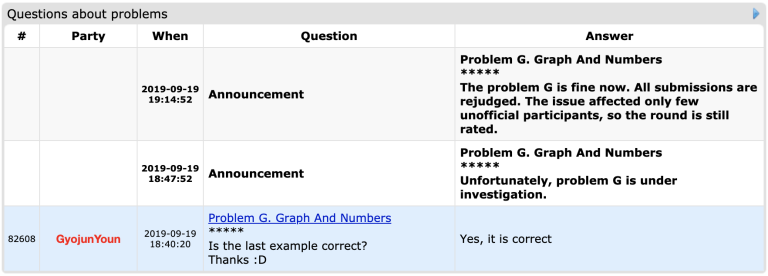
Yes, the problem G was correct... |
|
On
Errichto →
Codeforces Round #584 (Dasha Code Championship Elimination Round) (div. 1 + div. 2), 7 years ago
+3
What a beautiful time complexity XD |
|
+84
Please looking forward to my cosplay :D |
|
+156
For the problem D in Div.1, Both ko_osaga (submission) and Konijntje (submission) got accepted. But for the input below, ko_osaga and Konijntje's outputs are different. << INPUT >> << ko_osaga's output >> << Konijntje's output >> |
|
+1
Thank you very much! I really appreciate your help. |
|
+1
I explain about my equation. I'm going to add a new player whose index is the smallest. There have already been s - 1 players. After adding a new player, the number of players should be s. The first term, cp(s - 1, i) × pi, describe the case when a new player is not in the set of i players who lose to the others. The 'new added player' must win all the i players who are in the set. Thus, the probability is pi. The second term, cp(s - 1, i - 1) × (1 - p)s - i, describes the case when a new player is in the set. The 'new added player' must lose to all the s - i players who are not in the set. Thus, the probability is (1 - p)s - i. Would you tell me what is wrong?? Why should I add a largest-index-player like the official solution? |
|
+1
I have a question about the problem F. When we compute cp(s, i), if we think that we add a new player with the largest index, then the following equation holds: cp(s, i) = cp(s - 1, i) × (1 - p)i + cp(s - 1, i - 1) × ps - i. But I thought that I add a new player with the smallest index. The equation below is what I made. cp(s, i) = cp(s - 1, i) × pi + cp(s - 1, i - 1) × (1 - p)s - i I cannot find why I was wrong... I've spent almost two days in order to solve this problem... Could you tell me what I am doing wrong? |
|
+22
Could you tell me why considering only two problems set is enough (in Problem C)? Is it related to the range of k? If k = 20 then the solution does not work?? |
|
+5
I think they have to fix this bug ;( |
|
+28
Following code gives AC Joi.cpp Ioi.cpp |


