


Tutorial is loading...
Tutorial is loading...
Tutorial is loading...
Tutorial is loading...
Tutorial is loading...
Tutorial is loading...
| № | Пользователь | Рейтинг |
|---|---|---|
| 1 | jiangly | 3810 |
| 2 | Benq | 3676 |
| 3 | Kevin114514 | 3655 |
| 4 | maroonrk | 3463 |
| 5 | strapple | 3390 |
| 6 | Um_nik | 3387 |
| 7 | tourist | 3384 |
| 8 | heuristica | 3322 |
| 9 | turmax | 3319 |
| 10 | jiangbowen | 3291 |
| Страны | Города | Организации | Всё → |
| № | Пользователь | Вклад |
|---|---|---|
| 1 | Qingyu | 156 |
| 2 | nik_exists | 150 |
| 2 | maspy | 150 |
| 4 | Um_nik | 143 |
| 4 | AmShZ | 143 |
| 6 | Errichto | 139 |
| 7 | adamant | 137 |
| 8 | maroonrk | 134 |
| 9 | BledDest | 132 |
| 10 | qwexd | 129 |
 Разбор задач Codeforces Round 532 (Div. 2)



Auto comment: topic has been translated by den2204 (original revision, translated revision, compare)
sljdghcskdhclak;cladnjkcgsdijbcdn c
I solved B using segment tree without lazy propagation xD. code
this wouldn't have been needed if you gave us actually useful good problems.
why so short solution for D , please elabprate what u r saying den2204
For D,
Let us solve this question assuming that the king is at the centre of the board at (500, 500). (If it is not at the centre, then we need around at max 499 steps to reach it as it could have been at the corner.)
Once you are at the centre, consider the four newly created divisions (or quadrants) of the board. Choose the 3 divisions which do not have the minimum number of rooks. By doing this you ensure that the combination of these 3 divisions has atleast 666 * 3/4 >= 499 rooks otherwise you have not chosen the top 3 divisions correctly (basic pigeon hole principle).
From now, just move the king away from the section with the minimum rooks ( < 499 in any case) along the diagonal (this ensures that rows and cols are handled together).
Keep doing this till the corner. You are bound to get a check by a rook as no. of steps required to reach corner from the centre is 499 and from php we know that there are atleast 499 rooks there.
Eg. 1. king at 999,999
move king to 500,500
let quadrant IV have minimum rooks (167). So quads I, II, III have 499 rooks combined.
while going towards 0,0 (top left point inside quad II), we will end up checking from rows 500 to 1 and cols 500 to 1 simultaneously while going towards the top left diagonal.
since no. of steps to reach the diagonal is at max 499 and we know that there are 499 rooks in these 3 quads, we will get a check(mate) for sure.
NOTE: I may be off with the numbers by 1 or 2..but i hope you get the point. All of this will occur in less than 1000 steps
A good question it sure is.
There is one corner case you need to handle, which is if rooks are on the king's diagonals. You will need to go the nearest row and col together to eliminate the rook as you cannot eat it. I'll fix and share a code with good comments soon
F can be solved in O((n + q)logC).
Code: https://codeforces.me/contest/1100/submission/48345032
System tests for D are too weak. My submission that moves king to the center and then allways moves it to the same corner passed system test.
Code: https://codeforces.me/contest/1100/submission/48362464
Can you shortly explain your solution for F?
It's very similar to the standard Gaussian elimination with xors. The difference is that when adding new element to the structure, if we already have an element with the same highest bit, then we keep one with the highest index in the array and continue the process with the other.
Actually you can serve queries online if you precompute and store the linear basis for each position.
YES! O((n + q)logC) is the best solution!
Good Explanation for C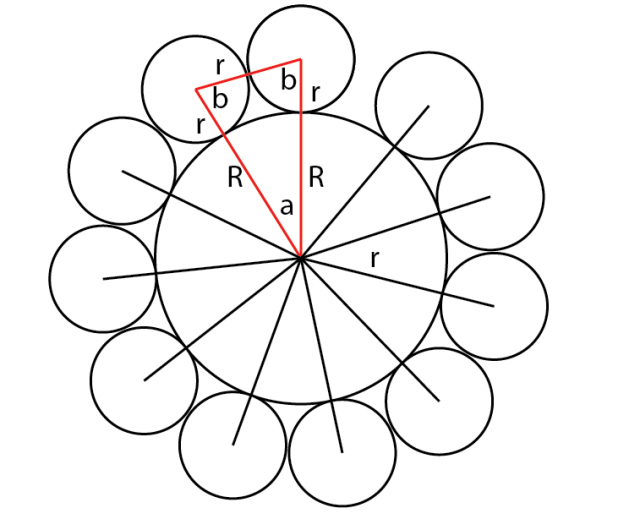
the Radius of the innar circle = R and radius of the outer circle = r by connect the center point of the innar circle with two center points of the other consective small circles , the angle (a) = 360 / n and the traingle is Isosceles triangle from the cousine law we will reach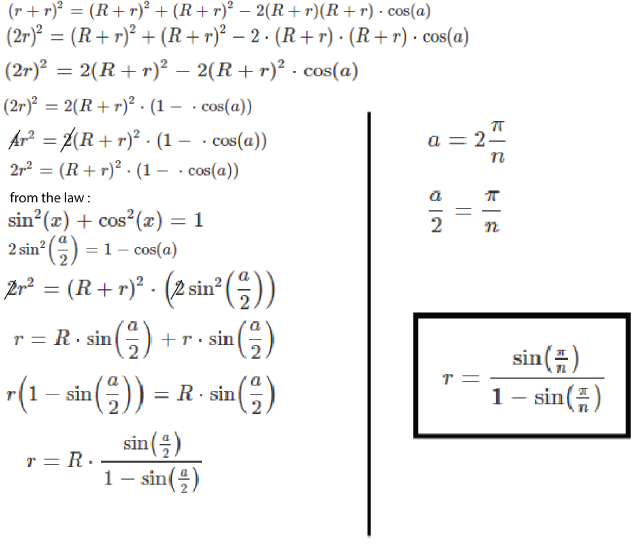
Nice explanation. One could also note that the polygon formed by connecting the centers of adjacent outer circles is a regular n-gon inscribed in a circle of radius R + r.
thank's bro . great observation
But , how would you deduce the value of 'r' (or the radius of the outer circle) from that sir ???. I couldn't get your point
From basic geometry we know that side length of a regular n-gon with circumradius R' is . In our case we observe that the side length of our polygon is 2r (r is unknown) and that the circumradius is R + r. Therefore, we get that
 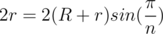 and solve for r.
That's really awesome sir !!! Thanks a lot !
Another approach is to note that if you cut the triangle in your diagram in half (bisect the angle a) you have a right angle triangle where the hypotenuse is the line connecting the centres of the big circle and little circle. This gives .
.
Thank you very much! This helped me a lot.
why (r+r)^b ? it's (r+r)^2 and how you get second equation ? i think it will be (2*r)^2 = 2 * (R+r)^2 *(1-cos(a))
Sorry , it's ^2 not b I has a mistake while typing in the second equation try to take (R + r)^2 as a common factor and you will get (2r)^2 = (R + r)^2 * (1 — cos(a))
let say x=(R+r)^2 then: x+x-2*x * cos(a) take x as common factor will be x*(1+1+2*cos(a)) then: x*(2+2*cos(a)) take 2 as common factor from(2+2*cos(a)) it will be x * 2 * (1-cos(a) )
for more let R=2 , r=3 , cos(a)=1/2=0.5; the res for first one will be 25 + 25 — 2 * 5 * 5 * 0.5=25 but in you second one will be 25 * 0.5=12.5
http://codeforces.me/contest/1100/submission/48402367
why D is falling? I just can not understand, plz help
Should be || instead &&.
Thank!
I had same problem and used your solution and got AC but can't understand why || works and && doesn't. can you explain?
I think, author's solution for D is wrong. For example, put the king to the center, put 333 rooks to positions 1 1, 2 2, 3 3,... 333 333, and other 333 rooks to positions 999 999, 998 998, 997 997,... In such case the king has no chance to win.
I tried to find additional restrictions in the task, excluding such an example, but don't see it. Am I wrong?
UPD: Thank you, guys, you are right
Just head straight to (999, 1) and you'll win.
You can move from (500, 500) to (1, 999). It will take you
499steps while the opponent would have to move666rooksD question was very good! Very good effort on your first contest as author.
Could somebody explain the time complexity of the hull method in F please?
I am seeing a O((nlog(n) + q)log2C) time complexity, with the recurrence
There are two parts. The first part is answering the queries, and the second part is divide-and-conquer itself. We should see them as seperate parts.
For the first part, each query costs log2(C), which is the time of combining the left basis and the right basis, so answering the total q queries will cost
For the second part, calculating the left basis list and the right basis list both costs , so the recurrence will be
  . Then
So totally the complexity will be something like .
.
The part about the queries don't confuse me. Ignoring the O(logC) components.
You mentioned that the recurrence is:
But they have reported the time complexity as O(n).
I am trying to understand you.
What do you mean by
But they have reported the time complexity as O(n).?Oh, thanks for being so patient.
In the last line of the editorial they have written:
This has an O(n) term, but no O(nlog(n)) term, and that is what I meant by
I feel that they should have a O(nlogn) term in the complexity.
Yes. I think so too.
den2204 could you take a look at this?
More strictly, complexity of first solution is , because we can add vector to hull in time proportional to the size of the basis —
  .
.
An International Grandmater(djq_cpp,He is only 13!!!!) told me there are answer code for problem F on the Internet.I copy the code and get accepted(I didn't take part in the contest.).So F is a problem appeared before.That's really bad!!!Submittion 48412606
Problem D 091 there: http://olympiads.win.tue.nl/imo/soviet/RusMath.html
Если следовать описанному алгоритму для D, можно нарваться на то, что король побьет ладью. Подозреваю претесты тоже эту ситуацию не хендлят
(https://codeforces.me/contest/1100/submission/48425126)
Seriously dude, it is test case 1. Don't expect other people to help you debug when you haven't put in the effort.
Why first solution fails and second one passes for E?
Code
Code
The order(deg) of every vertex need to be different!
There can be CIRCLE in the edges connected those vertexs with same order.
I don't really get it
consider input below,
Thanks :)
Besides, how to post part of the submission?
Click paper with blue <> sign and click block, then paste your code
In ques E,i am getting wrong answer on test case 7 but am not able to identify the problem in my code.Can somebody help me with it please?
link : https://codeforces.me/contest/1100/submission/48427349
Can anyone explain B plz. If possible give your code too xD
https://codeforces.me/blog/entry/64495#comment-484876
If I return 1 at the end of interaction I will get Runtime Error. Had many RE because of that!
How to implement E? Any suggestions? Thanks in advance
48427795 Could anyone help me with prob E. My solution is an implementation of the tutorial, however I get a TLE for test case 10. Many thanks in advance.
You don't need to delete/copy edges every iteration of your binary search. You can simply ignore them when you check for cycles.
48453854 Thanks, but I could only move forward till test case 12. Again stuck at TLE. Could you please have a look? Thanks again.
There are a few things you can improve. Try: removing usage of a
HashSet hs(not sure why you need it at all); shuffle array before sorting; you don't need to find a solution in every iteration of your binary search: simply useisCyclein your search and once you found k, you can find which edges to reverse.For E, can someone explain what i'm doing wrong.
code For 3rd tc, K is correct but it contains cycle if i remove edges by above rule.
I did this because here it says reversing an edge is same as removing in directed graph.
So basically what have you have done wrong is that you are telling the indices of every road whose weight was lower. You only have to print the ones that in fact did get reversed.
Got it, thanks.
in fact did get reversedBut in the question it is specified that we need not to minimize number of roads. So printing all the roads whose weight is less than K should also be true?
Can someone please explain or link me to what is being done with the hulls , and what are hulls ? Is it related to the convex hull or something related to do? Thanks
a set of number which is linearly independent in xor? that is,you can make a linear hull using some numbers, and using the numbers in the linear hull, you can get every number which you can get with the original numbers by xor
In problem E, after finding the min value of k using binary search how to determine which edges to be reversed. For example-
This will give me the k = 10 but how to determine which edge to remove.I was thinking of removing all the edges with val<=k. But the above test case will pose the problem , that the graph will become disconnected.Help please.
You need to sort the remaining graph topologically, then figure out which edges to flip.
why the solution 2 for F is O(nlog2C + q)? I think it should be O((n + q)logC) or did I misunderstand it? here is my solution
I have another way to solve B.
If we list the positions of every difficulty in n lines such as :
we can easily find that a round will be held when p - th problem is put into the pool, where p is the maximal number in each column. (In the example above, they're 3 and 11.) So we can denote cnt[i] as the number of problems in difficulty i and f[i] as the maximal number in i-th column and then do
f[++cnt[a[i]]] = i. Because the position i is increasing, f[j] is the maximal number. Print 1 if any f[j] (j ≤ min(cnt[k])) equals to i, otherwise print 0. The complexity is also O(m).Update: I understood the problem incorrectly. I thought that the king must stay checked after a rook moves. Not sure why. So my example is an instantaneous win for the king.
[It seems to me that the proposed solution to D is incorrect. Consider 5x5 board with 3 rooks and the king located like this (X for a blank):
Here we have 3 rooks and the king needs (sort of) 2 steps to reach the corner. However, considering that we can't take the rook at the first step — it is impossible to win. If we go right-up or up-right it is easy to see that all rooks can escape.
Now you can create a configuration on 999x999 board where 500 rooks are placed in 3 quadrants such that this bad case will occur when the king is 2 steps away from the corner (and blocked by the rook). And you can easily place other 497 rooks such they will escape one by one as the king moves diagonally from the field (500, 500).
Did I miss something?]
Explanation for 1100C - NN and the Optical Illusion