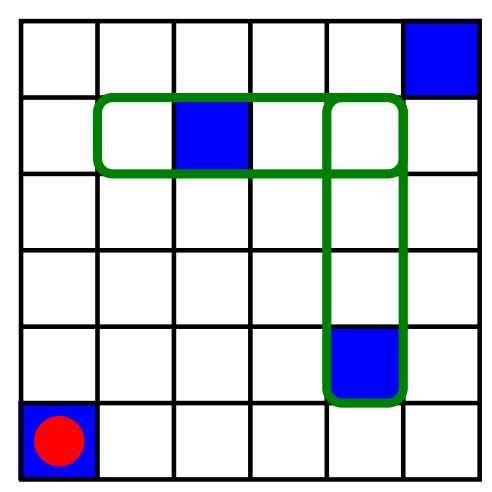
To get 80 points, we can insert each element to its position in $$$log(n)$$$ operations. To move the number $$$n$$$ to the end of the array, let's apply $$$S(i, n)$$$ where $$$i$$$ is the current position of this number. This operation moves the number to the middle of segment $$$[i, n]$$$. This way, in one operation we can halve the distance from a number to its position at the end of the array. So, in $$$log(n)$$$ operations we move $$$n$$$ to the end, and then we forget about that last element and we move $$$n-1$$$, and so on.
The last subtask is hard and it's worth only 20 points, so I think it's optimal to skip it during a contest. But let's see a solution.
Let's simulate the process from the end (then print operations in the reversed order). We start from the sorted permutation $$$[1, 2, \ldots, n]$$$ and we want to get the permutation from the input. The reversed operation changes a segmnet $$$[a, b, c, d, e, f]$$$ into $$$[d, a, e, b, f, c]$$$. Let's focus on element $$$c$$$ here. In one move, we can double the index of $$$c$$$ in the whole array, if we are able to choose a long segment with $$$c$$$ being the last element in the left half of the segment. If the index of $$$c$$$ is at least $$$n/2$$$, then we can get $$$c$$$ to the end of the array in one move! It still takes $$$log(n)$$$ operations to move an element from the beginning to the end, but most positions require only $$$O(1)$$$ operations. The array of costs is something like $$$[4, 3, 3, 2, 2, 2, 2, 1, 1, 1, 1, 1, 1, 1, 1]$$$, while previously it was $$$[4, 4, 4, 4, 4, 4, 4, 4, 3, 3, 3, 3, 2, 2, 1]$$$. The $$$i$$$-th element is the number of operations required to move an element from position $$$i$$$ to position $$$n$$$. The sum of costs is $$$2 \cdot n$$$.
The remaining issue is that maybe we first move one element from position $$$1$$$ to position $$$n$$$, then the next needed element is at the position $$$1$$$ and we must move it to $$$n-1$$$, and so on – we move each element from position $$$1$$$, so the number of operations is $$$n \cdot \log(n)$$$. To avoid that, we must shuffle the array first. Either apply several hundred random operations, or generate a random permutation $$$P$$$ and then first run the algorithm to change the initial permutation into $$$P$$$ and then $$$P$$$ into the sorted permutation. In fact, we must do the opposite because we simulate the process from the end. Anyway, this way organizers can't create a special malicious test against your solution.