Codeforces Round 1133 (Div. 1, Div. 2) is coming soon! Register here. ×

thangdz2k7's blog

By thangdz2k7, history, 2 months ago, In English

Hello everyone!

I think most of you are familiar with these two algorithmic techniques:

  • Small-to-large merging, which efficiently combines sets or data structures.
  • Tree knapsack, whose transitions often take $$$O(n^2)$$$ time.

At first glance, these techniques may seem simple to understand and implement. However, their efficiency is surprisingly powerful. Have you ever wondered why?

In this blog, I would like to share some interesting intuitions behind these algorithms—ideas that helped me understand not only how to implement them, but also why their time complexities are so efficient.


1. Why Is Small-to-Large Merging $$$O(n \log n)$$$?

Suppose every element belongs to a set, and we repeatedly merge two sets.

The small-to-large technique says:

> Always move the elements from the smaller set into the larger set.

It may seem that an element could be moved many times. However, every time an element is moved, the size of its set at least doubles.

If the current set has size $$$s$$$, then the other set has size at least $$$s$$$, because the current set is the smaller one. After merging, the new set has size at least: $$$s+s=2s$$$

Therefore, the set containing an element grows like:

$$$ 1 \rightarrow 2 \rightarrow 4 \rightarrow 8 \rightarrow \cdots $$$

Since no set can contain more than $$$n$$$ elements, each element can be moved at most: $$$O(\log n)$$$ times.

There are $$$n$$$ elements, so the total complexity is $$$O(n\log n)$$$.

This is an amortized analysis. One merge may be expensive, but each element can only participate in an expensive merge logarithmically many times.

Main intuition

Whenever an object is repeatedly processed, ask:

Does the amount of data associated with this object at least double after every processing?

If yes, then that object is processed only $$$O(\log n)$$$ times.

This idea appears in:

  • DSU on tree;
  • merging maps or sets;
  • maintaining colors in subtrees;
  • frequency-table merging;
  • “sack” techniques.

Practice problems


2. Why Is Tree Knapsack Usually $$$O(n^2)$$$?

Tree DP often requires merging the DP tables of children.

For example, suppose:

dp[u][k] = the best answer inside the subtree of u
           using exactly k selected vertices

When merging the current DP table with a child’s table, we often write:

for (int i = 0; i <= current_size; i++) {
    for (int j = 0; j <= child_size; j++) {
        dp_new[i + j] = max(
            dp_new[i + j],
            dp_current[i] + dp_child[j]
        );
    }
}

If the two parts have sizes $$$a$$$ and $$$b$$$, the merge costs approximately: $$$O(ab)$$$

Why does the total become $$$O(n^2)$$$?

The two loops can be interpreted as choosing two vertices:

  • one vertex from the already-processed part;
  • one vertex from the child’s subtree.

Consider a pair of vertices $$$x$$$ and $$$y$$$. They are combined when their two subtrees are merged at their lowest common ancestor.

After that, they will never be considered as belonging to two separate child subtrees again.

Therefore, every pair of vertices is counted at most once.

There are only:

$$$ \binom{n}{2}=O(n^2) $$$

pairs of vertices.

Thus, the total complexity of all merges is: $$$O(n^2)$$$.

Another view

Suppose a node has children with subtree sizes:

$$$ s_1,s_2,s_3,\ldots $$$

The merge costs are:

$$$ s_1s_2 $$$
$$$ (s_1+s_2)s_3 $$$
$$$ (s_1+s_2+s_3)s_4 $$$

and so on.

Expanding the total gives:

$$$ \sum_{i \lt j}s_is_j $$$

Each term corresponds to a pair of vertices from different child subtrees.

Since there are only $$$n$$$ vertices, the total number of such pairs is at most $$$O(n^2)$$$.

Important caveat

The $$$O(n^2)$$$ bound assumes that:

  • the DP state size of a subtree is proportional to its size;
  • merging two tables costs the product of their sizes;
  • there are no additional expensive dimensions or transitions.

Still, for the standard tree-knapsack merge, the pair-counting argument is the main intuition.

Practice Problems


Full text and comments »

  • Vote: I like it
  • +17
  • Vote: I do not like it

By thangdz2k7, history, 3 months ago, In English

Problem

Initially, we have an empty multiset $$$S$$$. We need to process $$$q$$$ queries.

Each query is one of the following two types:

  • Type 1 — 1 x: Insert the integer $$$x$$$ into $$$S$$$.
  • Type 2 — 2 u v: Count the number of elements in $$$S$$$ whose values lie in the interval $$$[u,v]$$$.

Limitation : $$$1 \leq x, u, v \leq 10^{9}$$$.

If all queries are known in advance, we can compress all the values and use a standard segment tree to process the updates and queries.

So, what if we have to process the queries online, updating the data structure and answering each query immediately ? Can we still use a segment tree ?

The Idea

Let $$$n$$$ denote the upper bound of the value range. In this problem, $$$n = 10^{9}$$$.

A normal segment tree cannot be built when the value range is as large as $$$10^9$$$ or $$$10^{18}$$$.

However, we do not actually need to create every node. For each update, we only need the nodes on the path from the root to the value $$$x$$$. Therefore, we can create nodes dynamically as they are needed.

This gives us a Dynamic Segment Tree: the tree represents the entire range $$$[1,n]$$$, but only the necessary parts are actually stored.

The key idea is simple:

Build only the nodes that we visit.

Since the height of the tree is $$$O(\log n)$$$, each update creates at most $$$O(\log n)$$$ nodes, while each range query can also be answered in $$$O(\log n)$$$ time.

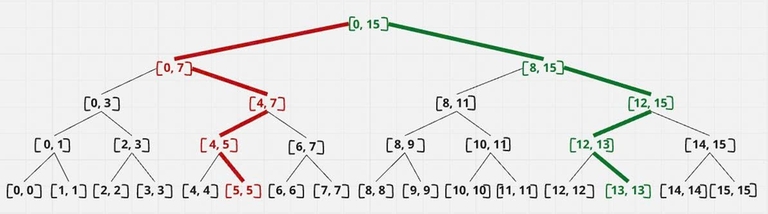
Here is an example showing the connection between this algorithm and a Trie:

Consider a Dynamic Segment Tree with the entire range $$$[0,15]$$$. Now, suppose we insert two values $$$5$$$ and $$$13$$$, whose binary representation are $$$(0101)_2$$$ and $$$(1101)_2$$$.

41133e76-e6a3-4dbe-88b1-eb0ac5fb68a0

Going to the left child corresponds to a bit of $$$0$$$, while going to the right child corresponds to a bit of $$$1$$$, just like traversing in a Trie.

The implementation

Initially, the segment tree contains only its root. We represent it as $$$(s = 1, l = 1, r = n)$$$, where:

  • $$$s$$$ is the node ID.
  • $$$[l, r]$$$ is the interval managed by this node.

For each node, we store three pieces of informations:

  • $$$Left_s$$$: The left-child ID of node $$$s$$$ (equal to $$$0$$$ if it does not exist).
  • $$$Right_s$$$: The right-child ID of node $$$s$$$ (equal to $$$0$$$ if it does not exist).
  • $$$Count_s$$$: The number of elements in the multiset whose values lie in the interval $$$[l, r]$$$ of node $$$s$$$.

Update

To insert a value $$$x$$$, we start from the root and recursively move down the tree.

If the current node does not exist, we create it. Then, we increase $$$Count_s$$$ by $$$1$$$, since the value $$$x$$$ belongs to this node's interval.

If $$$l = r$$$, we have reached the leaf corresponding to $$$x$$$ and can stop.

Otherwise, we split $$$[l,r]$$$ at $$$mid$$$: - If $$$x \le mid$$$, we recursively update the left child. - Otherwise, we recursively update the right child.

Notice that we only create nodes along the path from the root to $$$x$$$. Therefore, each update creates at most $$$O(\log n)$$$ new nodes.

void update(int &s, int l, int r, int x){
	if (!s) s = ++NumNode;
	Count[s]++;

	if (l == r) return;
    
	int mid = l + r >> 1;
	if (mid >= x) update(Left[s], l, mid, x);
	else update(Right[s], mid + 1, r, x);
}

Answer queries

To answer a query $$$[u,v]$$$, we recursively traverse the tree and only consider nodes whose intervals intersect with $$$[u,v]$$$.

There are three cases:

  • If the current node does not exist, or its interval is completely outside $$$[u,v]$$$, it contributes nothing, so we return $$$0$$$.
  • If the current node's interval is completely inside $$$[u,v]$$$, we can directly return $$$Count_s$$$ without going deeper.
  • Otherwise, the interval partially overlaps with $$$[u,v]$$$, so we recursively query both children and sum their results.

Thus, each query takes $$$O(\log n)$$$ time in the usual sparse-tree setting.

int get(int &s, int l, int r, int u, int v){
    if (!s || r < u || l > v) return 0;
    if (u <= l && r <= v) return Count[s];
    
    int mid = l + r >> 1;
    return get(Left[s], l, mid, u, v) + get(Right[s], mid + 1, r, u, v);
}

Practice Problems

An Advanced Application: 2D Data Structures

Consider an $$$n \times m$$$ matrix $$$a$$$, initially filled with zeros.

We need to process $$$q$$$ queries of the following two types:

  • Type 1 — 1 x u y v k: Add $$$k$$$ to every element in the submatrix whose top-left corner is $$$(x,y)$$$ and bottom-right corner is $$$(u,v)$$$:
$$$ a_{i,j} \mathrel{+}= k \quad \text{for all } x \le i \le u,\ y \le j \le v. $$$
  • Type 2 — 2 x y: Output the current value of $$$a_{x,y}$$$.

Limitation : $$$1 \leq n, m, q \leq 10^{5}$$$.

Solution

The type $$$1$$$ query can be decomposed into two suffix updates:

  • x n y v k
  • u+1 n y v -k

Therefore, we can use a Fenwick Tree to handle the first dimension. Each Fenwick Tree node stores a Dynamic Segment Tree, which manages the second dimension.

In other words, we have a 2D data structure:

$$$ \text{Fenwick Tree} \quad\rightarrow\quad \text{Dynamic Segment Tree} $$$

The Fenwick Tree handles the first coordinate, while each Dynamic Segment Tree handles the second coordinate.

Therefore, the total complexity of each update is

$$$ O(\log n \log m). $$$

For a point query, we similarly visit $$$O(\log n)$$$ Fenwick Tree nodes and perform a query on the corresponding Dynamic Segment Trees. Thus, each query also takes

$$$ O(\log n \log m). $$$

For memory, each Fenwick Tree update can create at most $$$O(\log m)$$$ new nodes in each of $$$O(\log n)$$$ Fenwick Tree nodes. Therefore, after $$$q$$$ updates, the total memory usage is

$$$ O(q \log n \log m). $$$

Code

const int MAX = 1e5 + 5;

int root[MAX], NumNode = 0;
int Left[MAX], Right[MAX], lazy_add[MAX];

void Update(int &s, int l, int r, int y, int v, int k){
    if (!s) s = ++NumNode;
    if (y <= l && r <= v){
        lazy_add[s] += k;
        return;
    }
    
    int mid = l + r >> 1;
    if (mid >= y) Update(Left[s], l, mid, y, v, k);
    if (mid < v) Update(Right[s], mid + 1, r, y, v, k);
}

void update(int x, int u, int y, int v, int k){
    for (; x <= n; x += x&-x) 
        Update(root[x], 1, m, y, v, k);
    for (u = u + 1; u <= n; u += u&-u) 
        Update(root[u], 1, m, y, v, -k);
}

int Get(int &s, int l, int r, int y){
    if (!s) return 0;
    
    int mid = l + r >> 1;
    if (mid >= y) return lazy_add[s] + Get(Left[s], l, mid, y);
    return lazy_add[s] + Get(Right[s], mid + 1, r, y);
}

int get(int x, int y){
    int ans = 0;
    for (; x; x -= x&-x)
        ans += Get(root[x], 1, m, y);
    return ans;
}

Practice Problems

Full text and comments »

  • Vote: I like it
  • +16
  • Vote: I do not like it

By thangdz2k7, history, 3 years ago, In English

Hello everyone, I recently accessed these 2 contests but the solutions were locked. If anyone has it, please let me know. Thank https://codeforces.me/gym/102538 https://codeforces.me/gym/102331 The problems here are very interesting and difficult !

Full text and comments »

  • Vote: I like it
  • +13
  • Vote: I do not like it