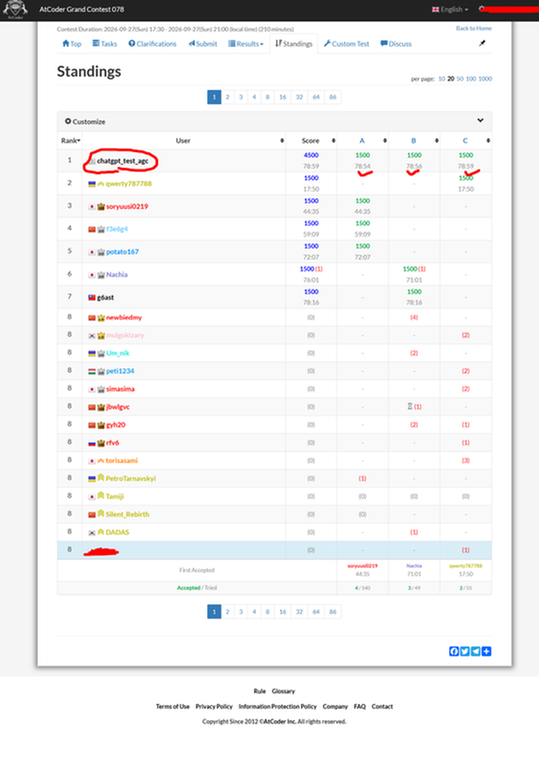
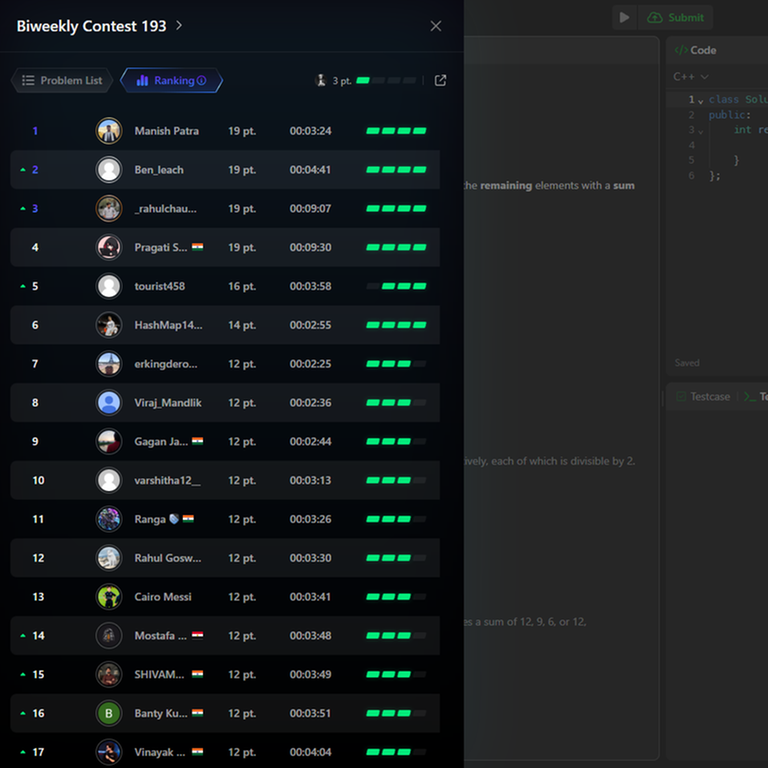
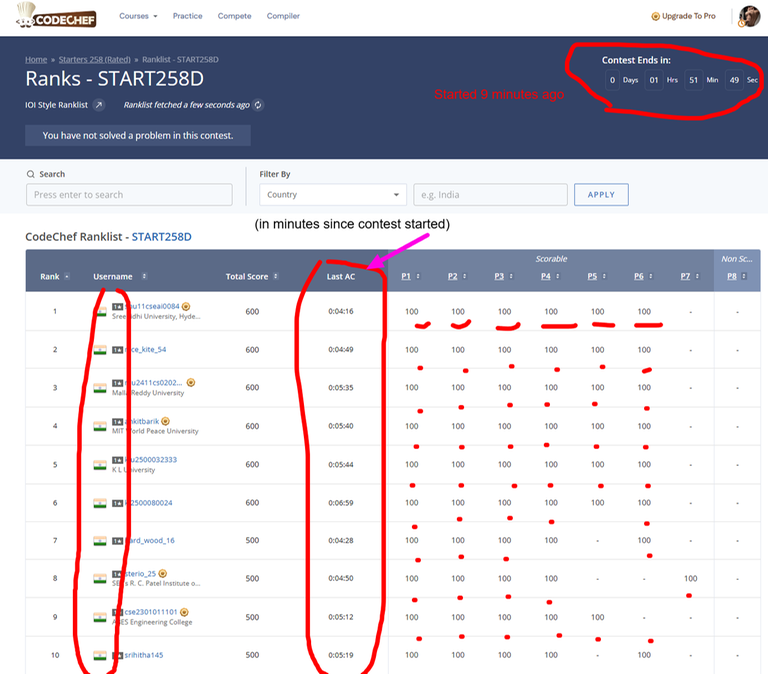
I hate every cheater ever but I specifically hate the ones from India WITH PASSION like they're not even trying to hide it, it's so blatant
10 minutes into the contest:
| # | User | Rating |
|---|---|---|
| 1 | Benq | 3676 |
| 2 | Kevin114514 | 3657 |
| 3 | jiangly | 3638 |
| 4 | turmax | 3442 |
| 5 | tourist | 3380 |
| 6 | Um_nik | 3353 |
| 7 | strapple | 3350 |
| 8 | squareOf105 | 3346 |
| 9 | heuristica | 3322 |
| 10 | maroonrk | 3310 |
| # | User | Contrib. |
|---|---|---|
| 1 | Qingyu | 158 |
| 2 | nik_exists | 151 |
| 3 | maspy | 149 |
| 4 | AmShZ | 144 |
| 5 | Um_nik | 143 |
| 6 | Errichto | 139 |
| 7 | adamant | 137 |
| 8 | BledDest | 133 |
| 8 | maroonrk | 133 |
| 10 | Proof_by_QED | 131 |
I hope Dominater069 looks to it.
Honestly, I think this is pretty good so I felt like sharing it.
You are given a permutation $$$p_1,p_2,\ldots,p_n$$$.
An array $$$a_1,a_2,\ldots,a_m$$$ is called good if its indices can be partitioned into groups such that every group consists of indices $$$i_1 \lt i_2 \lt \ldots \lt i_k$$$, where $$$k\geq 2$$$, and $$$a_{i_1} \lt a_{i_2} \lt \ldots \lt a_{i_k}$$$.
Every index must belong to exactly one group. The indices in a group do not have to be consecutive. The empty array is considered good.
Find the minimum number of elements you must delete from $$$p$$$ so that the remaining array is not good. Deleting elements does not change the relative order of the remaining elements.
If $$$p$$$ is already not good, the answer is $$$0$$$.
The first line contains a single integer $$$t$$$ ($$$1\leq t\leq 100$$$) — the number of test cases.
For each test case, the first line contains a single integer $$$n$$$ ($$$1\leq n\leq 5000$$$).
The second line contains $$$n$$$ integers $$$p_1,p_2,\ldots,p_n$$$ — a permutation of $$$1,2,\ldots,n$$$.
For each test case, print a single integer — the minimum number of elements you have to delete so that the remaining array is not good.
2
6
2 1 4 3 6 5
5
1 2 3 4 5
3
4
3
1
1
4
3 2 1 4
4
1 2 4 3
0
0
1
78 minutes in and well...