


can some1 explain me the two test cases of this question.. http://codeforces.me/problemset/problem/9/D..


can some1 explain me the two test cases of this question.. http://codeforces.me/problemset/problem/9/D..
| # | User | Rating |
|---|---|---|
| 1 | Benq | 3676 |
| 2 | Kevin114514 | 3659 |
| 3 | jiangly | 3640 |
| 4 | turmax | 3450 |
| 5 | tourist | 3382 |
| 6 | strapple | 3360 |
| 7 | Um_nik | 3354 |
| 8 | squareOf105 | 3348 |
| 9 | heuristica | 3322 |
| 10 | maroonrk | 3312 |
| # | User | Contrib. |
|---|---|---|
| 1 | Qingyu | 157 |
| 2 | nik_exists | 151 |
| 3 | maspy | 149 |
| 4 | AmShZ | 144 |
| 5 | Um_nik | 143 |
| 6 | Errichto | 139 |
| 7 | adamant | 137 |
| 8 | BledDest | 133 |
| 9 | maroonrk | 132 |
| 10 | Proof_by_QED | 131 |


On the first sight I thought there is a problem which requires 9-Dimensional Segment Trees. LOL :D
First of all, your link to the problem isnt correct. I think you meant this.The task in simple english is :
Given n ( no. of distinct nodes) and h (the minimum height) , you need to print the number of binary search trees possible. For sample case 1, the no. of distinct nodes is 3 and the minimum height required is 2. So the following 5 BST are possible.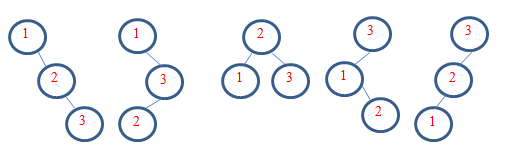
I hope the problem is clear now.