


I came across a seemingly easy problem recently which is as follows:
Problem:
You want to buy a laptop. Each laptop has two parameters: Rating & Price. Your task is to buy a laptop with the highest rating within a given price range. Given Q tasks, each query consisting of price range required, you have to print the highest rated laptop that can be bought within that price range.
Input format:
The first line contains N denoting the number of inputs. The following N lines contain P & R denoting price and range of a laptop. Next line contains Q denoting the number of queries. The following Q lines contain two integers X & Y denoting the price range (inclusive). Output format: For each task Q, print the highest rating that can be bought within the range. If you cannot get any laptop within the range, print -1.
Constraints:
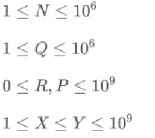
Sample Input:
5
1000 300
1100 400
1300 200
1700 500
2000 600
3
1000 1400
1700 1900
0 2000
Sample Output:
400
500
600
My approach:
1- Create a Map of laptops having key=price & value=rating (C++ maps are already sorted in ascending order by keys)
2- initialize result=-1
3- Take the query range as input and find the first key which belongs to this range. (If none of the keys belong in this range, return result)
4- Starting from this key, iterate over the map and take result=max(result, current rating) (Iterate until either the current key exceeds the query range OR traversal over the map is complete)
5- Return result
My problem:
This approach fails for all inputs except the given sample input. (I get Wrong Answer instead of TLE) Is there anything missing?


It can be solved using a segment tree approach.
Sort all the price, rating pairs in ascending order according to price.
Build a segment tree after that using the ratings of laptops.
Using $$$X$$$ and $$$Y$$$, find the position of the lower bound in the array of the pair $$$ X, N$$$ where N is a negative number. Do this for $$$Y$$$ also.
Find the max rating between those indices.
Code — https://pastebin.com/fqjYGuub
Run time error
My approach is almost the same as yours (i just didn't use any data structure to optimise range query). But upon submission I am getting Wrong Answer for smaller inputs (instead of TLE)
Is there any condition where my approach fails to solve correctly?
Can you provide your code?
My implementation in Python:
For small inputs, I am getting Wrong Answer instead of TLE. Thus, Considering that I would optimize time complexity using Segment tree or Sparse table. The answer would still be wrong!
Your implementation may not work properly if the input contains many laptops of the same price. Also, it is not recommended to use the same iteration variable(e.g.
i) in nested loops