


is it true that  ?


| № | Пользователь | Рейтинг |
|---|---|---|
| 1 | Benq | 3676 |
| 2 | Kevin114514 | 3659 |
| 3 | jiangly | 3640 |
| 4 | turmax | 3450 |
| 5 | tourist | 3408 |
| 6 | strapple | 3360 |
| 7 | Um_nik | 3354 |
| 8 | squareOf105 | 3348 |
| 9 | maroonrk | 3312 |
| 10 | idontwannadothis…e | 3191 |
| Страны | Города | Организации | Всё → |
| № | Пользователь | Вклад |
|---|---|---|
| 1 | Qingyu | 155 |
| 2 | nik_exists | 151 |
| 3 | maspy | 149 |
| 4 | AmShZ | 145 |
| 5 | Um_nik | 143 |
| 6 | Errichto | 139 |
| 7 | BledDest | 136 |
| 8 | adamant | 134 |
| 9 | maroonrk | 132 |
| 10 | cry | 130 |


Just thoughts.
L is left part, R is right part.
L = PL1 + PL2 + ... + PLk
R = PR1 + PR2 + ... + PRk
My theory is for all i = 1..k PLi > PRi.


Induction. Base i = 1.
So for x > 0: PL1 > PR1
And I really don't know what's next (if I'm on the right path).
Yeah, it is true. But proving this is a bit painful. Here is the only way I know:
Reminder: generating function of sequence is formal series
 .
Consider amount of ways to split number in sum of distinct numbers. Generating function for this sequence is
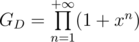 . Now consider number of ways to split number
 in sum of not necessary distinct odd numbers. Generating function for this sequence is
 . Let's multiply each functions by
 . Then first one becomes
 and the second one become
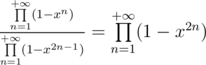 . Thus number of ways to split
 in distinct numbers equals number of ways to split in in odd numbers (you can also prove it with some combinatorics, I guess).
Now consider which is the number of ways to split
 in
 distinct numbers.
 . Thus if
 then
 . Then
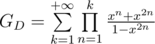 .
And with odd numbers part we have . Since
 , we have equation from the statement now.
Understanding of correctness of each transition in proof is left to reader as an excercise ;)