


Can somebody please explain how to use the Möbius function to solve this problem. https://www.hackerrank.com/contests/w3/challenges/gcd-product


Can somebody please explain how to use the Möbius function to solve this problem. https://www.hackerrank.com/contests/w3/challenges/gcd-product
| # | User | Rating |
|---|---|---|
| 1 | Benq | 3676 |
| 2 | Kevin114514 | 3659 |
| 3 | jiangly | 3640 |
| 4 | turmax | 3450 |
| 5 | tourist | 3382 |
| 6 | strapple | 3360 |
| 7 | Um_nik | 3354 |
| 8 | squareOf105 | 3348 |
| 9 | maroonrk | 3312 |
| 10 | idontwannadothis…e | 3191 |
| # | User | Contrib. |
|---|---|---|
| 1 | Qingyu | 155 |
| 2 | nik_exists | 151 |
| 3 | maspy | 149 |
| 4 | AmShZ | 145 |
| 5 | Um_nik | 143 |
| 6 | Errichto | 139 |
| 7 | BledDest | 136 |
| 8 | adamant | 134 |
| 9 | maroonrk | 132 |
| 10 | cry | 130 |


Let f(n,m) denote the number of pairs (x, y), such that x ≤ n, y ≤ m, and gcd(x,y) = 1. WLOG, assume n ≥ m
Using inclusion exclusion,
If we store an array of prefix sums of mobius function, then f(n, m) can be calculated in .
Now let G(g, n, m) be the number of pairs (x, y), such that x ≤ n, y ≤ m, and gcd(x, y) = g.
Clearly, . There are clearly
 different values of this for all the g's
Our required answer is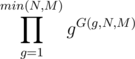 . Considering the different ranges in which G(g, n, m) is same, this can be calculated in O(n).
Thanks for the nice explanation.
I solved it little differently. After the step
Now I define a function f, such that for any prime p, f(pa) = p else f(n) = 1. It must be noted that
, Now If I substitute this expression in above expression and rearrange the multiplication we get
which reduces to
. Now this is very simple to evaluate.