


Prerequisite: DFS-Trees
Consider the following problem:
Given a graph $$$G(V, E)$$$ on $$$n$$$ nodes, find a simple path with at least $$$n/2$$$ nodes in either $$$G$$$ or its complement $$$G'$$$.
Let's ask ourselves a dumb question: Given some simple path $$$P$$$ in $$$G$$$, can we find a simple path $$$P'$$$ in $$$G'$$$ that contains every node that's not in $$$P$$$?
If this was possible for any path $$$P$$$, then at least one of $$$P$$$ or $$$P'$$$ would satisfy our requirements, as $$$\max(\vert P \vert, \vert P' \vert) = \max(\vert P \vert, n - \vert P \vert)\geq n/2$$$.
There can of course be exponentially many paths $$$P$$$ in $$$G$$$, so we restrict our analysis to a convenient subset of paths. Let's construct some "DFS-Forest" $$$F$$$ of $$$G$$$ (a DFS-Tree for every connected component). In fact, let's simplify our analysis even further for the moment, and assume that $$$G$$$ is connected, so it yields just one DFS-Tree.
Now, consider paths $$$P$$$ from the root $$$r$$$ to some node $$$l$$$. This simple path clearly exists in $$$G$$$, but what about $$$P'$$$? Can we somehow chain together nodes that don't lie in $$$P$$$ into a simple path?
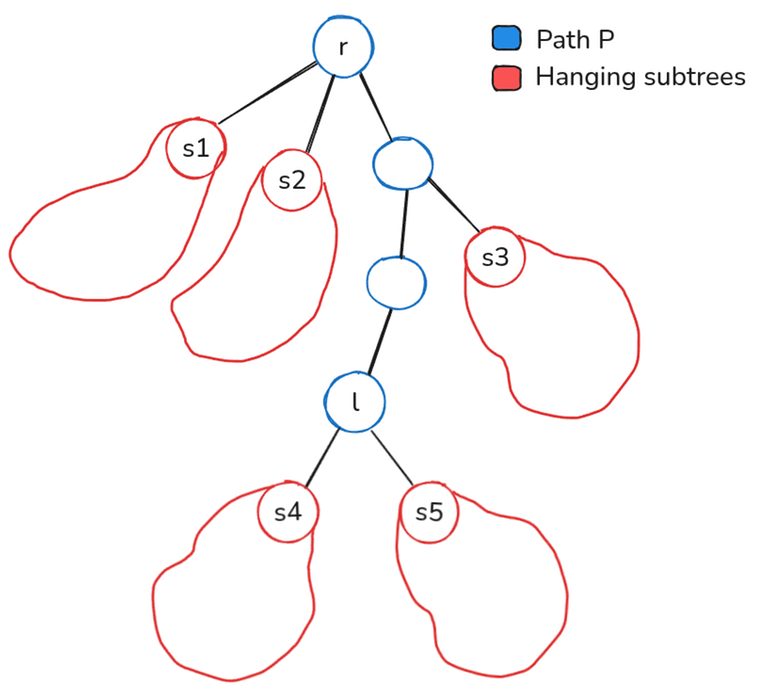
The DFS-Tree, along with $$$P$$$ can be visualised in the above manner. Can we think of some connection between DFS-trees and complement graphs that would allow us to chain together the red nodes to construct $$$P'$$$?
If you've read the blog I've linked at the top, the following observation will seem fairly natural:
Lemma 1
Neither $$$u$$$ nor $$$v$$$ is an ancestor of the other in $$$F$$$ $$$\implies$$$ edge $$$(u, v)$$$ exists in $$$G'$$$.
Now consider the subtrees $$$s_1, s_2, \dots s_k$$$ hanging off $$$P$$$. The above observation implies that there's an edge in $$$G'$$$ between every pair of nodes that belong to different subtrees!
Therefore, one (of possibly many) way to construct a path in $$$G'$$$ that visits every node in $$$S = s_1 \cup s_2 \cup \dots \cup s_k$$$ could be to start at some node outside $$$P$$$, and then repeatedly jump to a previously unvisited node that lies in a different hanging subtree from the current one.
What condition on $$$s_1, s_2, \dots s_k$$$ will allow us to always construct $$$P'$$$ in such a manner? We just want $$$\max(\vert s_i \vert) \leq \lceil \frac{\vert S \vert}{2} \rceil $$$!
But wait a minute, does there always exist a $$$P$$$ such that the induced $$$s_1, s_2, \dots s_k$$$ satisfy this property?
Lemma 2
For any rooted tree, we can always find a path $$$P$$$ starting at the root such that the induced $$$s_1, s_2, \dots s_k$$$ satisfy $$$\max(\vert s_i \vert) \leq \lceil \frac{\vert S \vert}{2} \rceil $$$.
So, that's it. You find $$$l$$$ such that the path $$$P$$$ from $$$r$$$ to $$$l$$$ satisfies this property. If $$$\vert P \vert \geq n/2$$$, you're done. Otherwise, you can just construct a path from the hanging subtrees.
The observant reader will now exclaim, "DNR! Your analysis holds only under the assumption that $$$G$$$ is connected (so $$$F$$$ has only one DFS-tree)!"
First, notice that Lemma 1 holds for arbitrary DFS-forests, so if we pick a rooted path in some DFS tree in $$$F$$$, then we can treat any other tree as an induced subtree $$$s_i$$$ too! But what about lemma 2? We did need it to guarantee the existence of $$$l$$$.... Can we get an analogous lemma for DFS-forests?
Lemma 3
For any rooted forest, we can always find a path $$$P$$$ starting at some root such that the induced $$$s_1, s_2, \dots s_k$$$ satisfy $$$\max(\vert s_i \vert) \leq \lceil \frac{\vert S \vert}{2} \rceil $$$.
Therefore, we've solved the problem. It's easy to implement this solution in $$$O(n + m)$$$.
More
The blog was inspired by the following problem, and one may realise that we have solved it:
Given a graph $$$G(V, E)$$$ on $$$n$$$ nodes, find a Hamiltonian path that first only uses edges in $$$G$$$, and then only uses edges in $$$G'$$$.
There's a much simpler 5-line solution that I won't expand upon.


 Комментарии (0)


