It's been some time... So anyways
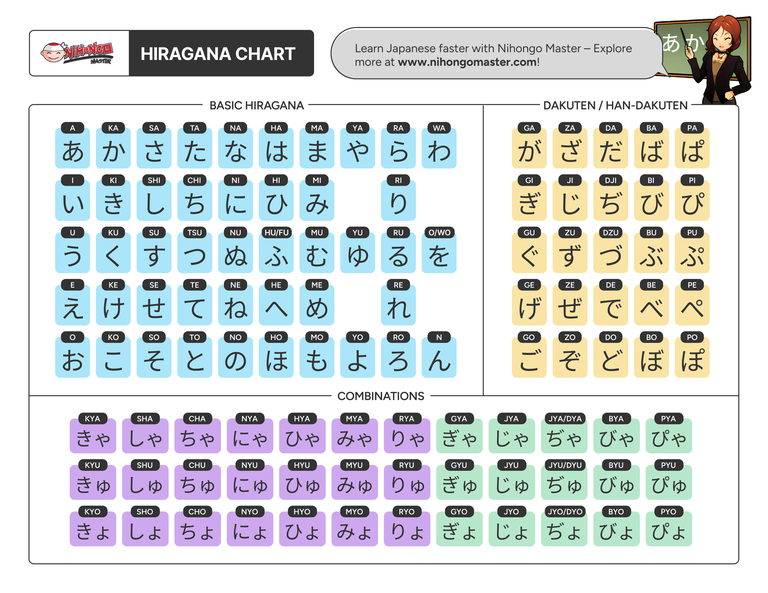
You've learned every basic Hiragana character.
Now it's finally time to understand your first Japanese sentence.
Topic marker and Copula
The simplest Japanese sentence follows this pattern:
Topic は Description です。
Here, です (desu) simply means "**is**" or "**am**".
For example:
わたし は がくせい です。
Meaning:
I am a student.
Let's break it down.
わたし
means:
I / Me
は
is called the Topic Marker.
It tells us what the sentence is about.
In this sentence, the topic is:
わたし
Then,
がくせい
means:
student
This is the word that describes the topic.
So in this sentence, you're saying what you are — a student.
Finally,
です
makes the sentence polite and means something close to "is" or "am"
So:
わたし は がくせい です。
literally becomes:
As for me,
student
am.
which we translate as:
I am a student.
This might seem a little confusing, so let's break it down.
I am a student.
For English:
Subject = I
Copula or Linking Verb = am
Subject Complement = a student
So English follows SVC (Subject + Verb + Complement).
For Japanese:
わたし は がくせい です。
you can analyze it as:
Subject = わたし
Copula = です
Complement = がくせい
So Japanese follows SCV (Subject + Complement + Verb)
Ok, time for practice.
But before you are given these exercises, here are some words you should know.
- ねこ — Cat
- かわいい — Cute
- さくら — Cherry Blossom
- きれい — Beautiful
- ほん — Book
- おもしろい — Interesting / Funny
Now translate the following into English:
- ねこ は かわいい です。
- さくら は きれい です。
- ほん は おもしろい です。
Congratulations!
You've just read your first complete Japanese sentences.
This, That, Here and There
Now that you know how to make simple sentences, let's learn one of the most useful word families in Japanese.
Japanese distinguishes things based on distance.
There are three levels:
- Near me
- Near you
- Away from both of us
Fortunately, the pattern is very easy to remember.
| Meaning | Near Me | Near You | Far Away |
|---|---|---|---|
| Thing | これ (kore) | それ (sore) | あれ (are) |
| This/That + Noun | この (kono) | その (sono) | あの (ano) |
| Place | ここ (koko) | そこ (soko) | あそこ (asoko) |
A simple trick to remember them:
Ko → Close to me
So → Close to you
A → Away from both
これ, それ and あれ
These words can stand on their own.
これ は ほん です。
This is a book.
それ は ねこ です。
That is a cat.
あれ は やま です。
That (over there) is a mountain.
この, その and あの
Unlike the previous three, these cannot stand alone.
They must always be followed by a noun.
この ほん は おもしろい です。
This book is interesting.
その ねこ は かわいい です。
That cat is cute.
あの やま は きれい です。
That mountain over there is beautiful.
Notice the difference.
これ は ほん です。
This is a book.
この ほん は おもしろい です。
This book is interesting.
ここ, そこ and あそこ
These refer to places.
ここ は がっこう です。
Here is a school.
そこ は へや です。
There is a room.
あそこ は やま です。
Over there is a mountain.
Ok, time for practice.
But before you are given these exercises, here are some words you should know.
- はこ — Box
- やま — Mountain
- がっこう — School
- へや — Room
Translate these into English.
- この ほん は おもしろい です。
- その ねこ は かわいい です。
- あの やま は きれい です。
- ここ は がっこう です。
- そこ は へや です。
- あそこ は やま です。
Congratulations!
You've just learned one of the most useful patterns in Japanese.
Once you know Ko → So → A, you'll start noticing it everywhere.