


Hello Codeforces!
We have added a new practice contest to Focused CPCs Training.
Session 8 — Bitmasking and Subset DP contains 20 problems, starting with bitmasking and moving on to subset DP.
| # | User | Rating |
|---|---|---|
| 1 | Benq | 3676 |
| 2 | Kevin114514 | 3659 |
| 3 | jiangly | 3640 |
| 4 | turmax | 3450 |
| 5 | tourist | 3408 |
| 6 | strapple | 3360 |
| 7 | Um_nik | 3354 |
| 8 | squareOf105 | 3348 |
| 9 | maroonrk | 3312 |
| 10 | idontwannadothis…e | 3191 |
| # | User | Contrib. |
|---|---|---|
| 1 | Qingyu | 153 |
| 2 | nik_exists | 151 |
| 3 | maroonrk | 150 |
| 4 | maspy | 149 |
| 5 | AmShZ | 146 |
| 6 | Um_nik | 143 |
| 7 | Errichto | 139 |
| 8 | adamant | 135 |
| 9 | BledDest | 134 |
| 10 | cry | 130 |
Hello Codeforces!
We have added a new practice contest to Focused CPCs Training.
Session 8 — Bitmasking and Subset DP contains 20 problems, starting with bitmasking and moving on to subset DP.
Hi Codeforces,
AdhamAfterMidnight and I have added Session 4 : Number Theory to Focused CPCs Training.
There are 56 problems, divided into five consecutive parts:
| Part | Problems | Topics |
|---|---|---|
| 1 | 01–12 | Divisibility, remainders and modular arithmetic |
| 2 | 13–23 | Primes, sieves, factorization and divisors |
| 3 | 24–36 | GCD, LCM and coprimality |
| 4 | 37–49 | Arithmetic counting, totient, Möbius and divisor transforms |
| 5 | 50–56 | Digit number theory and integer equations |
Each part is ordered independently by estimated difficulty, from easier to harder. The difficulty resets when the next part begins. You can work through the collection in order or start with whichever topic you need.
For those who missed the previous post, the group collects problems from different CPC contests and organises them into topic-focused practice sessions.
We use the VoidHub CPC Archive to put these collections together. The archive contains the original contest collections; the group brings selected problems together by topic.
The archive covers ECPC, ACPC, Syrian CPCs, JCPC, KCPC and TCPC, as well as CERC, NWERC, SEERC, GCPC, BAPC, NCPC, UKIEPC, Ural, Dhaka, Jakarta, Azerbaijan and the North America Championship.
It also includes local and university contests from Damascus University, Aleppo, Al-Baath and Homs. Not every source appears in every session, and more sessions will follow.
Every statement begins with “Originally from: [contest name]”. These aren't our problems; all credit goes to the original authors.
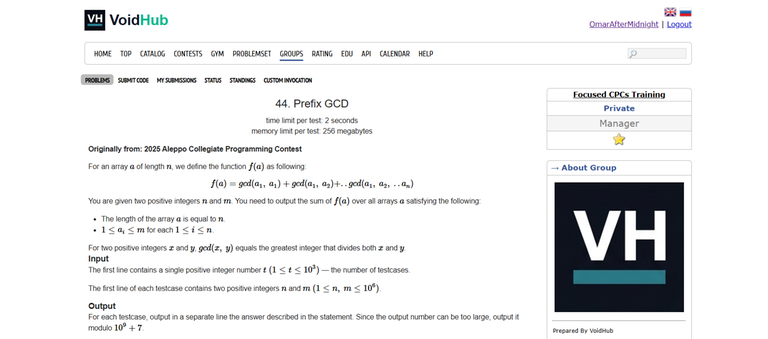
The earlier sessions are still available:
The group is private for now. Send a join request and I'll accept it.
Corrections to statements, feedback on the ordering, and suggestions for future topics are welcome.
Hi Codeforces,
I've been working with AdhamAfterMidnight on a training group called Focused CPCs Training, and we've just added our third session: Binary Search on Answer.
The idea behind the group is to collect problems on a particular topic from different CPC contests, then arrange them by estimated difficulty. We wanted something we could use for our own training, and thought others might find it useful too.
So far, we have:
We're using the VoidHub CPC Archive to put these sessions together. The original contest collections are available there, while the group brings selected problems together by topic.
The archive includes contests such as ECPC, ACPC, Syrian CPCs, JCPC, KCPC and TCPC, alongside CERC, NWERC, SEERC, GCPC, BAPC, NCPC, UKIEPC, Ural, Dhaka, Jakarta, Azerbaijan and the North America Championship. Not all of these are represented in the group yet; we'll keep adding more sessions.
Each statement starts with “Originally from: [contest name]”, so the source is easy to find. These aren't our problems; credit goes to their original authors.
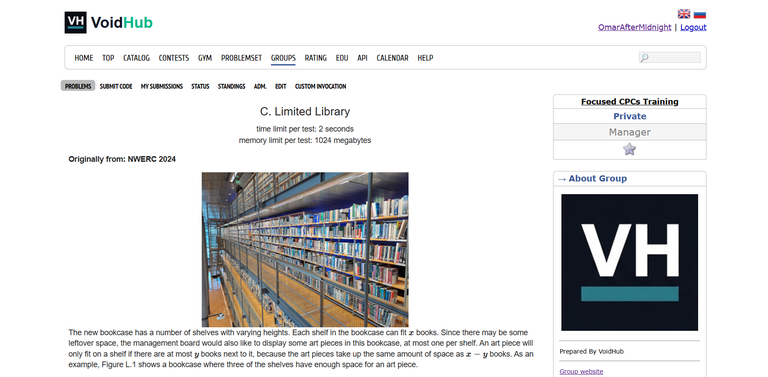
The group is private for now. Send a join request and I'll accept it.
Here's the group link. Give the sessions a try, and let us know if you find an issue or have a topic you'd like us to cover next.
Hi Codeforces!
A small update to our previous posts about VoidHub.
I, together with AdhamAfterMidnight, have added a new problem source to the platform: VH (VoidHub).
Hi Codeforces!
About seven weeks ago, AdhamAfterMidnight and I shared VoidHub, a project we started while preparing for the ECPC.
The main idea was simple: make regular practice feel less repetitive. Invite a friend, enter a live 1v1 room, solve under a timer, and let the original judge decide the result.
Since that post, we kept building, testing, and fixing plenty of details. This is a small update about what has changed.
Hi Codeforces!
I am OmarAfterMidnight, and together with AdhamAfterMidnight we have been working on a project called VoidHub.
During our preparation for the ECPC, AdhamAfterMidnight and I were looking for a way to make practicing more exciting. We wanted something that would push us to solve more problems under real contest pressure while competing directly against each other.
That is when we came up with the idea of building a platform for 1v1 programming battles using problems from Codeforces, Online Judge, and HackerRank.
This experience genuinely brought back my motivation for competitive programming while helping us prepare for the ECPC in a much more enjoyable and competitive way.
Today, I am happy to finally share the result: VoidHub.
Website: https://voidhub.co
VoidHub is a real-time duel platform for competitive programming.
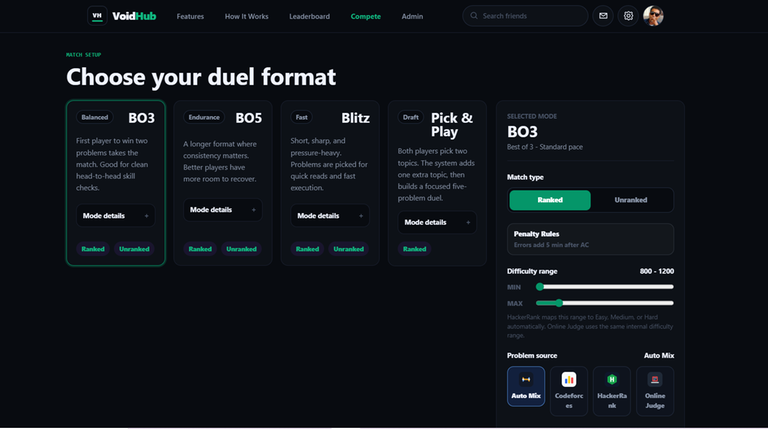
You invite a friend, choose a mode, set the difficulty range, pick a source, and play inside a shared match room with:
This is probably the most important part.
If the room uses Codeforces problems, your solution is submitted through your linked Codeforces account. So if you get Accepted, it also appears normally in your Codeforces submissions/profile.
VoidHub is not trying to replace Codeforces. It is more like a duel layer around the original judge.
You still solve real problems, with real verdicts, from the original source.
Inside a room, both players see the same problems and the same timer. The scoreboard updates while the match is running, so you can see who solved what, who is submitting, and how penalties are building up.
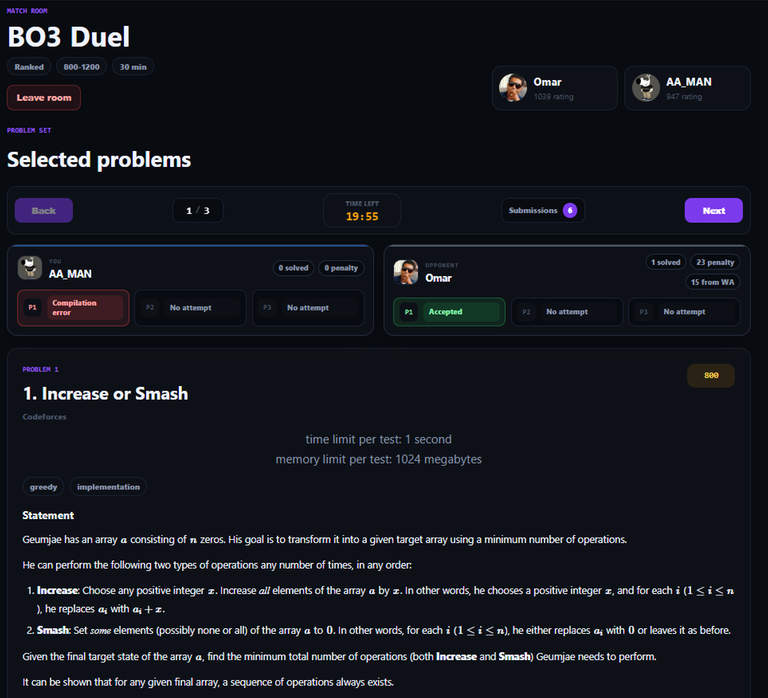
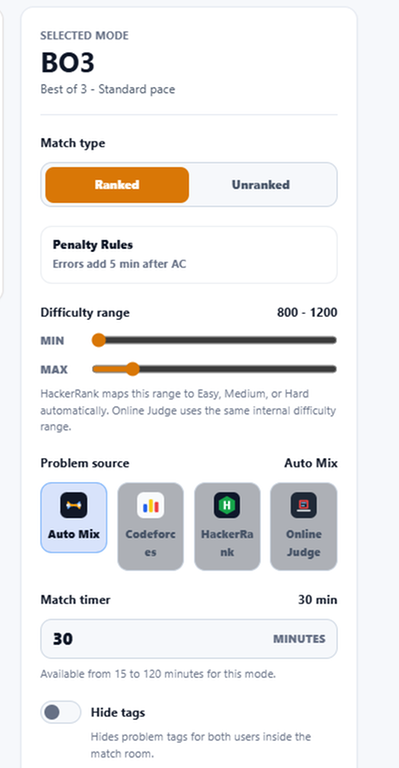
Current modes:
The room has a compiler/submission panel at the bottom. You choose a language, write or upload your code, and submit from the room.
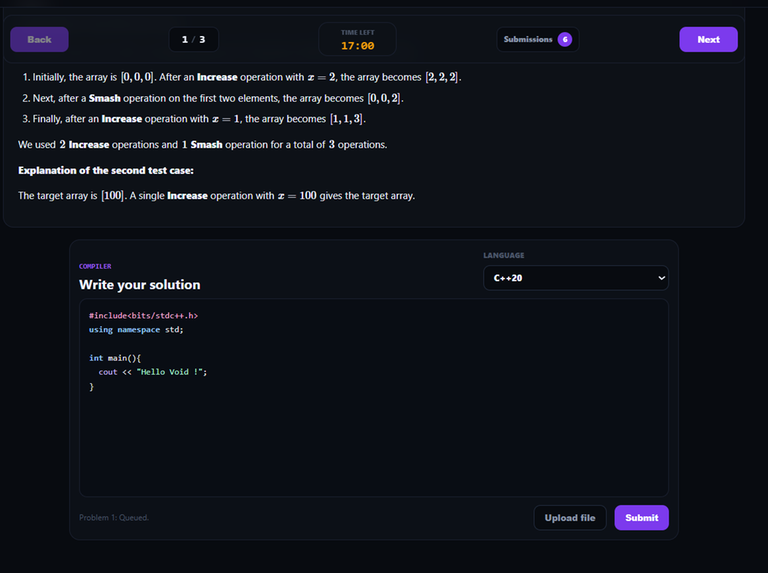
For Codeforces, the language list is fetched from the linked Codeforces session, so it matches the account setup.
VoidHub currently supports:
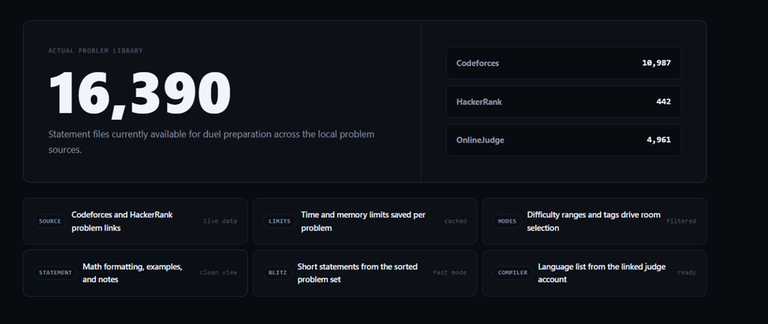
We also keep metadata such as time limit, memory limit, statement formatting, examples, and source information to prepare rooms faster.
Profiles show rating, match count, wins, losses, solved count, recent submissions, friends, and match history.
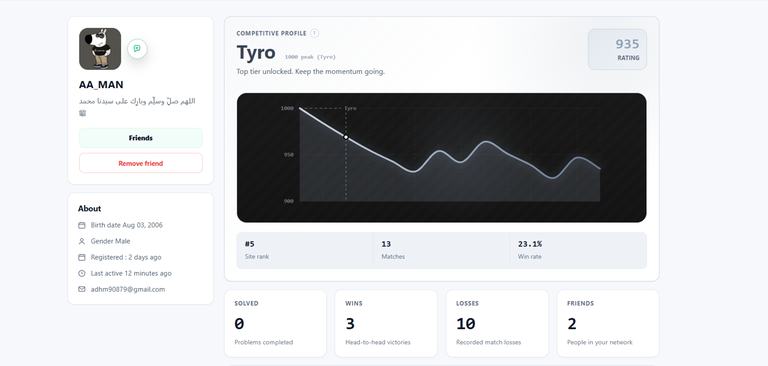
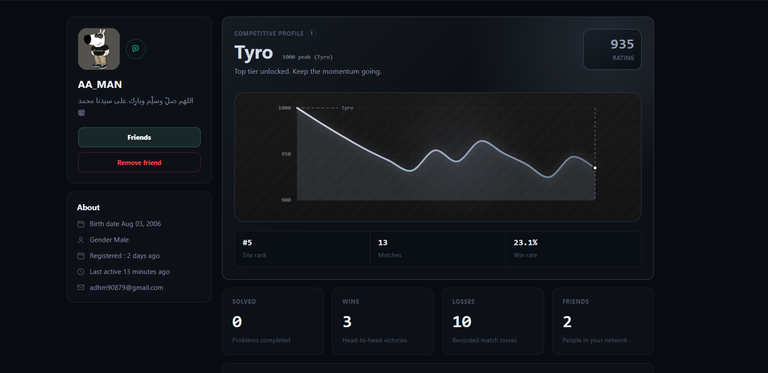
Ranked rooms affect rating. Unranked rooms are still recorded in general match stats, but do not affect rating.
A few important points:
We built VoidHub mainly for people who enjoy practicing with friends.
There are still things we want to improve, and feedback from Codeforces users would be really valuable, especially about:
You can try it here:
Thanks for reading. Any feedback, bug reports, or ideas are welcome.
For a long time, I felt like I was studying in a very random way.
I would learn an idea, solve a few problems, then move on. After a while, I’d forget most of it.
So I decided to try something simple.
Instead of solving randomly, I started grouping problems by topic. Nothing fancy, just trying to build some structure.
The goal is not to solve as many problems as possible. The goal is to understand the idea well enough so I don’t feel lost when I see it again.
Right now, I have a set where I solved 22 out of 26 problems, and I’m still stuck on some of them.
But honestly, this way feels much better than random practice.
I’m still learning, and I’m still adding more problems over time.
If you’re also struggling with number theory, maybe the problem isn’t difficulty, maybe it’s just the lack of structure.
https://codeforces.me/group/abU6lmt4Ia/contests
If you have suggestions for good problems or topics I should add, I’d really appreciate it.


