GreatShinobiOwl's blog

By GreatShinobiOwl, history, 3 weeks ago, In English

About ten months ago, Stop Fighting with Polygon — Create and Test Problems Locally was written. It introduced Polyman, a CLI for problem setters. You write the validator, generators, checker, and solutions on your own machine. One command, polyman verify, generates every test, validates it, and checks that every solution gets the verdict it should. Then polyman remote push sends the whole thing to Polygon.

Thank you for the upvotes, the issues and the pull requests. A lot has changed since then, so here is what's new.

Upgrade:

npm install -g polyman-cli@latest
polyman --version   # 3.0.0

There is one breaking change in how generator scripts are written. See Migrating from v2 at the end; it takes about two minutes.


1. Polyman is now built for AI agents

This is the biggest change. More and more of us write code together with Claude Code, Codex, Cursor or Aider. A problem package is a good job for an agent. The pieces are small and well defined, and there is a single objective test of "done": polyman verify passes.

The catch is that an agent needs to know the rules of problem setting. For example, the validator must read the exact bytes, and a WA solution must actually fail. So every problem created with polyman new now includes that knowledge:

my-problem/
├── CLAUDE.md             ← short orientation: pipeline, layout, where things live
├── AGENTS.md             ← same thing, for Codex/Cursor/Aider/etc.
├── Config.json
├── Config.schema.json    ← JSON Schema; agents and editors get validation + autocomplete
├── instructions/
│   ├── working-rules.md  ← how to behave, what "done" means
│   ├── validator.md  generators.md  generator-script.md  checker.md
│   ├── solutions.md  manual-tests.md  statements.md  config.md
│   ├── cpp-performance.md
│   └── commands/         ← one file per polyman command
├── solutions/  generators/  validator/  checker/  statements/  manual/

The docs are split on purpose. The agent reads CLAUDE.md and the working rules once, then opens validator.md only when it touches the validator. That keeps its context small and the output focused.

The instructions cover the mistakes agents (and people) actually make:

  • trailing spaces and missing final newlines that fail validation;
  • CRLF confusion;
  • Unicode dashes in LaTeX statements that Polygon warns about;
  • 1000000 written without digit separators;
  • "compiles fine" being mistaken for "done".

They also tell the agent not to rush ahead. If you paste a statement, it acknowledges it and asks a question. If you ask "what approach?", it analyses the problem without editing files. It writes code only when you ask it to.

Machine-readable results: --json

An agent shouldn't have to scrape box-drawing characters to find out whether a solution passed:

polyman verify --json
{
  "schemaVersion": 1,
  "ok": true,
  "command": "verify",
  "failedStep": null,
  "steps": [ { "name": "generate-tests", "ok": true, "errors": [] }, ... ],
  "solutions": [
    { "name": "main",   "tag": "MA", "matchesTag": true, "tests": [ ... ] },
    { "name": "slow",   "tag": "TL", "matchesTag": true, "tests": [ ... ] }
  ]
}

Standard output contains exactly one JSON document, and the human-readable log goes to stderr. If something fails before the solutions even run, such as a compile error in the validator, you still get valid JSON with failedStep set. polyman run <solution> --json works the same way.

Headless Polygon push

remote push used to stop and ask for confirmation before creating a new Polygon problem, which hangs an agent forever. Now:

polyman remote push . -y -n my-problem-slug

It creates the problem, uploads everything and saves the new problemId into Config.json. With no terminal and no flags, it exits with an error that names the flags instead of hanging.

What an agentic session looks like

Open the problem folder in your agent and say something like:

Here is the statement: given n numbers and S, find two indices i ≠ j with a_i + a_j = S. n ≤ 2·10^5. Write the validator with tests, a random generator plus one that makes many equal values, a main solution, a Python alternative, a brute force tagged TL, and two WA solutions that fail in different ways. Then make polyman verify pass.

The agent writes the files, runs polyman verify --json, reads which step failed, fixes it and runs it again until everything is green. You review the code, which is the part that needs a human, instead of doing the plumbing.

This isn't hypothetical. To test this release, I had an agent build exactly that problem from scratch, with 5 solutions, 2 generators, a custom checker and 12 tests. It then pushed the problem to Polygon, committed, built a package (READY, with verification), pulled it back into a fresh folder and verified it again. That run caught two bugs, and both were fixed before this release.


2. Generator scripts are real Polygon scripts now (breaking)

In v2 the generator script was a JSON commands array in Config.json, which Polyman translated to and from Polygon's format. The translation was fragile. Now the script is Polygon's format, in a plain text file:

<#-- generators/gen-script.txt -->

<#-- @group small -->
<#list 1..20 as i>
gen-random -n 10 -seed $$${i}  \gt  $$$
</#list>

<#-- @group large -->
gen-random -n 200000 > $
gen-equal  -n 200000 > $
gen-pair   7 > {40-41}
  • > $ means the next free index, > 5 is an explicit index, and > {40-41} means one generator run writes several tests.
  • <#-- @group X --> assigns groups, and <#list> loops work like they do on Polygon.
  • remote push and remote pull send the script exactly as written, in both directions. What you run locally is what Polygon runs.

Manual tests are files with explicit indices:

"testsets": [{
  "name": "tests",
  "generatorScript": { "scriptFile": "./generators/gen-script.txt" },
  "manualTests": [
    { "input": "./manual/tests/m-01-sample.in", "index": 1, "group": "samples", "useInStatements": true }
  ],
  "groupsEnabled": true,
  "groups": [{ "name": "samples" }, { "name": "small" }, { "name": "large" }]
}]

3. Much faster: compile cache and testlib built once

Every verify used to recompile everything. testlib.h is a large header, so each validator, generator and checker took several seconds to compile, every time.

Compile cache. Each compiled binary is stored under .polyman/cache/. It is looked up by a hash of:

  • the source;
  • every local header it includes, testlib.h among them;
  • the compiler flags;
  • the compiler version.

If you change any of those, that one file is recompiled. Otherwise it is reused. Polyman can't serve a stale binary, because any change produces a different hash.

testlib compiled once. Polyman now compiles the body of testlib.h once per problem and links it into every testlib program. Your generators, validator and checker compile against a small header, and the heavy part is never compiled twice.

Here are timings on my laptop for the template problem from polyman new (3 solutions, validator, custom checker, generator):

  • polyman verify --no-cache: 15.2 s
  • polyman verify, first run: 9.5 s (testlib is built only once)
  • polyman verify, next runs: 2.0 s
  • polyman test checker after editing the checker: under 1 s (was about 4.5 s)
$ polyman cache status
  ℹ Prebuilt testlib 0.9.45: 490.6 KB, linked into every testlib program
  ℹ 4 cached binaries, 935.7 KB
   1. solutions/acc.cpp      16.6 KB  compiled in 1.7s, last used 2026-09-25 20:04
   2. checker/chk.cpp       306.6 KB  compiled in 709ms, ...

verify prints Compile cache: 4 hits, 0 misses · saved ~7.8s at the end. Use polyman cache clear to wipe the cache, or pass --no-cache to any command to skip it. A cache problem never fails a compile: Polyman just compiles the file normally.


4. C++23, and your sourceType is respected

  • Local compiles now use -O2 -std=c++23 by default. Set "cppStandard": "c++20" (or another standard) in Config.json to change it.
  • On push, each file's sourceType in Config.json is used, for example cpp.gcc14-64-msys2-g++23. Before, every C++ file was uploaded as g++17.
  • .cc and .cxx files are accepted everywhere .cpp is.

5. Polygon sync fixes

  • Push errors show the reason. "Failed to upload generator" now includes Polygon's actual error message.
  • Generator names are mapped. A script line uses the name from Config.json, while Polygon resolves it against the uploaded file name. Polyman now rewrites the name on push, so pushed scripts run on Polygon.
  • Test groups are set correctly on script-generated tests.
  • Pushing from outside the problem folder is safe. It used to wipe the remote script and fail to upload a new one.
  • Pulls are cleaner. A pulled custom checker no longer shows up as a generator.

6. Reliability

  • Process spawning, including how time and memory limits are enforced, was rewritten on top of execa.
  • Paths with spaces and shell characters (~/My Problems/it's (hard)) work, thanks to Gustavo-Harnisch.
  • A fresh polyman new passes polyman verify straight away, so you start from a green state.
  • The codebase has 967 tests, and CI runs on Node 20 and 22.

Migrating from v2

  1. Move each testset's generatorScript.commands into a text file, one line per command, in the format above. Set "generatorScript": { "scriptFile": "./generators/gen-script.txt" }.
  2. Move manual tests into manualTests[]. Name the files m-01.in, m-02-edge.in and so on, and give each one an explicit index.
  3. Optionally add "$schema": "./Config.schema.json" to get editor validation. polyman new creates new problems with it already.
  4. Run polyman verify.

If you have a problem on Polygon already, the easiest route is polyman remote pull <id> ./dir. You get the new layout directly.


Thanks

  • Ahmad-Faraj built the compile cache.
  • Gustavo-Harnisch fixed shell-safe paths.
  • Everyone who opened issues: the C++23 request, the ulimit error and the generator upload failure all shaped this release.

What's next

These issues are open and PRs are welcome:

  • a diff between local and Polygon before you push (#10);
  • shell auto-completion (#9);
  • parallel generation and validation (#7);
  • time scaling for Java and Python (#5);
  • auto-deriving names from file paths (#12).

Links:

Tell me in the comments how you set problems today. And if you try the agent workflow, tell me where the agent got stuck. That is the most useful feedback for the next version.

Full text and comments »

  • Vote: I like it
  • +11
  • Vote: I do not like it

By GreatShinobiOwl, history, 5 months ago, In English

Hey Codeforces!

We've been quietly shipping something we're really excited about at Repovive: a full AI-assisted problem authoring workspace built for competitive programming setters. No more juggling six text files, a half-broken gen.cpp, a checker you wrote at 3 AM, and a tests/ folder you're afraid to touch.

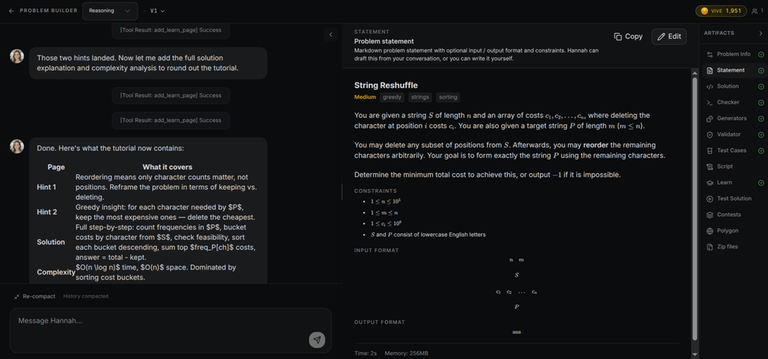
We call it the Build page, and there are two flavors live right now: v1 (the original chat-first design) and v2 (the new full multi-panel workspace). This post walks through what they are, why we built two, and what each one is good for.

TL;DR — v2 turns problem authoring into a Cursor-style IDE for problem setters. You chat with Hannah, our DeepSeek-powered agent, while she edits your statement, solution, validator, generators, checker, and test cases in real time. Multiple authors, one session, live sync.


Table of Contents

  1. What is a "build session"?
  2. v1 — The Original Chat-First Build Page
  3. v2 — The Workspace
  4. What Hannah Can Actually Do
  5. Headline Features
  6. How to Try It
  7. What's Next

What is a "build session"?

A build session is a single authoring workspace tied to one problem (or one bundle of problems if you split them up). Every artifact your problem needs lives inside it:

  • Statement (description, constraints, input/output format — Markdown + Latex)

  • Model solution (solution.cpp)

  • Alternative solutions (your wrong-on-purpose codes, brute forces, slow O(n^2) references — track verdicts: AC / WA / TLE / MLE)

  • Validator (testlib.h, ensures inputs match the constraints)

  • Generators (gen_small.cpp, gen_random.cpp, gen_corner.cpp, …)

  • Gen/data script (parameterized recipe: gen_random 1 100 1000, one per test)

  • Checker (default / wcmp / ncmp / fcmp / lcmp / custom testlib.h)

  • Interactor (for interactive problems)

  • Manual test cases + sample marking

  • Polygon import/export package

  • Learn pages (tutorial / editorial drafts)

  • Collaborators (other authors on your team)

You walk in with an idea. You walk out with a problem that's ready to drop straight into a contest.


v1 — The Original Chat-First Build Page

The first version of Build was deliberately minimal: a chat with Hannah on the left, an artifact rail on the right. You'd describe the problem, she'd write the solution, the rail would light up as each artifact got created.

┌──────────────────────────────┬────────────────────────┐
│                              │  Statement   ✓ ready   │
│   Chat with Hannah           │  Solution    ✓ ready   │
│   (streamed SSE)             │  Validator   …         │
│                              │  Generators  (2)       │
│   [ user message ]           │  Checker     ncmp      │
│   [ Hannah turn ]            │  Problems    →         │
│                              │  Polygon     ⤓ export  │
│   [ textarea + Send ]        │                        │
└──────────────────────────────┴────────────────────────┘

v1 nailed the "talk to the model, watch artifacts appear" loop. It still works great for quick problems where you just want to dictate the idea and have Hannah scaffold everything.

Status: v1 is frozen — bug-fix only, no new features. It still ships and is still the right tool when:

  • You're on mobile (landscape) and want a simpler surface.
  • You're authoring a small, fast problem and don't want the full IDE in your face.
  • You're showing the workflow to someone new — v1's UX is genuinely easier to teach.

You can flip back to v1 from the version switcher in the top-right of any build session.


v2 — The Workspace

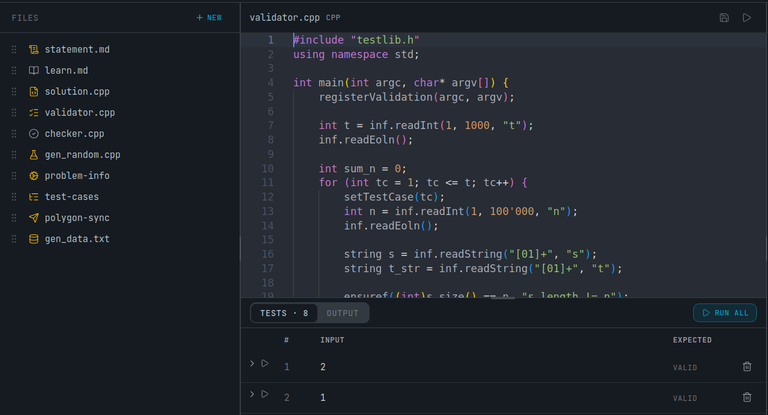
v2 is what happens when you stop thinking of "the build page" as a chat and start thinking of it as an IDE for problem authoring.

The Three Panes

┌────────────┬───────────────────────────────────┬────────────────┐
│            │                                   │                │
│  Files     │   Monaco Editor                   │   Chat with    │
│  (rail)    │   ┌──────────────────────────┐    │   Hannah       │
│            │   │ solution.cpp             │    │                │
│  ▸ stmt    │   │ #include <bits/stdc++.h> │    │   tier: max ▼  │
│  ▸ solu  ✓ │   │ using namespace std;     │    │   ──────────── │
│  ▸ valid ✓ │   │ ...                      │    │   [messages]   │
│  ▸ gen_sm  │   └──────────────────────────┘    │                │
│  ▸ gen_rnd │   ┌──────────────────────────┐    │   [textarea]   │
│  ▸ checker │   │ output / test cases /    │    │   [Send/Stop]  │
│  ▸ alt_brt │   │ TPS attribution panel    │    │                │
│  ▸ polygon │   └──────────────────────────┘    │                │
│            │                                   │                │
└────────────┴───────────────────────────────────┴────────────────┘
   20%                       60%                       20%

Both side panes are resizable + collapsible (snap-collapse to a 4% strip), and your layout is persisted per-user.

Left: The File Rail

Every artifact is a row. Drag to reorder generators. Right-click to rename or delete. Status badges tell you what's healthy at a glance:

  • statement with a ready checkmark when complete
  • solution with verification status
  • validator with last-run status
  • gen_small, gen_random, … each generator is its own row
  • checker with the type label (wcmp, ncmp, fcmp, custom, …)
  • alt_brute / alt_slow / … alternative solutions with their verdict pills
  • Footer rows for Learn Pages, Polygon, Problems, Generate Tests, TPS Overview

Center: The Monaco Editor + Tooling Tabs

The center pane is just Monaco — full C++ / Markdown / plain-text syntax highlighting, the editor you already use. It loads the right tool surface depending on which artifact you opened:

Artifact opened What you see
solution Solution code + tabs for alt solutions with their verdicts
validator Validator source + inline run output against current test cases
checker Checker source + checker-specific test cases
gen_data Gen/data script editor with parse hints
statement Markdown editor with LaTeX preview
testcases Manual test-case CRUD + sample marking
tps_overview Per-line attribution: which gen/data line produced which test, freshness
problem_info Title, slug, difficulty, tags, time/memory limits, points, markedReady
learn_pages Editorial / tutorial markdown content

Right: Hannah, the Agent

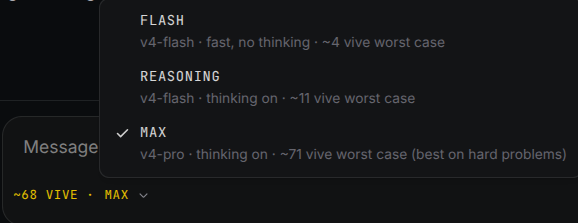
This is where Hannah lives. Three tiers to pick from per message:

  • flash — fast, no thinking, cheapest
  • reasoning — DeepSeek thinking mode on
  • max — DeepSeek-pro + thinking, the heaviest hitter

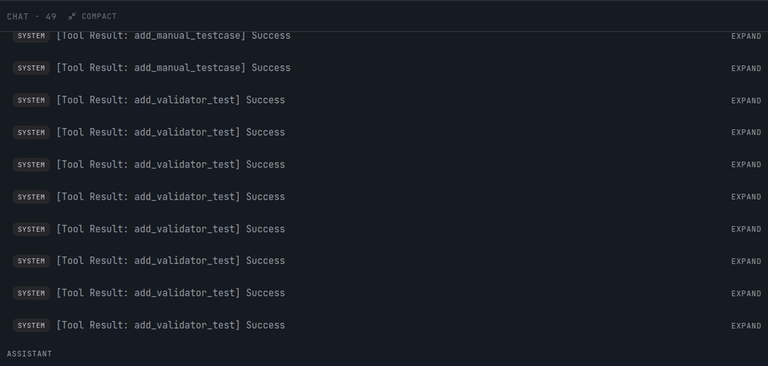
The estimated vive cost is shown before you hit Send. Messages stream in chunks: text_chunk, reasoning_chunk (collapsible thinking), tool_call, tool_result, turn_complete, and a terminal done / error / timeout / cancelled. The Stop button is wired to the server-side processing lock — clicking it actually aborts the in-flight DeepSeek stream within ~1 second.


What Hannah Can Actually Do

Hannah isn't a chatbot that suggests code for you to paste. She has direct write access to your build session via 28 tools. Here's the lineup:

Write tools

Tool Effect
update_solution Replace the model solution (solution.cpp)
update_generator(name, code) Create or update a named generator
delete_generator(name) Remove a generator and clean dependent gen/data lines
update_validator Set the input validator (testlib.h)
update_gen_data Set the parameterized generation script (one command per line)
update_problem_text Write description, constraints, I/O format, interaction format
update_problem_settings Title, slug, difficulty, tags, limits, points, markedReady
update_checker Set checker type: default / wcmp / ncmp / fcmp / lcmp
update_custom_checker Custom checker source (testlib.h)
set_interactor Mark interactive + write the interactor source
add_manual_testcase Add a single test case (input + expected output)
mark_samples Promote test cases to samples
add_or_update_alternative_solution Add a brute force / slow ref / wrong-on-purpose solution
add_or_update_learn_page Author tutorial / editorial markdown
list_problems List contest_problems generated from this session

Read tools (diagnostic)

read_solution, read_validator, read_generator(s), read_gen_data, read_problem_info, read_problem_text, read_checker, read_testcases, read_alternative_solutions, read_learn_pages.

She gets a compact manifest at the start of each turn (heavy bodies collapsed to one-line summaries with line counts), so she only burns tokens on the artifacts she actually needs to touch.


Headline Features

Collaboration

Multiple setters can work in the same build session at the same time. Edits sync via WebSocket connection. Live cursors, live edits, no merge conflicts. Add collaborators by email from the top bar; the owner manages access. (ongoing/ under development)

Polygon import/export

If you already have problems on Polygon, you can pull them straight in and keep editing in Repovive. Going the other way, every session exports as a Polygon-compatible ZIP (statement + solution + tests + checker), so you're not locked in.

Check the polygon-sync Tap!

TPS — Parameterized test generation with attribution

Instead of writing test files by hand, you write a gen/data script:

gen_small      1   10    42
gen_small      1   10    1337
gen_random   100  1e5    42
gen_random   100  1e5    1337
gen_corner   max_constraints

Each line runs through one of your generators, gets validated by the validator, and is checked against the model solution. Each test case carries attribution back to the line that produced it. If you change a generator, all tests that came from it get marked stale — one click to regenerate.

Long-running agent on its own service

Hannah's turns can take ~10 minutes.

The cancellation path is properly atomic: No orphaned turns, no double-charging.

Transparent pricing

Vive cost is shown before you send. Charging policy is enumerated — every turn ends with a classified result (done, timeout, cancelled, upstream_5xx, upstream_4xx, tool_dispatcher_error, local_exception) and the charge for each is fixed in a policy table. No surprise bills.


How to Try It

  1. Sign in at repovive.com.
  2. Go to repovive.com/dashboard/problems.
  3. Hit Create Problem on your dashboard. Give it a name. You're in.
  4. The default route lands you in v2. Use the top-right version switcher to flip to v1 if you want to.
  5. Watch Hannah scaffold the statement, solution, validator, a couple of generators, and a checker — all in one turn.
  6. Drag a teammate in via Collaborators.

What's Next

Things we're actively working on:

  • Editor-level Hannah commands — highlight a few lines in your solution and ask Hannah to refactor them in-place.
  • More external imports — beyond Polygon, we want DOMjudge / Kattis-style packages.
  • Richer alt-solution diagnostics — auto-classify why an alt is WA (which tests, which checker verdict).
  • Voice-driven build sessions (/build/[id]/live) — currently paused while we finalize the LiveKit transcript pipeline, but the foundation is there.

If you try the Build page and something feels off — or right — please leave a comment. We read all of them, and the v1→v2 evolution was driven almost entirely by what setters told us they wanted.

Happy authoring, The Repovive team.

Full text and comments »

  • Vote: I like it
  • +10
  • Vote: I do not like it