


This blog explains the standard technique used in problems like 920E - Связные компоненты?
What is Complement Graph?
Suppose we have a graph Vertices : 1 2 3 4 Edges : 1-2, 2-3
Original Graph : 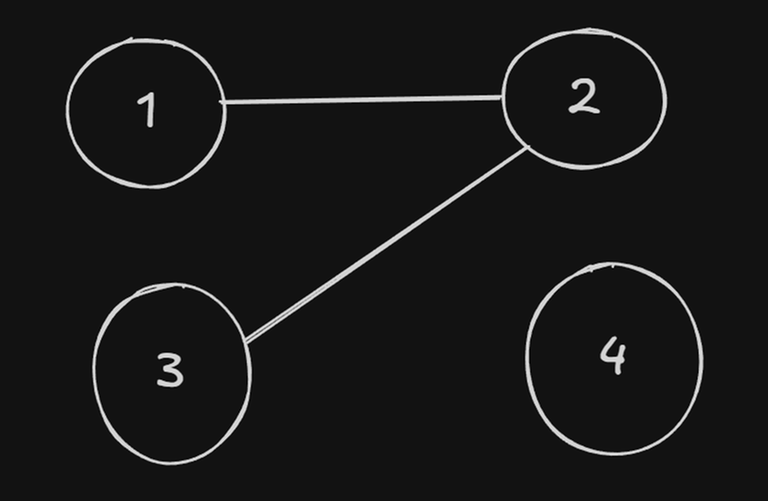
Complement Graph: 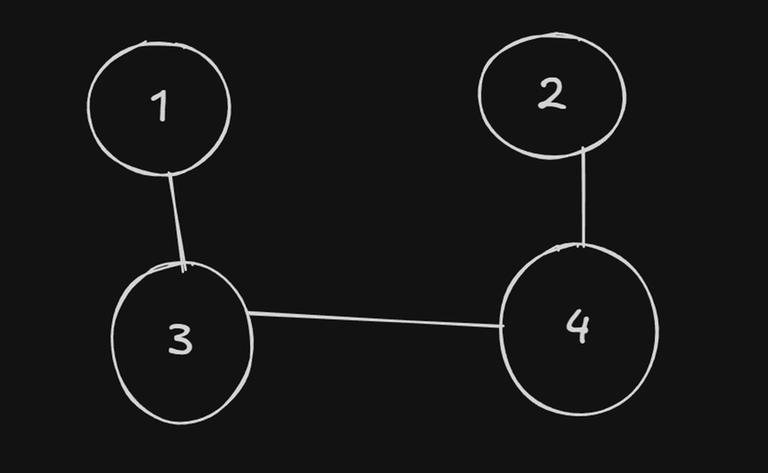
Why Can't We Build Complement Graph?
Suppose : n <= 200000 m <= 200000
The complement graph may contain ≈ n² / 2 edges which is ≈ 2 × 10¹⁰ Impossible to store.
So we need another idea.
Key Observation
Suppose we are currently standing at vertex u
Who are the neighbours of u in the complement graph?
Exactly those vertices
- which are still unvisited and which are NOT adjacent to
uin the original graph
In other words
Complement Neighbours = All Unvisited Vertices - Original Neighbours
Idea
The complement graph is usually too large to construct explicitly.
Instead of storing the complement graph, store the original graph.
During BFS/DFS, for every current node u, every unvisited vertex that is not adjacent to u in the original graph is a neighbour in the complement graph.
Data Structures
1. blocked
vector<set<int>> blocked(n + 1);
blocked[u] stores all neighbours of u in the original graph.
Checking
blocked[u].find(v) == blocked[u].end()
means that (u, v) does not exist in the original graph, so it does exist in the complement graph.
2. unvisited
set<int> unvisited;
Initially,
{1,2,3,...,n}
Whenever a node is visited, remove it from this set.
Thus, unvisited always contains the vertices that haven't been explored yet.
Algorithm
- Store the original graph in
blocked. - Put every vertex into
unvisited. - While
unvisitedis not empty:
- Pick any vertex and start BFS/DFS.
- For every node
upopped from the queue, iterate through all vertices inunvisited. - If
vis not inblocked[u], then(u, v)is a complement edge. - Visit
vand remove it fromunvisited.
- The number of visited vertices gives the size of one connected component.
Code Walkthrough
Build the original graph
vector<set<int>> blocked(n + 1);

for (int i = 0; i < m; i++) {
    int u, v;
    cin >> u >> v;
    blocked[u].insert(v);
    blocked[v].insert(u);
}
Initially every node is unvisited
set<int> unvisited;

for (int i = 1; i <= n; i++)
    unvisited.insert(i);
Start BFS from any remaining vertex
int startNode = *unvisited.begin();
unvisited.erase(startNode);

queue<int> q;
q.push(startNode);
Find complement neighbours
for (auto &v : unvisited) {
    if (blocked[u].find(v) == blocked[u].end()) {
        toremove.push_back(v);
        q.push(v);
    }
}
If v is not an original neighbour of u, then it is a neighbour in the complement graph.
Remove newly visited vertices
for (auto &x : toremove)
    unvisited.erase(x);
We remove them after the loop because modifying a set while iterating over it is unsafe.
Time Complexity
- Building the graph: O(m log n)
- Each edge lookup: O(log n)
The above implementation is simple but can take O(n² log n) in the worst case.
The optimized solution for CF 920E uses a smarter way of traversing unvisited, achieving O((n + m) log n). Solution Link — 382152731
Practice Problem:


