


Hey Codeforces!
We've been quietly shipping something we're really excited about at Repovive: a full AI-assisted problem authoring workspace built for competitive programming setters. No more juggling six text files, a half-broken gen.cpp, a checker you wrote at 3 AM, and a tests/ folder you're afraid to touch.
We call it the Build page, and there are two flavors live right now: v1 (the original chat-first design) and v2 (the new full multi-panel workspace). This post walks through what they are, why we built two, and what each one is good for.
TL;DR — v2 turns problem authoring into a Cursor-style IDE for problem setters. You chat with Hannah, our DeepSeek-powered agent, while she edits your statement, solution, validator, generators, checker, and test cases in real time. Multiple authors, one session, live sync.

What is a "build session"?
A build session is a single authoring workspace tied to one problem (or one bundle of problems if you split them up). Every artifact your problem needs lives inside it:
Statement (description, constraints, input/output format — Markdown + Latex)
Model solution (
solution.cpp)Alternative solutions (your wrong-on-purpose codes, brute forces, slow
O(n^2)references — track verdicts: AC / WA / TLE / MLE)Validator (
testlib.h, ensures inputs match the constraints)Generators (
gen_small.cpp,gen_random.cpp,gen_corner.cpp, …)Gen/data script (parameterized recipe:
gen_random 1 100 1000, one per test)Checker (default /
wcmp/ncmp/fcmp/lcmp/ customtestlib.h)Interactor (for interactive problems)
Manual test cases + sample marking
Polygon import/export package
Learn pages (tutorial / editorial drafts)
Collaborators (other authors on your team)
You walk in with an idea. You walk out with a problem that's ready to drop straight into a contest.
v1 — The Original Chat-First Build Page
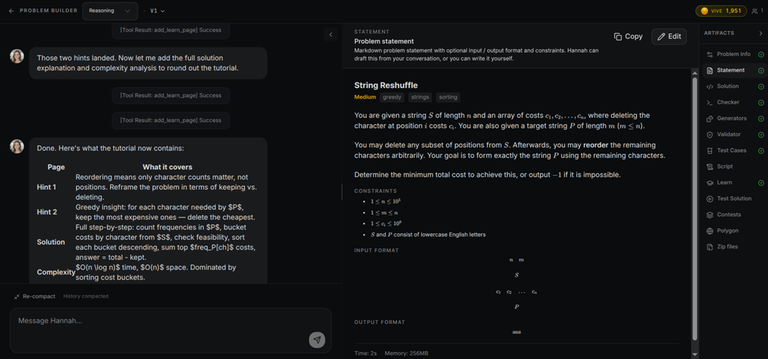
The first version of Build was deliberately minimal: a chat with Hannah on the left, an artifact rail on the right. You'd describe the problem, she'd write the solution, the rail would light up as each artifact got created.
┌──────────────────────────────┬────────────────────────┐
│                              │  Statement   ✓ ready   │
│   Chat with Hannah           │  Solution    ✓ ready   │
│   (streamed SSE)             │  Validator   …         │
│                              │  Generators  (2)       │
│   [ user message ]           │  Checker     ncmp      │
│   [ Hannah turn ]            │  Problems    →         │
│                              │  Polygon     ⤓ export  │
│   [ textarea + Send ]        │                        │
└──────────────────────────────┴────────────────────────┘
v1 nailed the "talk to the model, watch artifacts appear" loop. It still works great for quick problems where you just want to dictate the idea and have Hannah scaffold everything.
Status: v1 is frozen — bug-fix only, no new features. It still ships and is still the right tool when:
- You're on mobile (landscape) and want a simpler surface.
- You're authoring a small, fast problem and don't want the full IDE in your face.
- You're showing the workflow to someone new — v1's UX is genuinely easier to teach.
You can flip back to v1 from the version switcher in the top-right of any build session.
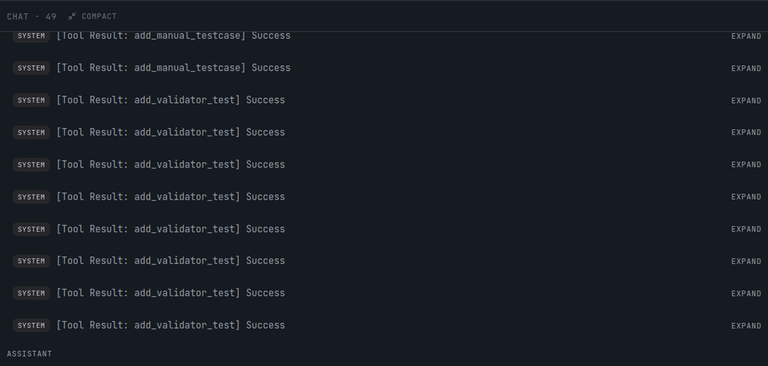
v2 — The Workspace
v2 is what happens when you stop thinking of "the build page" as a chat and start thinking of it as an IDE for problem authoring.
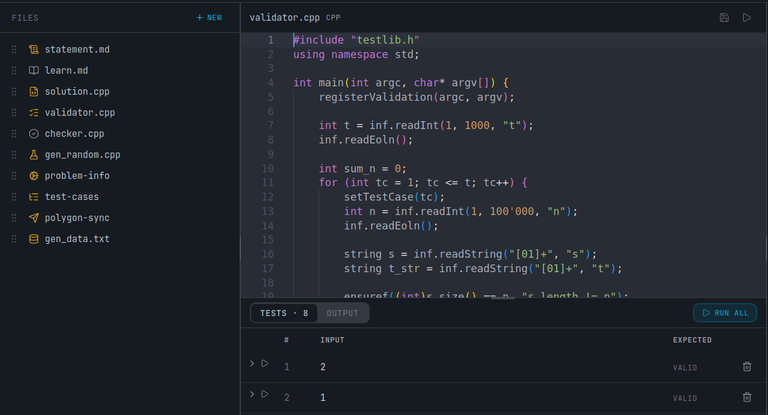
The Three Panes
┌────────────┬───────────────────────────────────┬────────────────┐
│            │                                   │                │
│  Files     │   Monaco Editor                   │   Chat with    │
│  (rail)    │   ┌──────────────────────────┐    │   Hannah       │
│            │   │ solution.cpp             │    │                │
│  ▸ stmt    │   │ #include <bits/stdc++.h> │    │   tier: max ▼  │
│  ▸ solu  ✓ │   │ using namespace std;     │    │   ──────────── │
│  ▸ valid ✓ │   │ ...                      │    │   [messages]   │
│  ▸ gen_sm  │   └──────────────────────────┘    │                │
│  ▸ gen_rnd │   ┌──────────────────────────┐    │   [textarea]   │
│  ▸ checker │   │ output / test cases /    │    │   [Send/Stop]  │
│  ▸ alt_brt │   │ TPS attribution panel    │    │                │
│  ▸ polygon │   └──────────────────────────┘    │                │
│            │                                   │                │
└────────────┴───────────────────────────────────┴────────────────┘
   20%                       60%                       20%
Both side panes are resizable + collapsible (snap-collapse to a 4% strip), and your layout is persisted per-user.
Left: The File Rail

Every artifact is a row. Drag to reorder generators. Right-click to rename or delete. Status badges tell you what's healthy at a glance:
- statement with a
readycheckmark when complete - solution with verification status
- validator with last-run status
- gen_small, gen_random, … each generator is its own row
- checker with the type label (
wcmp,ncmp,fcmp, custom, …) - alt_brute / alt_slow / … alternative solutions with their verdict pills
- Footer rows for Learn Pages, Polygon, Problems, Generate Tests, TPS Overview
Center: The Monaco Editor + Tooling Tabs
The center pane is just Monaco — full C++ / Markdown / plain-text syntax highlighting, the editor you already use. It loads the right tool surface depending on which artifact you opened:
| Artifact opened | What you see |
|---|---|
solution | Solution code + tabs for alt solutions with their verdicts |
validator | Validator source + inline run output against current test cases |
checker | Checker source + checker-specific test cases |
gen_data | Gen/data script editor with parse hints |
statement | Markdown editor with LaTeX preview |
testcases | Manual test-case CRUD + sample marking |
tps_overview | Per-line attribution: which gen/data line produced which test, freshness |
problem_info | Title, slug, difficulty, tags, time/memory limits, points, markedReady |
learn_pages | Editorial / tutorial markdown content |
Right: Hannah, the Agent
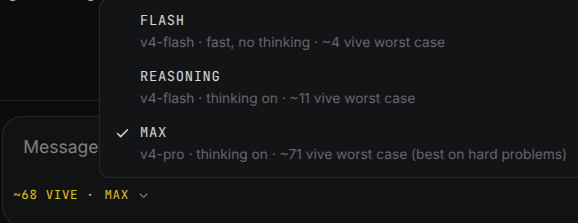
This is where Hannah lives. Three tiers to pick from per message:
- flash — fast, no thinking, cheapest
- reasoning — DeepSeek thinking mode on
- max — DeepSeek-pro + thinking, the heaviest hitter
The estimated vive cost is shown before you hit Send. Messages stream in chunks: text_chunk, reasoning_chunk (collapsible thinking), tool_call, tool_result, turn_complete, and a terminal done / error / timeout / cancelled. The Stop button is wired to the server-side processing lock — clicking it actually aborts the in-flight DeepSeek stream within ~1 second.
What Hannah Can Actually Do
Hannah isn't a chatbot that suggests code for you to paste. She has direct write access to your build session via 28 tools. Here's the lineup:
Write tools
| Tool | Effect |
|---|---|
update_solution | Replace the model solution (solution.cpp) |
update_generator(name, code) | Create or update a named generator |
delete_generator(name) | Remove a generator and clean dependent gen/data lines |
update_validator | Set the input validator (testlib.h) |
update_gen_data | Set the parameterized generation script (one command per line) |
update_problem_text | Write description, constraints, I/O format, interaction format |
update_problem_settings | Title, slug, difficulty, tags, limits, points, markedReady |
update_checker | Set checker type: default / wcmp / ncmp / fcmp / lcmp |
update_custom_checker | Custom checker source (testlib.h) |
set_interactor | Mark interactive + write the interactor source |
add_manual_testcase | Add a single test case (input + expected output) |
mark_samples | Promote test cases to samples |
add_or_update_alternative_solution | Add a brute force / slow ref / wrong-on-purpose solution |
add_or_update_learn_page | Author tutorial / editorial markdown |
list_problems | List contest_problems generated from this session |
Read tools (diagnostic)
read_solution, read_validator, read_generator(s), read_gen_data, read_problem_info, read_problem_text, read_checker, read_testcases, read_alternative_solutions, read_learn_pages.
She gets a compact manifest at the start of each turn (heavy bodies collapsed to one-line summaries with line counts), so she only burns tokens on the artifacts she actually needs to touch.
Headline Features
Collaboration

Multiple setters can work in the same build session at the same time. Edits sync via WebSocket connection. Live cursors, live edits, no merge conflicts. Add collaborators by email from the top bar; the owner manages access. (ongoing/ under development)
Polygon import/export

If you already have problems on Polygon, you can pull them straight in and keep editing in Repovive. Going the other way, every session exports as a Polygon-compatible ZIP (statement + solution + tests + checker), so you're not locked in.
TPS — Parameterized test generation with attribution
Instead of writing test files by hand, you write a gen/data script:
gen_small      1   10    42
gen_small      1   10    1337
gen_random   100  1e5    42
gen_random   100  1e5    1337
gen_corner   max_constraints
Each line runs through one of your generators, gets validated by the validator, and is checked against the model solution. Each test case carries attribution back to the line that produced it. If you change a generator, all tests that came from it get marked stale — one click to regenerate.
Long-running agent on its own service
Hannah's turns can take ~10 minutes.
The cancellation path is properly atomic: No orphaned turns, no double-charging.
Transparent pricing
Vive cost is shown before you send. Charging policy is enumerated — every turn ends with a classified result (done, timeout, cancelled, upstream_5xx, upstream_4xx, tool_dispatcher_error, local_exception) and the charge for each is fixed in a policy table. No surprise bills.
How to Try It
- Sign in at repovive.com.
- Hit Create Problem on your dashboard. Give it a name. You're in.
- Default route lands you in v2. Use the top-right version switcher to flip to v1 if you want to.
- Open the chat on the right, type *"design a problem about XOR on a tree with
Unable to parse markup [type=CF_MATHJAX]
$"*, and pick a tier. 5. Watch Hannah scaffold the statement, solution, validator, a couple of generators, and a checker — all in one turn. 6. Drag a teammate in via Collaborators. 7. When you're happy, link it into a contest from the Problems panel.
What's Next
Things we're actively working on:
- Editor-level Hannah commands — highlight a few lines in your solution and ask Hannah to refactor them in-place.
- More external imports — beyond Polygon, we want DOMjudge / Kattis-style packages.
- Richer alt-solution diagnostics — auto-classify why an alt is WA (which tests, which checker verdict).
- Voice-driven build sessions (
/build/[id]/live) — currently paused while we finalize the LiveKit transcript pipeline, but the foundation is there.
If you try the Build page and something feels off — or right — please leave a comment. We read all of them, and the v1→v2 evolution was driven almost entirely by what setters told us they wanted.
Happy authoring, The Repovive team.


