


You are currently playing a game called "Garupa". In an event of the game, you are trying to get more event points. You have $$$n$$$ cards, each with its own name, color, and power. When you play the game, you can put five cards of different names into your deck. The base point of this event is the sum of the power of the cards in your deck. On top of that, the event publishes a color and five names as bonus attributes, which means that each time you have a card with a bonus color in the deck, you end up with a $$$20\%$$$ increase in event point. And each time you have a card with a bonus name in the deck, you will eventually get $$$10\%$$$ of the event point (bonus values are calculated by addition, and we round down when calculating the final event point). Please find the maximum event point you will eventually get.
The first line is an integer $$$T~(1 \leq T \leq 50$$$), which is the number of test cases.
For each set of input data, input a positive integer $$$n~(5 \leq n \leq 100000)$$$ in the first line to indicate the number of cards you have.
The next $$$n$$$ lines, the $$$i$$$-th line input two strings $$$name_i$$$, $$$color_i$$$ and a positive integer $$$power_i~(1 \leq power_i \leq 50000)$$$ separated by spaces, indicating the name, color, and power of the $$$i$$$-th card. The input data ensures that there are at least five cards with different names.
The next line input five strings representing the five bonus names. The input data guarantees that the bonus names are different.
The last line input a string representing a bonus color.
The input data ensures that all strings consist of only uppercase and lowercase letters and the max length of them is $$$10$$$, and the sum of $$$n$$$ in all sets of input data does not exceed $$$1500000$$$.
For each set of data, output only one line of a positive integer, indicating the maximum number of bonus points that you will eventually get.
1
6
Saaya Power 45000
Kokoro Happy 45000
Kasumi Cool 45000
Rimi Power 45000
Aya Pure 45000
Aya Power 2000
Saaya Tae Kasumi Rimi Arisa
Power
382500
Mr. G invents a new game whose rules are given as follows.
Firstly, he has a $$$n \times n$$$ matrix, all elements of which are $$$0$$$ initially. Then, he follows up with some operations: in each time he chooses a row or a column, and adds an arbitrary positive integer to all the elements in the selected row or column. When all operations have been finished, he hides an element in the matrix and the element is modified to $$$-1$$$.
Now given the final matrix, you are asked to find out what the hidden element should be before the very last hiding operation.
The first line contains a single integer $$$n~(2 \leq n \leq 1000)$$$.
Next $$$n$$$ lines represent the matrix after the operations. Each element in the matrix satisfies $$$-1 \leq a_{i,j} \leq 1000000$$$, and exactly one element is $$$-1$$$.
Output a single integer, the hidden element.
3
1 2 1
0 -1 0
0 1 0
1
Brabo has $$$n$$$ images and an image processing APP. The $$$i$$$-th image, for any $$$1\leq i\leq n$$$, has a contrast value $$$v_i$$$. To make the images better, the APP receives a batch of images together (which contains at least $$$k$$$ images) and the contrast between these images should be as close as possible.
Brabo has already known the contrast values $$$v_i$$$ of all these images, and now he has to determine a partition splitting images into groups so that each group has at least $$$k$$$ images, and each image should belong to a certain group. Moreover, the maximal difference of contrast values for images in the same group should be as small as possible. Note that Brabo cannot rearrange the order of these images. That is, each group must contain several images with continuous indexes.
Let's denote $$$c_i$$$ as the smallest maximal difference of contrast values for splitting the first $$$i$$$ images into groups. Your task is to compute these values: $$$c_1, c_2, \cdots, c_n$$$. Note that when it is impossible to partition the first $$$i$$$ images, $$$c_i$$$ is regarded as $$$0$$$.
The first line contains two integers $$$n~(1 \le n \le 1000000)$$$ and $$$k~(1 \le k \le n)$$$ — the number of images, and each group of images should contain no less than $$$k$$$ images.
The next line contains $$$n$$$ integers $$$x_1, x_2, \cdots, x_n~(0 \le x_i \le 2\times 10^9)$$$ — the encrypted contrast $$$v_i$$$ of these images. The actual $$$v_i$$$ is $$$x_i\oplus c_{i-1}$$$, where $$$\oplus$$$ denotes bitwise exclusive-or. Note that $$$c_0=0$$$. It is guaranteed that $$$1\leq v_i\leq 10^9$$$ after decryption.
Output $$$n$$$ lines, where the $$$i$$$-th $$$(1\le i \le n)$$$ line contains a single integer, the smallest contrast differences $$$c_i$$$.
5 250 110 190 120 34
0
60
80
90
80
In the sample test, $$$v=[50,110,130,40,120]$$$.
A sequence $$$(a_{1},a_{2},\cdots,a_{n})$$$ is $$$(n,m,d)$$$-good if $$$1 \leq a_{i} \leq m~(1 \le i \le n)$$$ and $$$\gcd(a_{1},a_{2},\cdots,a_{n})=d$$$.
Given four integers $$$n$$$, $$$m$$$, $$$d$$$ and $$$k$$$, you are asked to calculate the sum of $$$f(q, k)$$$ for each $$$(n, m, d)$$$-good sequence $$$q$$$, where $$$f((a_{1},a_{2},...a_{n}),k) = (a_{1}a_{2} \cdots a_{n})^{k}$$$ for the sequence $$$q = (a_{1},a_{2},...a_{n})$$$.
Since the answer could be very large, you only need to output the answer modulo $$$59964251$$$.
The first line is an integer $$$T~(1 \leq T \leq 20)$$$, which is the number of test cases.
For each test case, the first line contains four integers $$$n~(1 \leq n \leq 10^{100000})$$$, $$$m~(1 \leq m \leq 100000)$$$, $$$d~(1 \leq d \leq 100000)$$$, $$$k~(1 \leq k \leq 10^9)$$$, which are described in the problem description.
For each test case, output a line containing a single integer.
1
3 3 3 1
27
You are given a tree with $$$n$$$ nodes labelled from $$$1$$$ to $$$n$$$, the root of which is the node $$$1$$$, and the node $$$i$$$ has a given value $$$a_i$$$ for each $$$i=1,2,\ldots,n$$$.
We define $$$d(x, y)$$$ as the number of edges in the shortest path from the node $$$x$$$ to the node $$$y$$$, and define a multiset $$$p(x, k)$$$ as $$$\{a_y \mid \text{$$$y$$$ is in the subtree of $$$x$$$ and}~d(x, y) \leq k\}$$$. Note that here $$$a_x \in p(x, k)$$$.
We define the score of any arbitrary set as the sum of squares of XORs of any two numbers. For example, the score of the set $$$\{1,1,2,3\}$$$ should be $$$$$$(1\oplus 1)^2+(1\oplus 2)^2+(1\oplus 3)^2+(1\oplus 2)^2+(1\oplus 3)^2+(2\oplus 3)^2=27$$$$$$ where $$$\oplus$$$ denotes the bitwise exclusive-or.
Now you are given the parameter $$$k$$$. For each node $$$x$$$ you need to compute the score of $$$p(x,k)$$$.
The first line of input contains two integers $$$n,k~(1 \leq k\leq n \leq 100000)$$$, the number of nodes of the tree and the parameter described above.
The second line of input contains $$$n$$$ integers, the $$$i$$$-th number $$$a_i~(1 \leq a_i \leq 10^9)$$$ is the value of the $$$i$$$-th node.
The third line of input contains $$$n-1$$$ integers, the $$$i$$$-th number $$$f_{i+1}~(1 \leq f_{i+1} \leq i)$$$ is the parent of the $$$(i+1)$$$-th node.
Output $$$n$$$ lines, the $$$i$$$-th line contains a single integer, the score of $$$p(i,k)$$$. Note that the answer can be extremely large, please output it modulo $$$2^{64}$$$ instead.
6 1
4 3 2 4 3 1
1 1 2 2 5
86
98
0
0
4
0
Define the function
$$$$$$ f_a\left( x \right) = a^x~(a \gt 0 \wedge a \neq 1) $$$$$$
for all $$$x \in (-\infty, +\infty)$$$.
You are asked to calculate the value of
$$$$$$ \sum_{a=2}^n{\left( a \sum_{b=a}^n{\lfloor f_{a}^{-1}\left( b \right) \rfloor}\lceil f_{b}^{-1}\left( a \right) \rceil \right)} $$$$$$
where $$$f_a^{-1}\left( x \right)$$$ is the inverse function of $$$f_a\left( x \right)$$$, $$$\lfloor x \rfloor$$$ is the largest integer that is less than or equal to $$$x$$$, and $$$\lceil x \rceil$$$ is the smallest integer that is greater than or equal to $$$x$$$.
Since the value could be very large, please output the value modulo $$$998244353$$$.
An integer $$$n~(2 \leq n \leq 10^{12})$$$ described above.
An integer denotes the value you have calculated modulo $$$998244353$$$.
2
2
10
236
Little Q is very sleepy, and he really needs some impenetrable hard problems coffee to make him awake. At this time, Little L brings a pot to Little Q, and he states the pot as follows.
For a prime number $$$p$$$, if $$$p^m | n$$$ and $$$p^{m+1}\not | n$$$, we say $$$\text{pot}_p(n)=m$$$.
The pot is very special that it can make everyone awake immediately.
Now Little L provides $$$n~(1 \le n \le 10^5)$$$ integers $$$a_1, a_2, \cdots, a_n$$$ to Little Q, each of which is $$$1$$$ initially. After that, Little L shows $$$2$$$ types of queries:
Now you need to perform $$$q~(1 \le q \le 10^5)$$$ queries of these two types of queries described above.
If you perform a "MULTIPLY" query, you don't need to output anything.
If you perform a "MAX" query, you need to output a line like "ANSWER y", where $$$y$$$ the value you've calculated.
The first line contains two integers $$$n~(1 \le n \le 10^5)$$$ and $$$q~(1 \le q \le 10^5)$$$, the number of integers and the number of queries.
Each of the next $$$q$$$ lines contains one type of query described above.
For each "MAX" query, output one line in the format of "ANSWER y", where $$$y$$$ the value you have calculated.
5 6
MULTIPLY 3 5 2
MULTIPLY 2 5 3
MAX 1 5
MULTIPLY 1 4 2
MULTIPLY 2 5 5
MAX 3 5
ANSWER 1
ANSWER 2
If $$$m$$$ and $$$n$$$ are non-zero integers, or more generally, non-zero elements of an integral domain, it is said that $$$m$$$ divides $$$n$$$ if there exists an integer $$$k$$$, or an element $$$k$$$ of the integral domain, such that $$$m \times k=n$$$, and this is written as $$$m \mid n$$$.
Pony is the boss of a courier company. The company needs to deliver packages to $$$n$$$ offices numbered from $$$1$$$ to $$$n$$$. Especially, the $$$s$$$-th office is the transfer station of the courier company.
There are $$$x$$$ ordinary two-way roads and $$$y$$$ one-way roads between these offices. The delivery vans will consume $$$c_i$$$ power if they pass through the $$$i$$$-th road. In general, the power consumption on one road must be non-negative. However, thanks to the experimental charging rail, the consumption may be negative on some one-way roads.
Besides, Pony got the following public information. The relevant department promised that if there is a one-way street from $$$a_i$$$ to $$$b_i$$$, it is impossible to return from $$$b_i$$$ to $$$a_i$$$.
To avoid the delivery vans anchoring on the road, Xiaodao wants to find these lowest power consumptions from the transfer station to these offices.
The first line contains four integers $$$n~(1 \le n \le 25000), x, y~(1 \le x, y \le 50000)$$$, and $$$s~(1 \le s \le n)$$$. This is followed by $$$x+y$$$ lines, each line of which contains three integer $$$a_i, b_i~(1 \le a_i, b_i \le n, a_i \neq b_i)$$$ and $$$c_i~(-10000 \le c_i \le 10000)$$$ describing the roads. The first $$$x$$$ given roads are ordinary two-way roads, and the last $$$y$$$ given roads are one-way roads.
The output should contain $$$n$$$ lines, the $$$i$$$-th line represents the minimum energy consumption from $$$s$$$-th to the $$$i$$$-th office if possible, or output "NO PATH" if it is impossible to reach the $$$i$$$-th office.
6 3 3 4
1 2 5
3 4 5
5 6 10
3 5 -100
4 6 -100
1 3 -10
NO PATH
NO PATH
5
0
-95
-100
As we already know, base64 is a common binary-to-text encoding scheme. Here we define a special series of positional systems that represent numbers using a base (a.k.a. radix) of $$$2$$$ to $$$62$$$. The symbols '0' – '9' represent zero to nine, and 'A' – 'Z' represent ten to thirty-five, and 'a' – 'z' represent thirty-six to sixty-one. Now you need to convert some integer $$$z$$$ in base $$$x$$$ into base $$$y$$$.
The input contains three integers $$$x, y~(2 \le x, y \le 62)$$$ and $$$z~(0 \le z \lt x^{120})$$$, where the integer $$$z$$$ is given in base $$$x$$$.
Output the integer $$$z$$$ in base $$$y$$$.
16 2 FB
11111011
A toad is travelling in Byteland, which consists of some cities and some roads, each of which connects a pair of cities. More specifically, the map of Byteland is an undirected connected edge-weighted graph in which every edge lies on at most one simple cycle. The toad is in the city numbered by $$$1$$$ at first and wants to go through all the roads at least once.
TIME IS MONEY!
The toad must minimize the total length of the path in his travelling.
The first line contains two integers $$$n,m~(2 \le n\le 10^5,n-1\leq m\leq 2n-2)$$$, indicates the number of cities and roads in Byteland.
Each of the next $$$m$$$ lines contains three integers $$$u_i, v_i, w_i~(1 \le u_i, v_i \le n, u_i \ne v_i, 0 \le w_i \le 10^5)$$$, representing a road with a length of $$$w_i$$$ connects $$$u_i$$$ and $$$v_i$$$. It's guaranteed that each pair of cities will be connected with at most one road.
Output a single integer, indicating the minimum possible sum.
6 7
1 2 1
1 3 1
2 3 1
3 4 1
3 5 1
4 5 1
2 6 1
8
In the sample test, one of the best paths is $$$$$$1\rightarrow2\rightarrow6\rightarrow2\rightarrow3\rightarrow4\rightarrow5\rightarrow3\rightarrow1$$$$$$ and the total length of the path is $$$8$$$.
You are given two $$$n \times m$$$ matrices, and the elements of each matrix are ranged from $$$1$$$ to $$$n \times m$$$ and pairwise distinct. You need to find the common submatrix with the largest size between these two matrices.
Example:
Matrix $$$A$$$: $$$$$$\begin{array}{ccc} 1 & 2 & 3\\ 4 & 5 & 6\\ 8 & 7 & 9\\ \end{array}$$$$$$
Matrix $$$B$$$: $$$$$$\begin{array}{ccc} 5 & 6 & 1\\ 7 & 9 & 3\\ 2 & 4 & 8\\ \end{array}$$$$$$
Largest common submatrix: $$$$$$\begin{array}{cc} 5 & 6\\ 7 & 9\\ \end{array}$$$$$$
The first line of input contains two integers $$$n~(1 \le n \le 1000)$$$ and $$$m~(1 \le m \le 1000)$$$, denoting the number of rows and columns of each matrix.
Each of the next $$$n$$$ lines contains $$$m$$$ integers per line, denoting the first matrix $$$A=(a_{i,j})_{n\times m}$$$. And again, each of the next $$$n$$$ lines contains $$$m$$$ integers per line, denoting the second matrix $$$B=(b_{i,j})_{n\times m}$$$.
It is guaranteed that $$$1 \le a_{i,j}, b_{i,j} \le n \times m$$$, and $$$a_{i_1,j_1} \ne a_{i_2,j_2} \wedge b_{i_1,j_1} \ne b_{i_2,j_2}$$$ always holds for each pair of $$$(i_1, j_1)$$$ and $$$(i_2, j_2)$$$, where $$$i_1 \ne i_2 \vee j_1 \ne j_2$$$.
Output an integer representing the size of the largest common submatrix.
3 4
5 6 7 8
1 2 3 4
9 10 11 12
5 6 8 7
1 2 4 3
12 11 10 9
4
Largest common submatrix in the sample test: $$$$$$\begin{array}{cc} 5 & 6\\ 1 & 2\\ \end{array}$$$$$$
In recent days, Raven is addicted to a game called Xian Xiang.
At the beginning of this game, there are some objects in an $$$n \times m$$$ rectangle. Every object has $$$k$$$ types of attributes. The player could delete any two objects by linking these two objects with a folding line, each part of which is either horizontal or vertical. However, the line can only change direction at most once, and there cannot be any object on its path (the rule is similar to that of Lian Lian Kan). Whenever the objects are deleted, the cells of the object will be left empty, and a score will be given according to the number of matching attributes of the two deleted objects. If there is $$$0$$$ common attribute between two objects, the score will be $$$s_0$$$; if there is $$$1$$$ common attribute, the score will be $$$s_1$$$, ...; and if there are $$$p$$$ common attributes, the score will be $$$s_p$$$.
There is a scoreboard and Raven is eager to go to the top of the scoreboard. So he must try his best to get the highest score in the game.
The first line is an integer $$$T~(1 \le T \le 20)$$$, which indicates the number of test cases.
Each case starts with three positive integers $$$n, m, k~(1 \le n, m \le 7, 1 \le k \le 5)$$$, representing the length, width, and the number of the attributes of the object respectively.
Next, there are $$$n \times m$$$ strings with a length of $$$k$$$, showing the corresponding objects. Initially, if the cell is blank, the string is assigned with $$$k$$$ "-"; if there is an object in the cell, the string is assigned with $$$k$$$ small-case letters. Each small-case letter represents a kind of attribute. If the letters at the same position of the string are the same for the linked two objects, it indicates that the two objects have the same attribute of that position.
Then there are $$$k+1$$$ positive integers $$$s_0, s_1, \cdots, s_k~(1 \le s_i \le 10000)$$$ in the last line for every group of data.
It is guaranteed that the number of objects in each group of data is an even number and no more than $$$18$$$.
For each case, output an integer in a line, showing the highest possible score for the game.
3
2 2 3
aaa aaa
bbb bbb
1 10 100 1000
2 3 3
aaa --- bbb
bbb --- aaa
1 10 100 1000
1 4 3
aaa bba abb aaa
1 10 100 1000
2000
2
1010
In the first sample, delete two objects in the first row and the second row and you will score $$$2000$$$ points.
In the second sample, as the same objects cannot be linked, you can only score $$$2$$$ points.
In the third sample, delete two objects in the middle, and then delete two objects at the far left and far right.
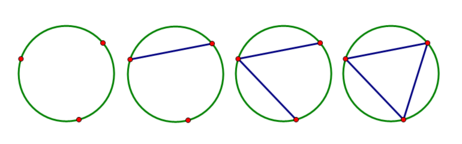
Mr. Li buys a circular strawberry cake on his birthday, and the pastry chef puts $$$n$$$ identical strawberries around the cake evenly. Now Mr. Li wants to divide the cake following the rules below:
Note that cutting tracks are allowed to connect two adjacent strawberries, and Mr. Li can also do nothing.
You are asked to help Mr. Li calculate the number of different ways in cutting the cake. Two ways are regarded as the same if they coincide after rotating the cake. Since the answer could be very large, you only need to tell him the answer modulo $$$1000000007$$$.
The first line contains an integer $$$T~(1 \le T \le 10^5)$$$, the number of test cases.
Each of the test cases contains an integer $$$n~(2 \leq n \leq 10^6)$$$, the number of strawberries.
For each test case, output an integer denotes the number of different ways of cutting the cake modulo $$$1000000007$$$.
2
2
3
2
4
The following figure shows the $$$4$$$ ways of cutting the cake with $$$3$$$ strawberries.
The Fibonacci sequence is a sequence of natural numbers, and is defined as follows:
Write a program to output the first $$$5$$$ numbers in the Fibonacci sequence.
There is no input for this problem.
Output $$$5$$$ integers indicating the first $$$5$$$ numbers in the Fibonacci sequence. Any two adjacent numbers in the output are separated by exactly one space and there is no extra space or symbol at the end of the line.
(no input)
1 1 2 3 5