


| # | User | Rating |
|---|---|---|
| 1 | jiangly | 3810 |
| 2 | Benq | 3676 |
| 3 | Kevin114514 | 3655 |
| 4 | maroonrk | 3463 |
| 5 | strapple | 3447 |
| 6 | Um_nik | 3387 |
| 7 | heuristica | 3322 |
| 8 | turmax | 3317 |
| 9 | tourist | 3307 |
| 10 | jiangbowen | 3291 |
| # | User | Contrib. |
|---|---|---|
| 1 | Qingyu | 156 |
| 2 | nik_exists | 150 |
| 2 | maspy | 150 |
| 4 | Um_nik | 143 |
| 5 | Errichto | 139 |
| 6 | adamant | 137 |
| 7 | AmShZ | 135 |
| 8 | maroonrk | 133 |
| 9 | BledDest | 132 |
| 10 | qwexd | 129 |


|
+14
I think you really should record yourself at least once. Your coding style is quite unusual, and if you can reproduce it in a recording, it would definitely make for a very entertaining video. |

|
+1
Also, in the same contest, did you use C1: https://codeforces.me/contest/2129/submission/331814162 |
|
0
I was somewhat reckless, and I apologize to you for that. However, your style really is rather strange. so all evidence can only serve as grounds for suspicion; it does not mean that he actually cheated. |
|
-10
Second edit: During my evidence-gathering investigation, I realized that I may not have fully considered some aspects. However, that does not mean the existing evidence is entirely wrong. |
|
0
Second edit: During my evidence-gathering investigation, I realized that I may not have fully considered some aspects. However, that does not mean the existing evidence is entirely wrong. so all evidence can only serve as grounds for suspicion; it does not mean that he actually cheated. |
|
+27
But the second point he deliberately obfuscated the code in order to evade AI-detection checks. |
|
+41
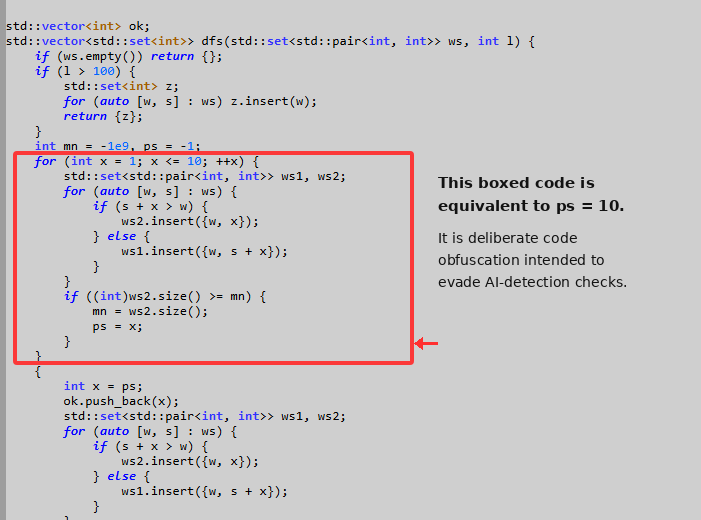
After reading this post, my initial reaction was that publicly accusing someone without sufficiently strong evidence was wrong. However, after examining two of plagues submissions myself, I found it increasingly difficult to believe that no generative AI was involved. First, consider this submission: The function $$$b(n)$$$ constructs the entire Pascal triangle in $$$O(n^2)$$$, yet it is called inside $$$s(v)$$$, which is executed separately for every test case. Therefore, the submission repeatedly performs the same quadratic combination-number preprocessing, for a total complexity of $$$O\left(\sum_i n_i^2\right),$$$ or $$$O(Tn^2)$$$ in the worst case. This is not a subtle optimization issue. Any experienced contestant—let alone an IGM—would know to precompute the table once up to the maximum required $$$n$$$, rather than rebuilding it for every test case. Repeating a complete quadratic preprocessing in this way is simply not the kind of elementary mistake I would expect an IGM to make. There is also this submission:
The highlighted loop appears to search for the best value of $$$x$$$ from $$$1$$$ to $$$10$$$ by maximizing the size of $$$ws2$$$. Whether an element is inserted into $$$ws2$$$ is determined by $$$s+x \gt w$$$. As $$$x$$$ increases, this condition only becomes easier to satisfy. Therefore, the set of input elements that qualify for $$$ws2$$$ can only grow, meaning that the size of $$$ws2$$$ is monotonically non-decreasing with respect to $$$x$$$. Its maximum over the range from $$$1$$$ to $$$10$$$ must consequently be attained at $$$x=10$$$. It is deliberate code camouflage: a predetermined constant assignment has been wrapped inside a meaningless pseudo-search to make it look like genuine algorithmic reasoning. Its purpose is to disguise the code and evade AI-detection checks. These are not merely unconventional stylistic choices. One submission repeats an obviously unnecessary $$$O(n^2)$$$ preprocessing for every test case, while another deliberately conceals a predetermined constant behind a ten-iteration pseudo-search. Together with the extremely unnatural naming, control flow, and data structures, this looks much more like generative-AI output that has been intentionally disguised than code genuinely written by an IGM. At this point, I honestly cannot convince myself that no generative AI was used. I can hardly believe what I am seeing. |
|
+40
They aren't trying to prove anything to you personally. Their names were publicly put next to the word “cheater,” so of course they are going to explain themselves. Do you seriously have nobody in real life whose opinion you care about? Maybe your closest friends would trust you, but acquaintances, coworkers or students who see this post may not. They may believe it, repeat it to others, and eventually even people close to you may start having doubts. That's how trust gets destroyed. And what if one of these people is a competitive-programming coach or works in a related field? Being publicly labelled a cheater could cost them students, opportunities or even their job. Saying “sorry” later won't magically undo that damage. The analysis in this post is obviously full of false positives—this comment already shows why. So if you have no idea what an accusation like this can do to someone's real life, don't sit here acting neutral and telling them they have nothing to explain. |
|
+54
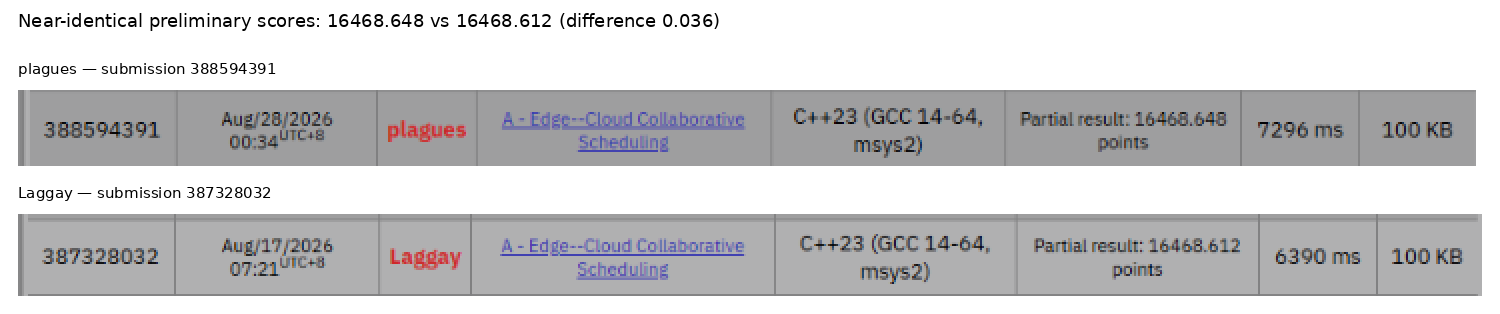
This is honestly ridiculous. It strongly appears that you modified the AI-generated report. If two people have no actual connection, then this should be classified, at most, as a weak correlation based on close scores. Are you pretending not to understand that distinction? More importantly, I genuinely do not understand why you claim that my point about the leaderboard not being final is unclear. The organizers have already answered this question explicitly. ICPC_Challenge wrote the following: "YES — THERE WILL BE A SYSTEM TEST AFTER THE CHALLENGE. The 22 preliminary tests are for feedback only and do not contribute to the final ranking. Final results will be determined by 20 separate frozen final tests." The organizers also explained: "The 20 frozen final tests are separate and unavailable during the Challenge, so they cannot be inspected or targeted individually. The 22 preliminary tests are for feedback only and do not contribute to the final ranking; the final score is the arithmetic mean of the 20 frozen-test scores." Official comment: https://codeforces.me/blog/entry/155646?#comment-1385544 I do not understand the purpose of leaving this information out. The current leaderboard is based on 22 preliminary feedback tests which, according to the organizers themselves, do not contribute to the final ranking. The actual ranking will be determined using 20 different frozen tests that nobody can inspect during the Challenge. There is also a concrete reason why I do not consider proximity on those 22 preliminary-test scores to be strong evidence by itself. Look at these two submissions: plagues: submission 388594391, Aug 28 at 00:34, 16468.648 points. Laggay: submission 387328032, Aug 17 at 07:21, 16468.612 points. The difference is only 0.036 points, even though the submissions were made more than 10 days apart.
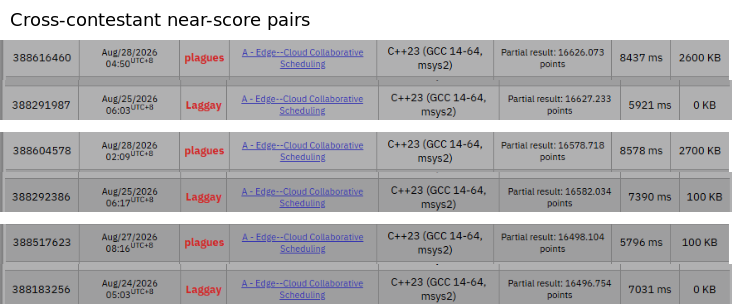
Are you seriously going to argue that this 0.036-point difference establishes a meaningful relationship between the two contestants? There are several more cross-contestant near-collisions: Pair 1: submission 388616460 by plagues scored 16626.073, while submission 388291987 by Laggay scored 16627.233. The difference is 1.160. Pair 2: submission 388604578 by plagues scored 16578.718, while submission 388292386 by Laggay scored 16582.034. The difference is 3.316. Pair 3: submission 388517623 by plagues scored 16498.104, while submission 388183256 by Laggay scored 16496.754. The difference is 1.350.
These are all comparisons between plagues and Laggay, not repeated scores from one contestant. They show that different contestants can independently land on the same narrow score region across submissions made at different times. This is precisely the problem with treating score proximity on the 22 preliminary tests as evidence of a relationship. The scoring surface clearly contains near-collisions, so different programs can obtain the same or almost the same scalar score. When many contestants independently optimize against the same small set of 22 visible feedback tests, score collisions and near-collisions are not surprising. Compressing the behavior of an entire program into a single scalar value measured on the same tests inevitably discards an enormous amount of information. And again, these are not even the final tests. Score proximity may justify examining a case more carefully, but by itself it is nowhere near sufficient to establish that two contestants collaborated, copied from one another, or used the same solution. If you want to accuse someone seriously, investigate that person individually and provide stronger evidence: source-code similarity, highly unusual identical output behavior, synchronized submission patterns, shared groups or communication, or other evidence that is genuinely difficult to explain through independent optimization. I am also not denying everything you wrote. There are people in the community who have admitted that they cheated, and those cases deserve proper investigation. But the existence of some genuine cheaters does not make every weak correlation a valid accusation. A methodology that produces obvious false positives still needs to be questioned—especially before publicly associating potentially innocent contestants with cheating. |
|
+11
Putting aside the regional and racial prejudice in your post, I think there are several serious problems with your reasoning.
|
|
+8
Why are you emphasizing Ningbo? Please correct your wording. |
|
0
So why not introduce ACM-ICPC rules in regular rounds? I believe it’s a long-standing wish among those who use Codeforces for ACM training. |
|
0
As you said, I’m unable to find earlier versions before the LLM training for testing, so there is no way to verify this. |
|
+4
Maybe what I said was a bit too harsh, and it triggered resentment from a certain group of people (but I had to say it). The probability of all these things happening together — P(that he has a prior cheating suspicion) × P(that he performs well in rounds where the suspected LLM also performs well) × P(that he performs poorly in rounds where the suspected LLM also performs poorly) — and on top of that, the probability that he didn’t actually cheat, I guess it’s less than 1%. You’re right that this alone doesn’t constitute sufficient evidence. Maybe it’s just luck. But I really can’t convince myself otherwise; it feels like the tiny chance of a DNA test not confirming kinship because of a hash collision. (Or maybe it really is? Haha.) This is not targeting anyone or racial discrimination. I only have disdain for people with prior cheating records. They must repent for their past unethical behavior, because they are the ones who ruined the environment of algorithm competitions. |
|
+1
Yes, and then I hope I can reach 1750 in this round |
|
0
You're wrong. What I mean is that precisely because problem 2113C couldn't be solved by an LLM, he can't solve it. Meanwhile, in the 2104 contest, the LLM could solve more problems. If your combinatorics were slightly better, you'd probably understand what I'm getting at. |
|
0
In fact, the reason why so many people in China have red names is that at various stages—middle school, high school, and university—they can secure direct admission opportunities based on their rankings in algorithmic competitions. In reality, cheating in China is very easy to report, and even a slight violation of the participation rules can result in losing the chance for direct admission. Because cheating is virtually impossible and the academic environment in middle and high schools is extremely stressful, many turn to algorithmic competitions... This is why only in China does the competition become so intensely obsessive |
|
+4
You may have truly been deceived by him. Problem 2104F was a 2600-rated question, and the DE problem was an extremely difficult DP challenge—yet in 2113’s Problem C, he somehow got stuck and couldn’t solve it. Problem C in 2113 was something even I could solve; it only required knowing prefix sums, and most people would crack it within five minutes. In my community, I had others test this problem, and it turned out to be exactly the kind of question AI would misunderstand and fail to solve. This is undeniable suspicion. I think... he might really have leaked/sold the problem... Though I’m more inclined to believe you were simply too trusting, which made you easy to deceive. |
|
+14
First, I apologize for my words—I thought you could take action but didn’t, when in reality, you couldn’t. I recall that during coordination, Little_Sheep_Yawn or others mentioned that some problem implementations might be very short and easily exploited by AI. Since you knew this could lead to widespread cheating, couldn’t you have proactively requested permission to ban cheaters in advance? |
|
+3
He did not take any effective action. He could have sanctioned the cheaters during the competition time. Even SSerxhs (schzmooth coordination) asked during the match whether he should be the one to ban the cheaters. It could have been handled perfectly, but the fact is he took no action at all. |
|
0
So in this round, even though I registered, I didn't submit any solutions. To prevent cheating, I won't participate in this contest |
|
+8
But for problem D in this round, you only need to learned binary search and prefix sums to solve it, and after solving problem D, the performance score far exceeds 1900... |
|
+6
hope to reach 1600+ |
|
-8
I believe that the rating on Codeforces largely reflects one's ability to observe and understand dynamic programming (DP) and greedy algorithms, which essentially boils down to the ability to guess the problem. However, focusing too much on the rating can prevent you from learning many data structures. I've seen an orange-rated friend who doesn't know segment trees but is proficient in DP; he can actually guide me on how to use segment trees to optimize certain parts of my DP solutions. On the other hand, I find the problems on AtCoder to be excellent. They don't try to be fancy; they present the problems with mathematical formulas in a very concise manner, allowing you to learn a lot beyond just obvious DP and greedy techniques. In contrast, many problems on Codeforces are quite difficult to understand (although I admit that my reading skills contribute to my low CF rating), which is not conducive to learning. |
|
0
Cheating is meaningless. The code generated by GPT is not aesthetically pleasing. Even if you temporarily achieve an undeserved rating through cheating, it will drop in the following rounds. If the rating cannot accurately reflect true skill, then it becomes even more pointless. |
|
+15
I took a look, and it doesn't seem that difficult; it only has a score of 1322. |
|
0
Sorry, I still don't understand how to use the greedy to solve this. Could you please explain it to me? |
|
On
SoCloseButStillSoFar →
Codeforces Round #840 (Div. 2) and Enigma 2022 — Cybros LNMIIT Editorial, 3 years ago
0
|
|
0
i am newbie too and i couldn't find love |
|
0
hope get positive rating delta |
|
0
hope this round can reach 1200 |
|
0
I hope this one can reach 1200 |
|
0
Can you tell me how to solve problem C? I don’t quite understand why other people’s code |
|
0
It’s so strange that the explanation for problem B is not very referential, and even you can’t solve it |
|
0
You will definitely reach your goal next time |


