


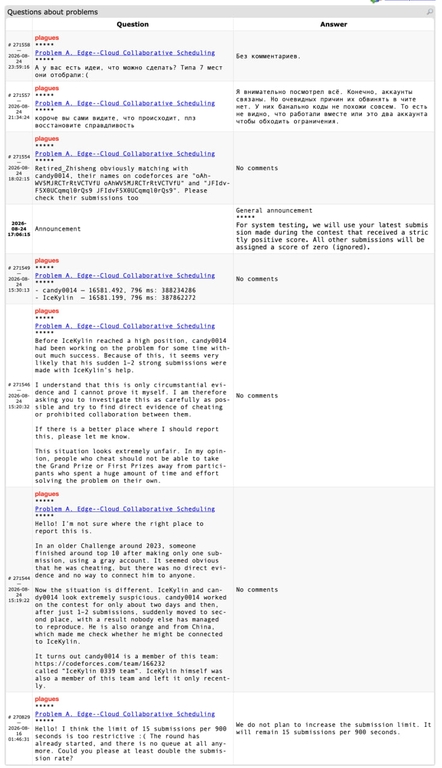
I am writing this because I believe that prohibited collaboration occurred during this Challenge and affected the prize positions. To state my personal conclusion plainly: I believe this is cheating, not merely a collection of innocent coincidences.
The final positions relevant to the accounts discussed in this post were:
| Rank | Handle | Final score | Result of my public-data review |
|---|---|---|---|
| 2 | IceKylin | 16808.628 | Historical team with candy0014 named “IceKylin 0339 team”; all-time runtime/score leads with candy0014 and Retired_Zhisheng |
| 3 | mahiro_zcy | 16757.390 | Repeated all-time runtime/score correlation with mojo__hugo; repeated timing correlation with Zinc-acetate; weak close event with Mango2011 |
| 4 | Zinc-acetate | 16754.865 | Repeated timing correlation with mahiro_zcy; shared Codeforces group with Retired_Zhisheng/mojo__hugo |
| 6 | paqi | 16747.652 | Strong behavioral correlation with Turritopsis_nutricula; direct team relation to Hyacinth and youlinaixu |
| 7 | Retired_Zhisheng | 16746.013 | All-time runtime/score leads with IceKylin and BitByBit123; several public social links; organizer-confirmed connection and synchronized progress episodes with candy0014 |
| 8 | candy0014 | 16736.677 | Historical “IceKylin 0339 team” connection and a post-hoc high-score match with IceKylin; organizer-confirmed connection and synchronized progress episodes with Retired_Zhisheng |
| 10 | mojo__hugo | 16729.029 | Repeated rare-score correlation with Lao_mang; repeated all-time runtime/score correlation with mahiro_zcy |
| 11 | youlinaixu | 16710.886 | Direct team relation to paqi/Hyacinth; very late large improvement, but no exact score match with paqi |
| 14 | Lao_mang | 16668.572 | Repeated public-data correlations with mojo__hugo and LA0mAng |
| 15 | al1swedel | 16661.204 | Medium-strength behavioral correlation with Tanya160; weaker link to Exiled_Code2022 |
| 16 | Jeffrey | 16660.865 | Broad timing clusters, but no meaningful stronger runtime/score signal found |
| 17 | Mango2011 | 16656.528 | One weak close-score event with mahiro_zcy; no public social link found |
| 18 | plagues | 16653.149 | — |
Where I report q below, it is a multiple-comparison-adjusted result from one fixed contest-wide screen. I use it only to prioritize source review, not as the probability that misconduct occurred.
1. paqi and Turritopsis_nutricula: a mirrored submission sequence
This is the clearest timing pattern I found. On August 24, Turritopsis_nutricula made two submissions ten seconds apart. Exactly 60 seconds after each one, paqi produced the same two-submission cadence and reached the same exact score:
| Handle | Submission | Time | Score | Runtime | Memory |
|---|---|---|---|---|---|
| Turritopsis_nutricula | 388196321 | 03:22:22 | 8296.577 | 625 ms | 65,536 B |
| Turritopsis_nutricula | 388196330 | 03:22:32 | 8296.577 | 671 ms | 61,440 B |
| paqi | 388196374 | 03:23:22 | 8296.577 | 484 ms | 57,344 B |
| paqi | 388196382 | 03:23:32 | 8296.577 | 593 ms | 49,152 B |
The runtimes and memory are not identical, so I am not claiming these four records prove identical binaries. The notable fact is the exact score and the perfectly shifted 10-second, then +60-second cadence.
This is not their only common fingerprint. They share six exact score plateaus in total. Four are rare and pair-exclusive in the full contest data: 8296.577, 9280.584, 16022.487, and 16024.151. For example:
- paqi submitted 387374421 and 387374432 at 10:16:11 and 10:16:20 on August 17, both scoring 16022.487; Turritopsis_nutricula submitted 387374660 at 10:18:36 with the same score.
- On August 22, Turritopsis_nutricula submitted 388054132, scoring 11580.203. After 53 and 60 seconds, paqi submitted 388054167 and 388054175, scoring 11580.163 and 11580.164.
paqi had 325 positive submissions across 13 contest days. Turritopsis_nutricula had 148 positive submissions concentrated on six days, frequently in pairs separated by roughly 7–14 seconds. The repeated cross-account mirroring is what deserves a log and source review. I found no direct public team or group link between these two handles; the only profile-context match nearby is that Hyacinth and Turritopsis_nutricula both self-report Wuhan, which is weak by itself.
The rp++ team connection and Hyacinth
paqi, Hyacinth, and youlinaixu are established teammates in the public Codeforces team rp++, with multiple actual team-contest participations.
Hyacinth made only four submissions in this Challenge. The first two, made 12 seconds apart on August 16, were already very strong and each reached a rounded total also reached by paqi:
| Handle | Submission | Time | Score | Runtime | Memory |
|---|---|---|---|---|---|
| paqi | 387258331 | 11:00:32 | 15936.908 | 1500 ms | 57,344 B |
| Hyacinth | 387259691 | 11:12:38 | 15982.034 | 1375 ms | 49,152 B |
| Hyacinth | 387259713 | 11:12:50 | 15936.908 | 1500 ms | 73,728 B |
| paqi | 387274883 | 13:21:03 | 15982.034 | 1625 ms | 57,344 B |
Both scores are pair-exclusive to paqi and Hyacinth in the contest data. The order is crossed: paqi first had 15936.908, Hyacinth then submitted both totals, and paqi later reached 15982.034. A direct teammate relationship plus two pair-exclusive shared totals among an account's first two submissions is much more informative than a shared self-reported city.
youlinaixu made only 20 submissions over three contest days. At 10:22:03 on the final day, 388664642 scored 15939.201. At 10:52:46, about seven minutes before the finish, 388667534 scored 16710.886, an improvement of 771.685 points and final rank 11. A late jump is not evidence by itself, and I found no exact paqi score match here. I include it because the organizer can compare this final source with the sources in the much stronger paqi/Hyacinth/Turritopsis_nutricula evidence.
2. mahiro_zcy, mojo__hugo, and Zinc-acetate
The fixed contest-wide screen found two repeated correlations involving final rank 3 mahiro_zcy that my initial report had missed.
mahiro_zcy and mojo__hugo
Across the contest, these accounts have nine event pairs with the same runtime and a score gap no greater than 0.3, representing eight distinct score pairs. With the wider fixed threshold of 1 point, there are 49 event pairs versus 9.44 expected from the empirical baseline among records with the same runtime, representing 23 distinct score pairs; the family-wide screening q-value is approximately 1.7e-16. In eight of the nine closest 0.3-point pairs, mojo__hugo submitted first.
One particularly close example is:
- mojo__hugo 387821595, August 20 21:14:01, score 16324.557, 609 ms, 356,352 bytes;
- mahiro_zcy 387947266, August 22 02:13:46, score 16324.556, 609 ms, 61,440 bytes.
The memory footprints differ systematically, and the lags are generally many hours or days. This is therefore not evidence of the same binary or a real-time hand-off. It is a repeated all-time runtime/near-score correlation that the organizers can resolve by comparing sources. The public team and group records I checked place the two accounts in separate networks and show no direct social link.
mahiro_zcy and Zinc-acetate
This pair shows a different pattern: synchronized score progress rather than matching resource measurements. Within one hour, the fixed screen finds 43 event pairs with score gap at most 1, versus approximately 13.0 expected under the baseline for that pair, spanning 13 distinct score pairs. The directions are mixed: Zinc-acetate is earlier in 26 pairs and later in 17. Within 15 minutes and a five-point gap there are 86 event pairs spanning 36 distinct score pairs, versus 23.3 expected.
For example, Zinc-acetate 388055634 scored 16371.944 at 22:35:50 on August 22, and mahiro_zcy 388057488 scored 16372.003 48 minutes 27 seconds later. Their runtime and memory differ. I found no direct or one-to-two-hop public team-party, shared-group, city, or organization connection between them. The effect could reflect parallel convergence by two highly active contestants on the same deterministic score landscape; nevertheless, its repetition makes it a legitimate source-review lead rather than a single coincidence.
Zinc-acetate separately shares the public group gN3WSMKicW with mojo__hugo and Retired_Zhisheng. That group edge does not establish communication in this Challenge, but it is a concrete public association adjacent to both repeated behavioral patterns.
3. mojo__hugo, Lao_mang, and LA0mAng
mojo__hugo and Lao_mang both publicly list Guangzhou University. More importantly, they share four exact plateaus; three of them are pair-exclusive: 16327.778, 16331.003, and 16336.595. On two different rare scores, I found submissions with the same public score, runtime, and memory:
| Handle | Submission | Time | Score | Runtime | Memory |
|---|---|---|---|---|---|
| mojo__hugo | 387672276 | Aug 19 11:25:43 | 16331.003 | 437 ms | 364,544 B |
| Lao_mang | 387712808 | Aug 19 17:22:52 | 16331.003 | 437 ms | 364,544 B |
| mojo__hugo | 387685482 | Aug 19 13:26:48 | 16336.595 | 546 ms | 352,256 B |
| Lao_mang | 387794592 | Aug 20 12:54:41 | 16336.595 | 546 ms | 352,256 B |
The time gaps are hours, not seconds. That weakens the timing evidence. In the runtime-only contest-wide screen, at a 0.3-point threshold there are 23 event pairs versus approximately 2.54 expected, representing 11 distinct score pairs, with family q around 1.2e-11. The two exact score/runtime/memory matches above are descriptively specific, but their hours-long gaps remain an important limitation. The direction is consistent across all four shared exact plateaus: mojo__hugo reached each first, and Lao_mang's first occurrence followed by between 8 hours 15 minutes 31 seconds and 18 hours 47 minutes 5 seconds. This remains a hypothesis for source comparison, not public proof of copying.
They are also in the same broader public team-contest circle, although not on a direct common team that I found. mojo__hugo has an actual two-person team party with YGkingNan (team 195089); YGkingNan has an actual party with BCNT and maomaoc (team 203766); and BCNT/maomaoc repeatedly competed with Lao_mang (team 201850). This multi-hop path is context, not transitive evidence of communication in this Challenge.
The Lao_mang/LA0mAng sequence is temporally tighter. The handles are visually similar, and LA0mAng made only 11 positive submissions, all on one day. Two scores, 15963.734 and 15974.214, are exclusive to this pair. The sequence of submissions at 15963.734 alternates between the accounts:
- Lao_mang 387353444, 07:17:27, 15963.734;
- LA0mAng 387354567, 07:28:40, 15963.734;
- Lao_mang 387354956, 07:32:30, 15963.734;
- LA0mAng 387356131, 07:43:44, 15963.734;
- Lao_mang 387358276, 08:04:54, 15963.734.
On the second score, Lao_mang submitted 387373444 at 10:06:24, LA0mAng submitted 387373793 at 10:09:44, and Lao_mang submitted 387374765 at 10:19:49. The last two both scored 15974.214 with exactly 968 ms and 307,200 bytes.
I found no direct public team shared by Lao_mang and LA0mAng. Their profiles list the same city but different universities. However, there is a short actual-party path through BCNT: BCNT repeatedly competed with Lao_mang in team 201850 and with LA0mAng in team 234098. Again, a two-hop social path does not prove that the endpoints collaborated here, but it makes the behavioral correlation less isolated and gives the organizers a concrete comparison set.
4. al1swedel, Tanya160, and Exiled_Code2022
This cluster is weaker than the first two, but it is still worth checking.
The al1swedel account was registered at 08:36:34 UTC on August 21, while the Challenge was in progress. Its first submission came 21 minutes later: 387864060, scoring 12480.305 with a 15,000 ms runtime. The only other account with that exact score was Exiled_Code2022: 387127370, also at 15,000 ms and submitted six days earlier. The long gap makes this a weak link. I preserve the chronology because it was the new account's first submission, but I do not have a population baseline that makes “new account plus first submission” independently suspicious.
al1swedel and Tanya160 share two rare plateaus:
- 16102.414: six submissions by al1swedel, followed 32 minutes later by the first of five from Tanya160; this score was also later reached by a third account, so it is not exclusive;
- 16130.989: first reached twice by Tanya160 on August 25, then first reached by al1swedel about 5 hours 49 minutes later, followed by two more al1swedel submissions the following night; this score is exclusive to the pair.
Their approximately six-megabyte memory range is only corroborative: globally, hundreds of submissions from dozens of handles fall in that broad range. The direction changes between the two plateaus (al1swedel to Tanya160, then Tanya160 to al1swedel). I found no public team, group, organization, or profile link between them. For that reason I classify this as medium-strength behavioral evidence, not as a public identity link.
5. Earlier reports involving IceKylin, candy0014, and Retired_Zhisheng
I reported this group to the organizers during the contest, and it is important to quote both the supporting facts and the exact limited scope of the organizer's response accurately.
Ticket chronology
The ticket text and UI timestamps below were supplied from my organizer correspondence; they are not exposed by the public Codeforces API, and I have not independently verified the UI timezone. The linked submission facts themselves were independently checked.
| UI-displayed time | Item | What was reported or answered |
|---|---|---|
| Aug 24 15:19:22 | #271544 | I reported the historical “IceKylin 0339 team” connection between IceKylin and candy0014. |
| Aug 24 15:20:32 | #271546 | I asked for a careful investigation of possible collaboration and source sharing. |
| Aug 24 15:30:13 | #271549 | I supplied submissions 387862272 and 388234286 and their near score/equal runtime. |
| Aug 24 17:06:15 | announcement | System testing would use the latest strictly positive submission and ignore the others. |
| Aug 24 18:02:15 | #271554 | I reported Retired_Zhisheng/candy0014, including their then-visible profile-name fields. |
| Aug 24 21:34:24 | #271557 | I asked that fairness be restored; the organizer replied that the accounts were connected but their code was completely dissimilar and showed no obvious collaboration. |
| Aug 24 23:59:16 | #271558 | I asked what could still be done because seven prize positions appeared affected. |
The profile-name fields cited in #271554
These were profile first-name/last-name fields, not the Codeforces handles themselves. In #271554 I recorded:
- Retired_Zhisheng:
oAhWV5MJRCTrRtVCTVfU oAhWV5MJRCTrRtVCTVfU; - candy0014:
JFIdvF5X0UCqmql0rQs9 JFIdvF5X0UCqmql0rQs9.
I considered the anonymized-looking fields and candy0014's later deletion of them suspicious when I reported them. The independently recoverable history is more limited. A Wayback capture from February 25, 2026, about six months before this Challenge, already shows candy0014 using the JFId... string as both first and last name. If my contemporaneous #271554 record is accepted, that string remained visible on August 24 and was cleared sometime afterward; the official API omitted both fields by August 28. Retired_Zhisheng, by contrast, still had the oAh... string in both fields on August 28.
Thus the public evidence supports a later removal of candy0014's fields, not a claim that both accounts first installed random strings after reaching the top. It cannot establish the exact removal time or motive. I still ask the organizers to inspect their own profile-change audit log, which can determine the exact sequence unavailable publicly.
IceKylin and candy0014
There is a historical Codeforces team 166232 named “IceKylin 0339 team.” This is the team's name on Codeforces, not wording I invented for ticket #271544. candy0014 is shown as a member, while IceKylin is shown as a former member. The public page does not prove that their membership periods overlapped during this Challenge, and I found no joint submission under this team.
Ticket #271549 pointed out this pair:
- IceKylin 387862272: 16581.199, 796 ms, 126,976 bytes;
- candy0014 388234286: 16581.492, 796 ms, 65,536 bytes.
The equal runtime and 0.293-point score gap make this more specific than an ordinary nearby-score event, but its strength must not be overstated. Among 604 positive submissions from 32 handles in the post-hoc high-score subset (score >= 16500), there are three cross-account pairs with the same runtime and a score gap no greater than 0.3; the cited IceKylin/candy0014 pair is one of them. For both cited submissions, the other is the closest-scoring foreign submission among all 796 ms submissions. candy0014 has exactly one positive 796 ms submission; IceKylin has two.
The limitations are equally important. Runtime 796 ms occurs in 920 positive submissions from 455 handles. In the contest-wide screen without the high-score cutoff, this pair has one observed same-runtime hit within 0.3 versus 0.01764 expected, raw p 0.01749, but family q 1; 692 of 65,093 directed screens have at least one such hit, 452 have exactly one, and IceKylin has 49 such counterparts. The submissions are also 74 hours 54 minutes apart and their memory differs substantially. Thus this is not evidence of a real-time hand-off or an identical binary. I still consider it a source-review target because the separately established historical-team association makes the coincidence less isolated.
The full history also corrects an overstatement in my initial report: candy0014 did not make only one or two submissions in total. The account made 101 submissions, 87 positive, beginning on August 17. Any review should use that complete chronology rather than the incorrect “one or two submissions” premise.
Retired_Zhisheng and candy0014: what the organizer confirmed, and what remains unchecked
In ticket #271554 I reported the public-profile pattern involving Retired_Zhisheng and candy0014. In the response attached to #271557, the organizer wrote that the accounts were indeed connected. The response then said that their codes were completely dissimilar and that no obvious evidence of joint work was visible. From the ticket order, I understand that answer as referring to the pair reported immediately beforehand.
I do not regard that response as an exoneration. It confirms the non-random part that a public observer cannot normally establish with certainty—the accounts are connected—and reports only that code similarity was not found. The rules prohibit collaboration and sharing solution ideas, not merely submitting textually similar source. Different implementations, independent rewrites, different LLM generations, or code built around shared test-level observations can look completely different while still resulting from prohibited information exchange. The response also does not say whether the organizers compared semantic control flow, constants and policy tables, all intermediate sources, the complete 22-test vectors, compilation artifacts, or account/session logs.
The public strict-best chronology contains several near-synchronized progress episodes. These are not identical final scores, but they are concrete, reproducible jumps rather than a vague impression from the leaderboard:
| UTC | Handle / submission | Score transition | Improvement | Relation to the other account's nearby jump |
|---|---|---|---|---|
| Aug 24 11:34:38 | candy0014 388234286 | 16372.944 → 16581.492 | +208.548 | first event in this episode |
| Aug 24 11:47:27 | Retired_Zhisheng 388235530 | 16026.811 → 16424.418 | +397.607 | 12m49s later |
| Aug 24 14:33:55 | candy0014 388253727 | 16581.492 → 16637.137 | +55.645 | first event in the second episode |
| Aug 24 14:38:19 | Retired_Zhisheng 388254181 | 16504.440 → 16554.425 | +49.985 | 4m24s later; similar jump magnitude |
| Aug 24 14:58:08 | Retired_Zhisheng 388256252 | 16554.425 → 16584.869 | +30.444 | 24m13s after the candy jump |
| Aug 25 02:22:53 | Retired_Zhisheng 388299769 | 16606.154 → 16653.190 | +47.036 | first event in the third episode |
| Aug 25 03:07:06 | candy0014 388305671 | 16637.137 → 16699.410 | +62.273 | 44m13s later |
| Aug 25 12:03:43 | Retired_Zhisheng 388348905 | 16661.032 → 16665.151 | +4.119 | first event in the fourth episode |
| Aug 25 12:11:30 | candy0014 388349555 | 16717.373 → 16736.677 | +19.304 | 7m47s later |
The clearest pair is therefore not an exact-score collision: it is the August 24 sequence in which candy0014 gained 55.645 points and Retired_Zhisheng gained 49.985 points only 4 minutes 24 seconds later, followed by another 30.444-point improvement from Retired_Zhisheng. Earlier that day, both accounts had already made very large strict-best jumps only 12 minutes 49 seconds apart.
This occurred during a much broader late movement among the prize-position accounts discussed in this post. In the final-score reconstruction, seven of them first crossed 16500 on August 24: candy0014 at 11:34:38 (388234286), paqi at 11:44:35 (388235233), Retired_Zhisheng at 12:38:47 (388241023), mojo__hugo at 16:04:07 (388263099), mahiro_zcy at 18:11:19 (388277401), Zinc-acetate at 18:22:15 (388278759), and Mango2011 at 23:50:59 (388294972). The threshold is descriptive and selected after the fact; deadline pressure and normal parallel progress are possible explanations. Nevertheless, this concentration is exactly why checking only whether one connected pair's source texts look alike is too narrow.
For precision, the pair has no shared positive exact total and no cross-account submissions within 60 seconds; the fixed near-score screen also finds no score-distance-≤5 pair within one hour. Those facts do not negate the table above: the observed strict-best episodes are separated by 4 to 44 minutes and often land at different totals. The relevant organizer-side comparison is whether the same hidden tests, parameters, or scheduling ideas improved at the same moments, which requires the unavailable 22-test vectors and source history.
Because the organizer confirmed the relationship, because the public chronology contains repeated synchronized progress, and because many high-ranking accounts moved sharply in the same late period, I believe this pair should be reopened as part of a cluster-wide investigation. In my view, that combination is affirmative evidence of possible prohibited coordination, not merely neutral social context. “The code is different” answers one narrow question. It does not resolve whether ideas, test discoveries, parameters, prompts, or other prohibited information were shared.
Other all-time leads involving Retired_Zhisheng
The same contest-wide screen found two long-lag same-runtime patterns that I also ask the organizers to inspect:
- Retired_Zhisheng/IceKylin: five event pairs, all distinct, within 0.3 with the same runtime, versus approximately 0.231 expected event pairs from the empirical same-runtime baseline (family q about 0.00436). All five IceKylin records are earlier, and none is within one hour. The closest example is IceKylin 387495808, 15948.596 at 734 ms, followed six days later by Retired_Zhisheng 388195700, 15948.598 at 734 ms. Memory differs.
- Retired_Zhisheng/BitByBit123: 28 same-runtime event pairs within one point, spanning 19 distinct score pairs, versus approximately 0.275 expected (family q about
3.15e-42). Every BitByBit123 record is earlier; none is within one hour. For example, 387787710, 15948.065 at 687 ms, precedes Retired_Zhisheng 388170345, 15947.944 at 687 ms, by more than three days. Memory differs.
These are repeated all-time output/runtime correlations, not evidence of a live hand-off. I found no direct public association between Retired_Zhisheng and IceKylin. A separate endpoint check also found no shared actual party, Codeforces team, group, city, organization, or party/team intermediary for Retired_Zhisheng and BitByBit123. Their consistency and one-way order make them useful source-comparison leads, while the long delays remain a substantial alternative-explanation caveat.
Compact appendix for the accounts I am asking the organizers to review
For completeness, this table gives a strongest additional counterpart for each remaining account discussed in this review, selected by the same fixed, symmetric contest-wide comparison rules. “Events/distinct” prevents a large number of resubmissions at one score from looking like many independent discoveries. Different rows can use different fixed profiles, so the counts are not directly comparable across rows. “Screen-positive” means only that the selected correlation survives the screen's multiple-comparison rule; it does not mean that misconduct was established.
| Rank / account | Additional counterpart | Fixed-profile observation | Classification and main limitation |
|---|---|---|---|
| 2 IceKylin | mayanktr3900 | 8 / 2 within 15m and gap ≤5 | Repeated but fragile and burst-dependent; separate candy0014/Retired_Zhisheng leads discussed above |
| 3 mahiro_zcy | nameyoutube | 214 / 130 all-time same-runtime pairs within 5 | Screen-positive but broad; the more interpretable mojo__hugo and Zinc-acetate patterns are discussed above |
| 4 Zinc-acetate | Calto | 154 / 99 all-time same-runtime pairs within 5 | Screen-positive broad runtime/score correlation; public-link check found no direct or enumerated party/team connection |
| 6 paqi | Irval | 116 / 73 all-time same-runtime pairs within 5 | Screen-positive but all-time only; Irval is consistently later in the closest 0.3-point examples |
| 7 Retired_Zhisheng | BitByBit123 | 28 / 19 all-time same-runtime pairs within 1 | Screen-positive, consistently one-way, but all lags exceed one hour |
| 10 mojo__hugo | Lao_mang | 603 / 178 all-time same-runtime pairs within 5 | Screen-positive; narrower rare/exclusive evidence and social context are discussed above |
| 11 youlinaixu | tony1107 | 2 / 2 all-time same-runtime pairs within 5 | Does not survive the multiple-comparison correction; the direct paqi/Hyacinth team relation is the substantive public link |
| 14 Lao_mang | mojo__hugo | 603 / 178 all-time same-runtime pairs within 5 | Same reciprocal repeated cluster discussed above |
| 15 al1swedel | Mohamed_Mahmoud11 | 33 / 13 within 15m and gap ≤5 | Screen-positive broad timing cluster; public-link check found no shared team, group, city, organization, or party/team intermediary |
| 16 Jeffrey | Lyoshach | 4 / 2 within 15m and gap ≤1 | Repeated timing lead, but only two distinct score pairs |
| 17 Mango2011 | yuangengqi | 19 / 3 within 15m and gap ≤5 | Burst-dependent broad timing cluster |
Pair-by-pair reading of the appendix
The compact table is easy to misread, so below is the concrete interpretation of every fixed-profile representative. Expected counts and q-values come from the same fixed comparison families for all handles; they do not incorporate public-team evidence and do not turn a correlation into a verdict.
Rank 2, IceKylin / mayanktr3900. There are eight events versus 0.0778 expected in the same 15-minute/five-point family, but only two distinct score pairs (q about
6.2e-11). One pair is only 11 seconds apart: IceKylin 388657345 at 15906.799, followed by mayanktr3900 388657369 at 15905.495. Their runtimes and memory differ. The small number of distinct plateaus and final-day burst structure make this much less robust than the event count suggests; no public relationship was found.Rank 3, mahiro_zcy / nameyoutube. The all-time same-runtime five-point family has 214 events versus 33.81 expected and 130 distinct score pairs (q about
1.13e-91). A close example is mahiro_zcy 388040701, 16390.156 at 421 ms, and nameyoutube 388088104, 16390.028 at the same 421 ms roughly ten hours later. Memory differs. This is a broad all-time runtime/near-score correlation, not a short-time transfer, and the public team and group records I checked show no shared public object.Rank 4, Zinc-acetate / Calto. The corresponding all-time same-runtime family contains 154 events versus 18.26 expected and 99 distinct score pairs (q about
3.87e-82). Calto 387313504 scored 16393.839 at 546 ms; almost a week later, Zinc-acetate 388060975 scored 16393.889 with the same runtime but very different memory. Again, this is a long-lag runtime/near-score correlation. No shared team, party, group, city, organization, or enumerated intermediary was found between the endpoints.Rank 6, paqi / Irval. The all-time same-runtime/five-point family has 116 events versus 7.32 expected and 73 distinct score pairs (q about
2.28e-90). paqi 387872660 scored 16382.978 at 609 ms; Irval 388631798 scored 16382.946 at the same runtime approximately 6.7 days later. Memory differs, and the closest examples consistently place Irval later. The long lags and absence of a public relationship make this a source-review lead, distinct from the much tighter paqi/Turritopsis_nutricula cadence.Rank 7, Retired_Zhisheng / BitByBit123. This is the 28-versus-0.275, 19-distinct, one-way all-time same-runtime pattern detailed above (q about
3.15e-42). Every matching BitByBit123 record is earlier and every lag exceeds one hour. It deserves semantic source comparison, but not a claim of a live hand-off from timestamps alone.Ranks 10 and 14, mojo__hugo / Lao_mang. Their reciprocal all-time same-runtime/five-point screen has 603 event pairs versus 41.77 expected and 178 distinct score pairs (q about
3.3e-296). That broad count, the narrower 23-versus-2.54 result at 0.3 points, the pair-exclusive plateaus, shared Guangzhou University field, and the three-hop team-party path are all described above. The pair has no direct common team.Rank 11, youlinaixu / tony1107. There are only two all-time same-runtime/five-point events versus 0.0821 expected, two distinct pairs, and family q about
0.457. For example, tony1107 387769338 scored 15689.969 at 1281 ms, while youlinaixu 388525112 scored 15685.223 at the same runtime almost a week later; memory differs. This does not survive the multiple-comparison correction. The relevant public connection for youlinaixu remains the directrp++party with paqi and Hyacinth, not this weak pair.Rank 15, al1swedel / Mohamed_Mahmoud11. The 15-minute/five-point screen contains 33 events versus 5.85 expected and 13 distinct score pairs (q about
1.5e-12). al1swedel 388114190 scored 16102.138; Mohamed_Mahmoud11 388114511 scored 16102.728 four minutes 18 seconds later. Their runtime and memory differ. Mohamed_Mahmoud11 belongs to many public groups, but none is shared with al1swedel; no team, city, organization, or party/team intermediary was found. This broad timing result is separate from the more interpretable al1swedel/Tanya160 exact plateaus.Rank 16, Jeffrey / Lyoshach. The 15-minute/one-point family has four events versus 0.0176 expected, two distinct score pairs, and q about
2.6e-05. Lyoshach 387991882 scored 16027.901; Jeffrey 387992371 scored 16027.563 five minutes 11 seconds later. Runtime is the same 1937 ms, but memory differs. With only two distinct pairs and no public relationship, I classify this as repeated but fragile.Rank 17, Mango2011 / yuangengqi. The 15-minute/five-point family has 19 events versus 0.685 expected but only three distinct score pairs (q about
6.7e-18). yuangengqi 387352967 scored 15917.136, followed 55 seconds later by Mango2011 387353049 at 15915.376; their runtimes and memory differ. Both have public team histories, but their party/team neighborhoods are disjoint. The result is burst-dependent and is not evidence of a shared binary.
Several additional repeated correlations were not each account's single strongest profile but are still worth preserving for source review:
| Pair | Public submission pattern | Public-link check |
|---|---|---|
| mahiro_zcy / Junky_Jami | 84 all-time same-runtime pairs within 5, 58 distinct; also 31 events within 1h and gap ≤1, 15 distinct | No direct team/group/profile link found |
| mojo__hugo / shaikhmubin | 56 events within 1h and gap ≤1, 15 distinct; no same-runtime match in that branch | Their public groups differ; no direct or two-party-hop link found |
| paqi / floweria | 9 events within 1h and gap ≤1, 3 distinct; two events are within 20s | Their public teams differ and have no common teammate |
Finally, these are the very short one-off events that I found and preserved even though none survives the fixed multiple-comparison screen:
| Pair | Submissions | Time gap | Score gap | Execution comparison |
|---|---|---|---|---|
| IceKylin / kitekat1__4 | 387737775 / 387737779 | 5 s | 0.450 | Runtime and memory differ |
| mahiro_zcy / Mango2011 | 387969205 / 387969229 | 22 s | 0.813 | Runtime and memory differ sharply |
| candy0014 / faustaadp | 387540813 / 387540869 | 29 s | 0.959 | Runtime and memory differ |
There is also a second Mango2011/mahiro_zcy observation 453 seconds apart with score gap 0.229, but it remains part of the same weak local episode. I found no exact Codeforces handle or public historical mapping for the label kitaksu. kitekat1__4 is a real account, but equating it with kitaksu would be speculation; no public team/group/profile link to IceKylin was found.
I regard this documented set—especially where repeated score behavior overlaps with a concrete public association—as strong grounds for a source-and-log review. I am not claiming that the one-off rows independently prove cheating; their purpose is to ensure the organizers receive every reproducible lead rather than only the most dramatic examples.
What I am asking the organizers to check
Please do not decide this from rounded totals alone. The organizers can test the hypotheses directly:
- Compare source code semantically, including control flow, constants, policy tables, class-specific branches, and unusual ordering decisions—not only textual similarity.
- Compare the complete 22-test score vectors and per-test metric vectors for the cited submissions. A 22-dimensional fingerprint is much more informative than one rounded total.
- Check whether the paired submissions came from related sessions, devices, networks, or compilation artifacts. This can be done privately; no personal data needs to be published.
- Review the membership history and verified contestant identities behind the public teams and groups.
- Because the final judging rule selected the latest strictly positive submission, inspect that selected source for each prize-relevant account as well as the cited probe submissions.
- If the review finds no violation, publish an anonymized explanation of what was checked. That would be much more convincing than silence and would protect innocent contestants from speculation.
My position
I reached second place during the Challenge and was pushed down to fifteenth place in less than three hours. I ultimately finished eighteenth. Seeing that sudden movement alongside the correlations above is why I investigated instead of silently accepting the result.
Under this handle, I finished within the published prize ranges in three previous Huawei/ICPC Challenges, and the current result is a fourth such placement. I have invested a great deal of time in this format. I am not asking for automatic disqualifications from a spreadsheet; I am asking the organizers to use the evidence above to perform the source-and-log review that only they can perform. My conclusion from the public pattern is nevertheless direct: I believe prohibited collaboration occurred and that it materially affected the prize standings.
If the organizers are not prepared to conduct and explain a source-and-log review when presented with evidence of this kind, then in the LLM era it is time to admit that the Huawei Challenge format no longer has a meaningful competitive future; after four published prize-range placements in these Challenges under this handle, I will no longer recommend that anyone participate in them again.
P.S. I apologize if parts of this post read awkwardly. I used machine translation for some passages because I did not have time to polish the English, and I believe the organizers need to see this information as soon as possible.
Btw, here’s a funny video showing how the cheaters simultaneously pushed me from top 2 to top 15 in less than three hours: https://www.youtube.com/watch?v=yXFaB-dMkpk


tl;dr: There are lots of cheaters in top10, most of them are from Ningbo like IceKylin
Awesome work! How did you do this?
I just noticed that ten contestants from the same country overtook me in eps time, even though I had held a top2 for a week.
Tibo's posts about quota: — August 27 — 16:35 UTC — August 25 — 14:46 UTC — August 24 — 00:46 UTC — August 13 — 01:01 UTC — August 11 — 00:27 UTC
Watch the video and you will see that this sudden leaderboard shift did not happen immediately after the quota reset, but 19 hours later. Moreover, it is difficult to believe that people with hex-like names—who are now claiming in the comments that this is their “first time communicating”, yet abruptly changed their names as soon as they reached the top—just happened to start using Codex simultaneously exactly 19 hours later, and that, miraculously, it produced equally strong results for both of them: results that none of the earlier participants using Codex had managed to reproduce.
And somehow, one of them is on the same team as the top-ranked participant—a team named after that very participant, who had also been a member of it. And yes, somehow their scores also ended up being almost identical.
August 24, 00:46 UTC → August 24, 08:46 China Standard Time (UTC+8) August 25, 14:46 UTC → August 25, 22:46 China Standard Time (UTC+8) August 27, 16:35 UTC → August 28, 00:35 China Standard Time (UTC+8)
You should not ignore people’s sleep schedules or the time required to optimize their solutions.
Are you really ignoring everything else I wrote?
No. I am pointing out a specific flaw in your timeline. Submission timestamps show when a result was uploaded, not when someone started using Codex. Everything else you wrote does not fix that error.
Regarding your mention of "people with hex-like names," this stems from a once-popular online competition platform in China that allowed users to choose a set of challenges and obtain the submission times of both competitors. This platform required users to associate their names on CodeForces with specific strings.
As for the submission times, if you insist it's not a coincidence, I can only speculate that it's related to the "hiding scores" habit of Chinese algorithm competition participants.
Are you prepared to take responsibility for what you just said?
You're not only accusing me, but also insulting my hometown, Ningbo. I've already reported your false accusations to the organizers.
Are you trying to threaten me? :) It is more than obvious that you participated dishonestly. Even if all of you worked hard and used Codex, which produced many strong solutions, that does not negate the absolutely obvious connection between you. Honest people do not try to conceal their identities, and everything I wrote above is direct evidence that you were communicating.
As for your statement, “I've already reported your false accusations to the organizers”: I think the organizers can see my post for themselves—that is exactly why I wrote it. :)
Most importantly, I am sure Ningbo is a wonderful city, and I never wrote anything negative about it. You are the one insulting your city by listing it in your profile and then engaging in cheating.
You're right, I won't deny that many of us do know each other. But consider this: is it really that strange for an outstanding person to know a group of outstanding people and all achieve excellent results in the same field?
Doesn't jiangly know tourist?
You are just reporting people who rank higher than you, may know each other, or are in the same city. NO TRULY VALID EVIDENCE!
Agree, those people just have the same point with (nearly) the same submission time "coincidentally", they just "coincidentally" in the same team, they "coincidentally" have a pair-exclusive point. Totally agree, this is just a coincident
I noticed that you got to CM in 4 contests :skull:
"Honest people do not try to conceal their identities"
What if he's honest and he didn't cheat?
low
It's so exciting to follow this post. I need some popcorn.
same here. Missing popcorn. but loving it. though i hope issues are not much bigger.
not accusing you, but your comment sounds like exact type of shit guilty people usually say trying to defend themselves / change topic of discussion (in my experience) (maybe just unlucky concidience! not accusing, okay?)
i feel u took it in another way. i am not against a cheater to get punished. the accuser submitted with full proof. and from comment section we see other parties are claiming strongly. lets see the outcome. nothing personal. just following and hoping for the best.
This is exactly true. Regarding IceKylin's complaint about plagues "insulting" his city — he didn't. He just wrote a fact how it is. And IceKylin tried to make it look like he insulted his city in order to make pressure using Chinese community (which I personally love and respect). Anyway, obviously there are too much "coincidences". I just hope it will be investigated thoroughly.
Why are you emphasizing Ningbo? Please correct your wording.
You are just reporting people who rank higher than you, may know each other, or are in the same city. NO TRULY VALID EVIDENCE!
Are you insulting the city Ningbo? Do you even know it? Are you just angry because you cannot receive money and there are a lot of people higher than you from Ningbo?
top 1 racist bum moment
Thank you. You can rest assured that the organizers will carefully review your information.
orzzzzz
you are funny
ahahaha, lmao
Anyone who reads this message and has more than 16,500 points can provide your code, I would like to test it on my tests, check the stability of the solution on possible hidden tests and anti-tests, and better understand the solution to the problem. Thanks!
It's nice to meet you. This is our first time communicating, right? I don't know how the "organizers" concluded that we had communicated.
Hi, this is our first time communicating, right?
Thats crazy, whole leaderboard is just full of potential cheaters
Did you just say potential?
Well yes, probably not ALL of them are actually cheating, but considering that there is a money prize, there definetely are some
You don't know the meme ;(
can you explain plis? and also why am i getting downvoted i didnt say anything bad did I?
You just said the word
I googled it... I get it now
You're right, but whether I can get a higher score really just depends on Tibo's mood—if he resets it, I'll be able to use Codex again. I've been working during the day and working on this at night for a while now. I'm really tired—time to sleep.
Who is Tibo?
It's only generated 3,287 C++ code files with Codex, using 10 billion tokens.
(I don't know if this image can be seen.)
What I'm trying to say is, are you willing to take responsibility for what you said?
So everyone ranked ahead of you is a cheater?
I believe the organizers will clear my name.
Cool. I believe many of those are actually cheaters. But I do have one question for you, Vladimir.
Why did you include me on that list? Just because at some point there was a submission from another account whose score differed from my submission by less than one point?
Well, Vladimir, why didn't you include similar "evidence" against yourself then?
It took me five minutes to find two cases where one of your submissions had a score difference of less than one point compared to a submission from a newly created account:
1) "Partial result: 14232.348 points → 387019846" and "Partial result: 14232.983 points → 387977273" by sharma2806
2) "Partial result: 13168.052 points → 387022043" and "Partial result: 13168.707 points → 387148200" by yashdhadge
Vladimir, shouldn't you have put those next to your own nickname as well?
And to the Codeforces team. I believe there should be consequences for making false accusations.
Oh, and the "Result of my public-data review" column next to your name is empty! You should add the evidence I found there!
Yeah, I checked: the claims concerning you are the weakest ones in my post. They appear specifically in the section about the most likely alt accounts associated with the top 16. Those accounts were identified by a script, and in that particular section I am not accusing anyone, they are simply “accounts I am asking the organizers to review.”.
It does look like you genuinely competed fairly, and I apologize for including you here. In any case, the purpose of this post is not to humiliate everyone I suspect, but to get the organizers’ attention so that they investigate all of my findings. I am very glad that Mike has already written to me: “You can rest assured that the organizers will carefully review your information.”
If you also believe this is by coincidence, do you think it would be better to remove me from the list? The only other sentence in this blog related to me is "Broad timing clusters, but no meaningful stronger runtime/score signal found", which does not sound like an argument.
If you still think this should be kept to support Codeforces team's review, then for fairness, I suggest to provide the "most likely counterpart" results for rest of top 18. I also think that with the comparison with contestants you are not reporting, you can better justify that these numbers support your opinion. Thank you in advance.
Damn, so many "No comments" responses :(
oh,it's right. this comment is this response's first comment
It looks like you got knocked down the prize standings, called the people who passed you “cheaters,” and then worked backwards from there. It’s honestly sad to see an IGM publicly brand people as cheaters based on evidence this flimsy. I expected better.
with which part of analysis you disagree? Some of them are already admitting that they were cheating: https://codeforces.me/blog/entry/156292?#comment-1388607
I read the post you linked from the beginning. One person’s admission is evidence against that person alone, not against everyone else on the list. My main objection is still his methodology and his attempt to present weak correlations as proof.
Bro, I’m with you on this. There are definitely people on the leaderboard running multiple accounts or sharing answers.
That said, I don’t think the stats alone are strong enough evidence. For a while, I was submitting almost exactly every 15 minutes because of the cooldown, so it’d be pretty easy for me to end up with the same submission pattern as someone else doing the exact same thing over a few hours, even though I have no clue who that person is.
Still, I think this is absolutely worth bringing up and giving the organizers something to look into more closely.
Interesting
Interesting inference, but I think you should study the concept that correlation does not imply causation, as well as the principle of who questions should provide evidence. Instead of questioning things here, why do you never doubt that it is your AI problem?
Racist gm wow, thats one off the bingo card EDIT: to those who are downvoting me, enjoy your pathetic and miserable lives being a racist you outliers of a human being
I genuinely don’t understand what you mean by that :( I’ve been to China, and all of my friends can confirm that I sincerely believe China is one of the best countries in the world to live in. I love people, and I would never judge or classify anyone based on their belonging to any particular group.
All I did was point out that the participants suddenly gained a huge number of points at almost exactly the same moment. Then I showed that they were physically located in the same place, and after that I found even stronger connections between them.
China <3
"most of them are from Ningbo" just pack it up dude it's not looking good
It's not racism (it's identical to saying "most of them are from the same city")
Hello, I can assure that I completely compete on my own and do not communicate with anyone about the problem (in particular Lyoshach). I think for any submission, the probability of "there exists another submission made within 15 minutes, that has score difference less than 1" is not very low (and I made hundreds of submissions). I appreciate your effort on the investigation, but I suggest to think carefully before posting such content, even if you say "this list is just for reference", it may still unexpectedly have negative impact on other people. Thank you.
Nice blog!
It’s very sad that, even in competitions where llms are allowed, cheaters still manage to ruin the standings. It’s not the first time some Chinese contestants have been accused of teaming or cheating, especially in a challenge with such large prizes.
I’m curious, though: was it necessary to write a public blog post? Wouldn’t it have been better to email the admins and deal with it behind the scenes?
When you accuse a large number of people, they tend to team up, mass downvote you, and push false narratives. Only a few of the accused users actually provided any arguments. Someone even played the race card, which I found funny.
Thank you very much for the reasonable response. Of course, I also emailed the organizers about this and asked about it in the problem questions, but I never received any reply by email, and you can see the result of the second option in the screenshot.
So the only reason I wrote this blog post was to draw attention to the issue.
My English is not very good, so please forgive me for using machine translation to help write the following. You can treat this as me writing a little diary entry and, at the same time, trying to clarify things for myself.
I should really be getting some proper rest right now, but I have been tossing and turning and simply cannot fall asleep. Being publicly accused online of things I never did feels awful, so I guess I might as well get up and write something.
First of all, I want to state this very clearly and seriously: throughout the entire competition, I never shared my code with anyone, nor did I ever post my code on any public platform. My code only ever existed on my two computers and in the web version of ChatGPT.
Second, I never shared anything related to the problem with anyone, including ideas, interpretations, implementation details, or code.
I admit that all of my code was generated by AI, and all of the ideas behind my code were also provided by AI. I knew essentially nothing about the specific implementation details or optimization directions. I barely even understood the problem itself. All I did was use every method I could think of to direct AI to work for me.
Next, I will roughly explain how I completed this competition.
Before August 22, I had mainly been using DeepSeek-V4, GLM-5.3, and GPT-5.6-Sol models accessed through several third-party API services to help me with the task. At the time, I was mostly participating just for fun, so my score was never particularly good.
For quite a long period, because we could see the scores of individual test cases, I kept using a rather “mysterious” method to get AI to improve my score.
I would take a test case where my score was relatively low and tell the AI something like:
“I found that #xx seems to be able to reach xxx points” — where xxx was a score considerably higher than mine — “please help me optimize the code.”
Then, after a long wait and several submissions, the score on that individual test case would actually improve.
On August 22, I got my first-ever ChatGPT Pro 20x account. At that point, I realized that if I had enough tokens and access to sufficiently good models, I might actually have a chance of reaching the top 50. That would not only allow me to recover the money I spent, but potentially give me a pretty good return as well, so I gritted my teeth and bought it.
After getting the account, I found that the experience really was much better. My score seemed to improve much faster, and suddenly it felt like I actually had a decent chance.
Then, at some point, something suddenly felt wrong.
The problem statement did not explicitly tell us what each test case contained, so how was the AI managing to improve specific test cases so precisely?
I asked the AI about this, and it told me that through repeated submissions it had inferred characteristics of certain test cases, and then made targeted adjustments and optimizations based on those characteristics.
That immediately felt wrong to me.
Wasn't that overfitting?
So I quickly stopped using that approach and asked whether it was possible to learn something from those overfitted versions of the code and derive a more generalized solution from them, so that the score improvements could remain stable across different data.
The answer I received was basically yes.
So I started having the AI “overfit” on one side while trying to generalize those improvements on the other. During this period, my score kept slowly “crawling” upward.
Later, I started thinking: if I simply tell the AI to “generalize,” how do I know whether it has actually generalized?
So I asked it to generate a large amount of additional data for local testing. I then had it optimize its performance on those locally generated test cases while also making sure that its Codeforces score did not decrease.
At the same time, I discovered that the Chat mode on the ChatGPT website seemed to have effectively unlimited usage, and that its reasoning effort could be set to the Pro level.
So I gave the problem statement, my code, and the data package to multiple ChatGPT web conversations and had them all optimize the code in parallel.
It honestly felt a bit like opening loot boxes.
After many rounds of this “loot-box opening,” together with several of my other AI tools working in parallel, I took multiple pieces of code produced by different AIs and different conversations and threw all of them into Codex. I asked it to merge everything together into a single version that could achieve high scores across different test cases at the same time.
That resulted in a major breakthrough in my score.
Of course, those versions still seemed somewhat overfitted, so I continued having some AIs work on generalization while other AIs tried to squeeze out even more points.
Since I had already generated a large amount of local test data by then, I reduced the frequency of my online submissions. After all, manually submitting each version one by one was genuinely exhausting — especially since some of those submissions were made while I was slacking off at work.
This round of parallel optimization and generalization by multiple AIs unexpectedly produced two very different results.
One was a high-scoring but heavily overfitted version specialized for part of my locally generated data.
The other was a stable, generalized version produced from several earlier versions of the code.
On many additional datasets that I later generated locally, the generalized version consistently achieved decent scores, while the overfitted version behaved extremely unpredictably, with its scores sometimes very high and sometimes very low.
Wanting to put a little pressure on the leaderboard, I submitted the version trained on similar data generated from the previously inferred test-case characteristics.
As expected, it received a very high score — this was the 16754.865 submission.
Of course, I was never going to use that version as my final submission.
So I continued asking AI to optimize the generalized version, while also trying to extract useful ideas from the overfitted version and incorporate them into further improvements.
In the end, I submitted the 16603.635 version, which had gone through stress testing on more than ten thousand locally generated test cases.
I was looking forward to seeing how well it would hold up in the final evaluation.
And then what happened?
Then I discovered that I had been publicly called out online and labeled a cheater.
So what exactly were all those days of effort supposed to mean?
Just because some of my submissions happened at similar times to other people's submissions, because some of our scores happened to be similar, and because I happened to be in the same algorithm-competition enthusiast team as some other people — a team that was created several years ago and has as many as 362 members — or even simply because one particular submission happened to have a similar score and the same runtime, you can put me in the “cheater” category?
You can include me in your AI-looking “list of cheating evidence for people ranked above me”?
Fighting cheating is absolutely the right thing to do.
But is the way you are doing it actually right?
Using AI to scrape the submission data and personal information of people ranked above you, and then supposedly analyzing each person's “evidence of cheating” — do you really believe that this is the right way to handle it?
I apologize if some of the descriptions above sound strange, or if I made mistakes in the way I expressed myself.
I am simply far too tired right now, and I no longer have the energy to deal with this.
In theory, the process described above should be reproducible.
The cost was roughly:
four weekly usage quotas from a ChatGPT Pro 20x account, a Zhipu Coding Plan subscription, OpenCode Go, some DeepSeek token usage, and several nights spent staying up until morning.
The total token consumption was approximately 15 billion tokens.
Thank you to everyone who made it this far.
It's time to sleep.
Good night.
I am genuinely sorry that I made you feel this way. I deeply regret upsetting you, and please believe me when I say that I do care about the fact that my actions may have hurt innocent people.
But you can see for yourself that there is CLEARLY something wrong here. I am absolutely convinced that some form of cheating has taken place.
At the same time, simply sitting back and doing nothing would be the worst option. I am not a site administrator, and I have no real way to report what I believe happened. I tried contacting both the organizers by email and Codeforces, but I received no response.
I sincerely believe that it is better to present everything I managed to find and make it public, even knowing that I will inevitably be wrong about some people, than to say nothing at all simply because I know I might make mistakes.
So the fact that you appeared on my list despite not cheating does not mean that all your work was for nothing. You write as though everything you did has now been completely invalidated, but the fact that I included you among more than 30 people I personally considered suspicious does not, by itself, mean anything.
I would be incredibly glad if you could see this not as a devastating blow, but as evidence that there are people willing to fight for honest participants to receive the prizes they deserve, even at the risk of damaging their own reputation. Obviously, I understood from the beginning that I would inevitably get some accusations wrong and receive a lot of backlash for it. But I still believe that this is better than simply watching what is happening and doing nothing.
I am sorry that I dragged you into this. But everything I wrote above consists only of my own suspicions and guesses. Until the organizers themselves accuse you of cheating, the only reputation being damaged by this is mine — as the person who falsely suspected and accused an innocent contestant.
So please, try not to worry too much about it. The people on this site are not stupid. They understand perfectly well that without any official confirmation, all of this is nothing more than my own words and speculation.
And please believe me: nothing I said makes you any worse as a person or diminishes what you achieved.
Putting aside the regional and racial prejudice in your post, I think there are several serious problems with your reasoning.
Most of the evidence you collected appears to have been gathered around the same date, the 28th. This strongly suggests that the material was collected through generative-AI-assisted search rather than through careful manual investigation and verification of comparable submissions. The 28th was also obviously a day when a large number of contestants were submitting solutions. More importantly, there are only 22 scoring test groups on Codeforces here. When many contestants use generative AI, identical or very similar scores can occur quite frequently, so score overlap by itself may be entirely normal.
Why do I believe that most of your evidence came from generative-AI-assisted search? You overlooked a crucial point: you did not provide the actual problem to the AI. Therefore, it could only compare historical submission results and scores. Those scores are primarily related to the output strategy; they do not imply that two programs used the same amount of time or memory, or were produced in the same way. In fact, many of the examples you cited have very different execution times and memory consumption. That is entirely consistent with different contestants independently using their own prompts and obtaining different implementations.
I also do not think the current leaderboard should be treated as the final ranking. I do not understand the significance of the phrase “from top 2 to top 15.” You do not know the 20 system-test groups. In that case, what exactly does heavily optimizing performance on these 22 visible scoring groups prove? A temporary position on the current leaderboard is not evidence of the final result, much less evidence of cheating.
I also think you have omitted the investigation results concerning yourself and the contestant currently ranked first. A generative-AI-based search of this kind would presumably collect suspicious similarities without selectively excluding particular people. So why not publish the complete report? If the same methodology also links you, the first-place contestant, or unrelated contestants together, then that information is highly relevant when evaluating whether your methodology is reliable in the first place.
Even if you genuinely believe that some contestants cheated, you should investigate those cases individually instead of publishing unverified information produced by generative-AI search. Generative AI itself explicitly warns users that its output can be inaccurate and should be independently verified. You therefore have a responsibility to distinguish valid evidence from false positives before publicly accusing people. Publishing an insufficiently verified list and allowing it to damage a group of contestants merely for attention or votes would be irresponsible.
If you believe a particular contestant cheated, investigate that contestant individually. Find precise, independently verifiable evidence strong enough to establish the accusation. Without evidence of that standard, score similarity or AI-generated correlation alone does not prove very much.
This is honestly ridiculous. It strongly appears that you modified the AI-generated report. If two people have no actual connection, then this should be classified, at most, as a weak correlation based on close scores. Are you pretending not to understand that distinction?
More importantly, I genuinely do not understand why you claim that my point about the leaderboard not being final is unclear. The organizers have already answered this question explicitly.
ICPC_Challenge wrote the following:
"YES — THERE WILL BE A SYSTEM TEST AFTER THE CHALLENGE. The 22 preliminary tests are for feedback only and do not contribute to the final ranking. Final results will be determined by 20 separate frozen final tests."
The organizers also explained:
"The 20 frozen final tests are separate and unavailable during the Challenge, so they cannot be inspected or targeted individually. The 22 preliminary tests are for feedback only and do not contribute to the final ranking; the final score is the arithmetic mean of the 20 frozen-test scores."
Official comment:
https://codeforces.me/blog/entry/155646?#comment-1385544
I do not understand the purpose of leaving this information out. The current leaderboard is based on 22 preliminary feedback tests which, according to the organizers themselves, do not contribute to the final ranking. The actual ranking will be determined using 20 different frozen tests that nobody can inspect during the Challenge.
There is also a concrete reason why I do not consider proximity on those 22 preliminary-test scores to be strong evidence by itself.
Look at these two submissions:
plagues: submission 388594391, Aug 28 at 00:34, 16468.648 points.
Laggay: submission 387328032, Aug 17 at 07:21, 16468.612 points.
The difference is only 0.036 points, even though the submissions were made more than 10 days apart.
Are you seriously going to argue that this 0.036-point difference establishes a meaningful relationship between the two contestants?
There are several more cross-contestant near-collisions:
Pair 1: submission 388616460 by plagues scored 16626.073, while submission 388291987 by Laggay scored 16627.233. The difference is 1.160.
Pair 2: submission 388604578 by plagues scored 16578.718, while submission 388292386 by Laggay scored 16582.034. The difference is 3.316.
Pair 3: submission 388517623 by plagues scored 16498.104, while submission 388183256 by Laggay scored 16496.754. The difference is 1.350.
These are all comparisons between plagues and Laggay, not repeated scores from one contestant. They show that different contestants can independently land on the same narrow score region across submissions made at different times.
This is precisely the problem with treating score proximity on the 22 preliminary tests as evidence of a relationship. The scoring surface clearly contains near-collisions, so different programs can obtain the same or almost the same scalar score.
When many contestants independently optimize against the same small set of 22 visible feedback tests, score collisions and near-collisions are not surprising. Compressing the behavior of an entire program into a single scalar value measured on the same tests inevitably discards an enormous amount of information.
And again, these are not even the final tests.
Score proximity may justify examining a case more carefully, but by itself it is nowhere near sufficient to establish that two contestants collaborated, copied from one another, or used the same solution.
If you want to accuse someone seriously, investigate that person individually and provide stronger evidence: source-code similarity, highly unusual identical output behavior, synchronized submission patterns, shared groups or communication, or other evidence that is genuinely difficult to explain through independent optimization.
I am also not denying everything you wrote. There are people in the community who have admitted that they cheated, and those cases deserve proper investigation.
But the existence of some genuine cheaters does not make every weak correlation a valid accusation. A methodology that produces obvious false positives still needs to be questioned—especially before publicly associating potentially innocent contestants with cheating.
Hi plagues, My handle appears in the secondary correlations table with mojo__hugo (close scores within 1 hour). I competed completely independently the entire time. I do not know that account at all have never communicated with them and have no connection. In a multi-day optimization contest with many submissions score proximity of this type can easily occur by chance when people independently explore similar high-scoring regions. There are no identical runtimes, mirrored timings, shared teams/groups or exact plateaus in my case. I am happy to fully cooperate with any source review by the organizers. I hope the stronger cases get proper attention.
Also I was once around rank 11 and finished at 57. Late score movements affected many people.
I don't know that guy, Retired_Zhisheng at all.
I need to admit that this blog is 1e9 + 7 times better than my cheater exposing blogs. Great work!
being equivalent to 0 times better isnt a good thing...
*literally crying r n*
Translated from Chinese by ChatGPT 5.6 Pro.
I understand your concerns. However, I can state with certainty that I did not share any contest code or ideas with anyone, nor did I obtain anyone else's code or ideas. Moreover, most of the people you listed are complete strangers to me. During the contest, all of my code was generated entirely by ChatGPT 5.6 Pro or by ChatGPT 5.6 Sol Ultra in Codex. However, because my own statement alone is not persuasive, I am presenting evidence here solely to help clarify what actually happened. The contest organizers can directly review the code of every submission, but most people cannot view other contestants' code, so I am publishing the code for all of my submissions that you listed.
Original Files for All of My Submissions
First, I will provide information about every submission involving me that appears in your article. For each one, I list, in order, the submission link, the minified source code that was actually submitted (because Codeforces requires submitted files to be no larger than 65,535 bytes), and the readable version of the code.
387947266 (which you allege is related to mojo__hugo's 387821595)
388057488 (which you allege is related to Zinc-acetate's 388055634)
388277401 (the submission you mentioned as the first to exceed 16,500 points)
388040701 (which you allege is related to nameyoutube's 388088104)
387969205 (which you allege is related to Mango2011's 387969229)
Regarding your allegation of a correlation between my submissions and Junky_Jami's, you did not provide the corresponding submission IDs, and I have found no correlation at all between our submissions. Therefore, please provide more information. However, this user will be mentioned below, so please pay particular attention.
Moreover, in every allegation you presented, there is a large discrepancy in at least one of the following—score, execution time, or memory usage—between my submission and the corresponding user's submission. I am shocked by how tenuous this evidence is. Rather than drawing a tenuous conclusion without reviewing the source code, why not properly investigate what actually happened, verify it with the organizers, and only then publish carefully organized content that can be fully verified? However, since you have already published it, let the organizers determine the truth. If it is ultimately established that every accusation about me in your article is false, I hope you will take appropriate responsibility and bear the corresponding consequences.
Additional Information
During the contest, some people did in fact try in various ways to get me to provide them with some information, but I ignored them completely. They contacted me through private messages, and I chose not to respond at all. They were Bob_lower (asking for my code), HerrMuller (asking for my code), and Junky_Jami (asking for my judgement protocol).
Two other people contacted me by email, but I did not respond to them either. They were [email protected] and [email protected].
In addition, there was an unexplained login to my account from an IP address I did not recognize. I have still been unable to determine who it was or whether that person stole my code. I changed my account password immediately after this happened. However, because it happened on August 26, while all the submissions cited in your allegations were made before then, I believe that, at the very least, this incident is unrelated to your allegations.
By the way, I'm not from Ningbo at all.
Exactlyyyyy. I don’t even know you.
Also, speculations—or allegations—based on vague analysis of submission correlation do not prove any kind of malpractice. Since India and China have almost identical time zones, even without accounting for sleeping hours, if you consider the entire 24-hour period and ignore 39k+ participants, you’re still left with 36k+ participants. With that many people submitting, having roughly 25 submissions overlap within a minute is hardly some groundbreaking evidence of a connection.
I know the logic doesn’t make much sense, but apparently neither does expecting someone who can’t accept defeat like a man to refrain from crying and trying to defame someone by tagging them simply because you think they MAY have some connection, based solely on submission timestamps.
What a waste of IQ, especially coming from someone with a 2400+ Codeforces rating. I guess memorizing problems really does make you one of Codeforces’ “bright minds.”
hello cheater
Aah allegations. Helloooo though.
It's so easy to defame someone while sitting on your PC.
Alas, there are already so much hatred in the world and dont wanna add up to it but you should chill and let the organisers come to a conclusion please. oh by the way i also fell from 38th rank to 74 now i guess.
Well i was busy in the morning but i also looked in your account Mr/Mrs RainRecall and what i found was ahmm lets see.
First, we have E1 and E2 — Voting (Easy Version) and Voting (Hard Version) — submitted within the same minute, in fact at the exact same displayed timestamp: 11:39.
For those who aren't aware, these are not exactly trivial problems.
Moving down, we have E — Turtle. You submitted it four times, at 11:03, 11:04, 11:05, and 11:06. All four submissions received Runtime Error on test 1, with essentially identical runtime and memory usage.
Now, I'm not an expert at judging what a Grandmaster should or shouldn't do, but isn't it at least a little suspicious that someone at Grandmaster level would submit the same problem four times in this fashion, receiving the exact same runtime error on test 1 each time? After the first one, sure. Maybe even the second one. But four consecutive submissions, roughly one minute apart, all failing on test 1 in essentially the same way?
Hmmmm. That's a little fishy. And then we have E1 and E2 appearing at the exact same timestamp.
I'm not claiming that these observations, by themselves, prove anything. I'm simply pointing out love. I have more to say, but I'll leave it here for now.
By the way, thanks for calling me a cheater.
I'm a Java developer and a student who was trying to learn C++. And I won't lie — switching languages while trying to build logic from scratch is harder than I expected. I don't know why, but somehow the logic that feels natural in one language becomes a completely different battle in another.
So, RainRecall, if you're going to accuse someone publicly, at least have the professionalism to hold yourself to the same standard you're applying to others.
Please don't behave unprofessionally and then get embarrassed by your own words in front of everyone.
My dear i guess it's me who should call you "hello cheater".
hey bro this is practice mode
I'll let readers decide and its about the pattern. i dont think anyone practices this way. Maybe some do.
Maybe i am wrong, maybe i am right.
Speculationssssss as you had with mine.
Perhaps I should clarify further: I submitted Summoning Minions and received an AC 5 minutes after submitting Turtle and obtaining re on test 1 because I mistakenly submitted the code for Summoning Minions to Turtle and did not find it (this is easy to verify, you can directly check my code, they are completely identical)
As for voting, it is a very easy problem for me and can be easily solved within 30 minutes. If you cannot solve it, please improve your skills.
Surely I'll. Thanks for the advice.
lol I believe no CF user with a rating of 1400 or higher would say such nonsense
I have determined that without the help of ChatGPT or Claude, you would still be posting posts like 'How to become Pupil' or 'Why can't I solve any problem in div2', it is very common to submit a Hard Version first and then an Easy Version, whether in competitions or practice. You may not even know how to become a Master by directly/slightly modifying the Hard Version through the Easy Version. Now I know how foolish and arrogant Cheater from a great country is
Fact proves Submitting the Summoning Minions code of RainRecall directly to Turtles will result in a 15 ms 23900 KB re on test 1 decision, without any issues. Oh haha, I believe you are about to accuse me of cheating by copying someone else's code and submitting it in practice mode
Are you trolling?
Hello cheater
But you are, in fact, a cheater... as I have mentioned.
Even though you seem to agree with me here, that does not change the facts. That’s unfortunate, but it doesn’t change the facts.
(EDIT: I may have gotten something wrong here. Sorry about that.)
“The use of AI tools, including generative AI and AI-assisted coding tools, is permitted during the Challenge. Participants remain fully responsible for the correctness, originality, and compliance of their submissions with all applicable rules.”
Nowhere in this statement does it say that participants cannot ask another participant for their judgement protocol. If there is a separate rule that prohibits it, then I accept that and I accept the consequences. I have no intention of arguing against a rule if one exists.
Unlike some participants, I did not have access to paid AI models. I had to make use of the free credits available across different AI platforms, including multiple accounts where those platforms provided separate free credits.
I did, however, get stuck for more than a day and a half at a score that appeared to be a local maximum. The score simply was not moving despite repeated attempts. At that point, I asked for a judgement protocol—not someone's solution or code, but information that could help me understand where my approach was failing. The individual tests had different significance, such as whether the issue was related to cloud behaviour and, within that, preprocessing, processing, or postprocessing.
My intention was to identify the area in which I was losing performance and continue improving my own solution.
If asking for a judgement protocol is considered a violation, then I am guilty of that violation. I have no shame in acknowledging it if that is what the rules determine. If it is wrong, then it is wrong. I don't want to manufacture arguments or give unnecessary justifications for it.
Thank you though for putting my name out their with others.
Take care. Cheers!!
I may indeed have gotten this wrong, because I grouped you together with people who asked me for my code, which is clearly against the rules.
However, I genuinely do not know whether asking for the judgement protocol itself is a violation. I think that is something the organizers should decide.
So if I wrongly characterized your case, I apologize for that.
I have updated my comment to clarify this.
It's fine. I accept your apology and true i also do believe lets leave it to the organizers.
It's such a beautiful life. Look at the sky and relax.
Take care.
For 5%???? Really????? Are you that poor?
Would you rather: Have a 1% chance of not getting caught cheating and getting the 13k/7k/5k AND placing first/second/third
OR
Don't get the impossible 13k but help the community become better.
I don't understand what you're trying to say. Even if you offered me 100%, I still wouldn't accept the kind of request you're proposing. Cheating must be prohibited.
Cool post! However, I am wondering that since GPT quota reset made huge improvement to these top participants, why we have no participant with multiple accounts completely rules the challenge?
So stunned. This was generated by AI, right? It feels like a normal human wouldn't write something this lengthy.
It's AI but for a diffirent reason
If you really need these thousands of euros, please report to the organizer instead of spreading rumors on Codeforces
He reported, but they ignored.
I also have some concerns about the methodology used in this post. If this was truly a fixed, contest-wide statistical screen, I do not understand why the post focuses mainly on a selected subset of high-ranked contestants, especially people around or above your own position, instead of publishing the complete screening results. Why not show the strongest match found for every relevant contestant, including yourself and contestants for whom the script found nothing? A statistical method is much easier to evaluate when both its positive and negative results are visible. More importantly, similarities in public submission data are neither necessary nor sufficient evidence of collaboration. If two people actually wanted to communicate dishonestly, that communication could happen through private messages, phone calls, face-to-face conversations, private repositories, or many other channels that cannot be observed from Codeforces submission timestamps. Public submission data cannot detect most of those channels. Conversely, two completely independent contestants can easily produce submissions with similar scores or nearby timestamps. This was a multi-day optimization contest with thousands of participants, many submissions, only 22 visible scoring groups, submission cooldowns, and many contestants using similar AI tools. Under those conditions, coincidences are not surprising. The relevant question is not whether coincidences exist, but how often similar patterns also occur between unrelated contestants.
By the way, I'm not from Ningbo at all,too.I come from Henan. I also do not know Exiled_Code2022 or Mohamed_Mahmoud11. I have never communicated with either of them about this contest, exchanged code or ideas with them, or received any contest-related information from them. Therefore, at least in my case, neither the geographical connection nor the supposed social connection exists. What remains is essentially a statistical correlation in public submission data, and I do not believe that such correlation alone is sufficient to infer communication or collaboration between participants. Another point that should be considered is that the number of widely used high-performance AI models and coding tools is fairly limited. Many contestants are using the same or similar models, facing exactly the same problem, the same 22 visible scoring groups, the same scoring function, and the same public feedback. Under these conditions, independent AI-assisted optimization can naturally converge toward similar strategies and similar score regions. Therefore, score proximity is not particularly surprising by itself. If two independent contestants use similar models to optimize the same objective against the same visible feedback, similar outputs or score plateaus can occur without any communication between them. This does not mean that every similarity is meaningless. It means that similarity alone needs a proper baseline before it can be treated as evidence of collaboration. I also have verifiable records of my own development process, including source-code history, intermediate versions, local testing records, and AI/Codex conversation history where available. If necessary, I can provide the corresponding source code and development records for the submissions mentioned in this post. I do not think private account information should be posted publicly, but the technical development history itself is verifiable. If the claim is that contestants exchanged code or ideas, then source-level similarity is much more meaningful evidence than merely observing similar scores or nearby submission timestamps. Similar public scores can arise from independent optimization, especially when many contestants are using the same small set of AI models on the same problem and the same visible scoring system. In my case, I am confident that my code-development history is consistent with independent work. My development history can be examined directly; there is no need to infer collaboration indirectly from score coincidences. And one more thing: please do not treat the current public leaderboard as if it were the final ranking. Believe me, once the final system-test results are released, some of the contestants you are currently describing as having “overtaken” you may no longer be ahead of you at all. Some of us may even finish below you. This is an optimization challenge with hidden tests. A high score on the 22 visible groups may simply mean that a solution is better fitted to those visible groups, while a more generalized solution may deliberately sacrifice some public score for better performance on unseen data. Therefore, the fact that someone temporarily passed you on the public leaderboard does not by itself establish anything unusual, let alone provide evidence of cheating.
I didnt participate :(
Those who fabricate charges against others shall be subject to double punishment.
ShitHeadd phuocsang nguyenphuocsang
Can something be done about these accounts as well? I'm 100% certain these accounts are owned by the same person (the last 2 are self-explanatory). The first 2 accounts have similar submission / scoring patterns as well.
skibidi toilet
Hi plagues. My handle is nameyoutube. I am a high school student from Kazakhstan, and I have no idea who any of these people are. I competed completely alone. I actually dropped from rank 19 down to 82 at the end, so I wasn't part of any coordinated late push.
You linked me to mahiro_zcy strictly because our runtimes hit 421ms on some test. If you look at the actual source codes, they are entirely different. My code uses polymorphism with StrategyBase and a custom BucketQueue. His code is a massive monolithic Scheduler class with an 18-state RequestPhase enum.
When hundreds of participants use Claude or GPT to optimize against the exact same 22 public tests, scalar scores and runtimes will inevitably collide by pure chance.
I completely agree that the organizers need to review everyone's source code to catch the actual cheaters. But publicly linking people based purely on a millisecond match is absurd. I hope you realize this was a massive false positive in my case
How do you know what their source code looks like? Lmao
See here.
To help with the investigation, I have published the code for all of my submissions that plagues listed.
Although you might have the mentality of hoping that ranking would improve by having the top few judged as cheating, can still investigate the specific situation. However, I think it's almost impossible that these two solutions are the result of communication between the two parties. The differences between the solutions you listed for users are too numerous.
I can explain why so many people near the top of the rankings know each other. In fact, I personally know at least ten of them. Although around 30,000 people participated, very few were willing to realize how large the prize money was and invest a huge amount of effort into it. Once people discovered that winning a prize was actually quite easy, those who knew each other started recommending their friends to participate at virtually any cost, such as paying for several ChatGPT Pro subscriptions. From an outsider’s perspective, this seems completely crazy: if I hadn’t seen so many of my friends already in the top 50, I would never have spent several hundred dollars on it. This created a situation where many of the people near the top already knew each other.
Therefore, unlike clear evidence of cheating, the fact that people know each other (including being on the same team or having registered on the Duel platform) cannot be considered evidence of cheating.
The comment is quite different from what I intended to express. I had run out of credits, so I used the free version of GPT to translate it.
I saw a pattern in the comments, particularly in the way the upvotes and downvotes are distributed and presented. It gives me the impression that there may be a group of people targeting certain participants for particular reasons or trying to defend others.
To the organizers, I would request that you also consider checking the public IP addresses associated with the submissions, where relevant, as one additional piece of information during the investigation. I understand that a shared public IP by itself does not prove that multiple accounts belong to the same person or that any collaboration took place, especially with shared Wi-Fi networks and mobile carriers. I am only suggesting it as supplementary evidence alongside the other information available to the organizers.
And honestly, while going through the comments and subcomments, the way the discussion keeps unfolding gave me another thought. Whenever something is said against certain participants, there seems to be a fairly quick reaction pushing back or defending them. Maybe there is nothing behind it at all and I am simply noticing a pattern because I am looking too closely. Still, it felt unusual enough that I thought I would mention it.
Maybe I am wrong. Maybe I am right.
Who knows?
There is nothing unusual about this. As I mentioned above, many people know each other. I would not blindly assume that everyone I know is not cheating, but some false accusations have significantly affected people's normal lives, so I will provide the information that people are missing.
As for IP checking, I assume you are mainly targeting Chinese developers. Chinese developers place a very strong emphasis on privacy protection, and they never use their real IP addresses. Unfortunately, this will not be very effective.
Other than that, to be honest, I think you are being a bit arrogant. As someone who has only been on Codeforces for two months, you do not know that people are not allowed to communicate via private messages during contests, nor do you know that RE on test 1 and submitting the hard version before the easy version are both normal. Yet when other people point out this information, your response is: “What a waste of IQ, especially coming from someone with a 2400+ Codeforces rating. I guess memorizing problems really does make you one of Codeforces’ ‘bright minds.’” and “Third, are you sure you’ve been on Codeforces for five years? It hasn’t even been two months for me, and even I know that.”
Instead of reflecting on whether your accusations are reasonable or apologizing for violating the rules, you have chosen to repeatedly attack people who disagree with you in a sarcastic and mocking tone. You lack basic decency.
Again, someone else defending someone else.
Anyways, whatever you said is absolutely wrong, because the timeline of when I said those things does not match. If you are using AI to translate, then please at least verify what you are translating before posting it.
I already accepted that I did reach out to people, and neither you nor I are in a position to decide whether that was acceptable. As I said to mahiro_czy, I accepted my part, showed the rules, apologised and they did the same. We both agreed to leave the final decision to the organizers, and that is exactly what I have done. I have already accepted that for your information.
As for your second question, I wrote “maybe” because it is entirely possible that someone had solved two similar types of questions and simply decided to submit both. The same applies to the E-Turtle submissions: I saw four submissions, each roughly a minute apart, from a 2400-rated Codeforces user, and I pointed it out because I found the pattern unusual. That is all. Maybe you are translating it and then reading it differently. Unlike RainRecall, I am not directly accusing someone or calling them “hello cheater” without concrete proof. I simply pointed out the pattern and showed them a taste of their own medicine.
As for the third point, that message was deleted by the Codeforces team because that person was using racial slurs against me, calling me “pajeet”, “Indian”, “Dalit”, etc. So thank you for defending your racisr friend without even knowing the context or maybe you knew because that message is deleted and yet you are able to quote it.
And yes, I did apologize. Again, maybe actually read the discussion yourself rather than copy-pasting it through AI.
A group of unprofessional and indecent people are now calling me out for supposedly lacking basic decency, while simultaneously teaming up against one person. I am simply responding to each claim one by one and bringing the relevant facts forward. Also the fact that texts does not convey someone's tone should also be kept in mind.
And now that you have mentioned that you people know each other, that also makes the whole situation more interesting. It certainly raises the question of why several people are attacking one person like a mob, as though this were some social-media comment section. The fact that there may be no immediate consequence for publicly shaming someone does not mean you have the right to do it without evidence.
Do you really want me to make a proper blog about this?
I even have screenshots of the person who was using the racial slurs. I am fairly certain you know who he is as you mentioned twice that you all know each other. After I reported him, he changed his name and university and started presenting himself as being from Finland.
I have not even put all the evidence out yet. So please do not push me into going deeper and laying everything out publicly.
I forgot about the IP thing. Why are you taking the stress. I called out to organizers.
You and your friends really love to put your nose everywhere,
The first issue was my mistake. I mistakenly thought your message was directed at mahiro_zcy, when in fact it was directed at plagues. I had no intention of taking your words out of context, and I sincerely apologize for misunderstanding who you were responding to.
As for the second issue, I understand that you were trying to push back by calling them cheaters, but the evidence you provided is not convincing at all. When people see “E1 and E2 were submitted in the same minute, isn’t that suspicious?”, they will think that you are deliberately nitpicking. In reality, X1 and X2 problems are generally exactly the same, with only the constraints being different.
As for the third point, when I said that we “know each other,” I was simply saying that I know 10 of the top 50 people on the standings, and explaining why I have a relatively high number of likes. I do not know RainRecall or gnida. I was not defending them either. I was only pointing out that the evidence you provided was not convincing.
As for the racist content, I strongly condemn it as well, but I genuinely did not see it. I don't know whether it was posted by RainRecall or gnida. (Also, I genuinely cannot read the comments myself. I use AI to translate the problem statements when I read them.)
In fact, this was posted by another user
Thanks, I understand. I think Codeforces shouldn’t just delete the comment—they should deduct 100 contribution points from people like that.
The first competition where I did not read the task
and.... you got 3680th place
me 33th place, lmao
A doubt. I could be very very wrong but as much i know codeforces support either english or russian language and many of the people in this blog's comment say that they have and had to ask AI to translate for them from/to english as they don't know it.
I wonder how they read and understand Contest Problems.
You don't even want to use a translator, and using AI to translate questions (NOTE: not to solve the problem) is completely legal
oo i see. Thanks. I think this one is also AI translated and that too wrong grammar.
It is very pleasing to see that someone has raised the same question as mine and has conducted a more detailed analysis.
Based on the submitted code and submission records, it should be possible to further verify whether such a situation exists: some contestants are using the differentiated error messages returned by the analysis system to conduct side-channel probing on the hidden data online. Since each probe can extract multiple (multi-bit) information, only a small number of tests are needed to recover a large amount of previously undisclosed test data or key data features.
If this is indeed the case, it will give the relevant contestants significantly more hidden test information than other normal contestants. In particular, it is worth noting that if the accounts conducting such probing have real-world connections, mutual acquaintance, or information sharing, or if the same actual contestant controls or uses multiple accounts to conduct probing, test, or submission respectively, then the non-public test information obtained through side-channel could be further spread and utilized among multiple contestant accounts.
Therefore, I am particularly concerned about two issues: If the differences in the final model/algorithm performance mainly result from the advantage of obtaining and sharing such non-public test information, rather than the generalization ability of the algorithm itself, then has this behavior already damaged the fairness of the competition? Additionally, using differentiated error messages as a side-channel, through a small number of probes to recover hidden test information and share this information among relevant contestants, or through multiple accounts to collaborate in obtaining and utilizing this information, does this comply with the rules of this competition?
I believe that these situations should have a certain degree of verifiability based on the submitted code, submission time, and submission records. I also hope that the organizers can verify this and provide a clear explanation.
While your hypothesis is interesting, aren't you overthinking this a bit too much? Without concrete evidence, this sounds more like a conspiracy theory. Let's step back and wait for the official data and response from the organizers instead of making unverified assumptions.
You didn't participate in your competition, so you might not understand the reasons behind it.
While it seems reasonable, wait until system tests. Maybe all of them will be out of top50 cause such "train on each test" strategy is funny
https://codeforces.me/profile/Pirate-King can anyone ban this cheater too. In 6 contest he has become international master and 7 months back he was struggling to maintain expert position. He cheats so nicely take time to submit and he submit his solution in random order. He also change variables name so nicely that no one can trace it.
Your comment is a bit close to being an insult. Please be more careful.
If you have to compliment somebody to call them a cheater and not show proof via code then maybe the one you're accusing isn't a cheater.
From a different perspective, if I didn't have the aforementioned problems, I wouldn't be here talking to you and explaining so much to you at all... After all, you are not a formal referee. I don't know what they are trying to prove to you.
From a different perspective, if you didn't have the aforementioned issues, you wouldn't be here talking to us and rambling on so much at all... After all, you're not the one being called out up there. I don't know what you're trying to prove to us.
They aren't trying to prove anything to you personally. Their names were publicly put next to the word “cheater,” so of course they are going to explain themselves. Do you seriously have nobody in real life whose opinion you care about? Maybe your closest friends would trust you, but acquaintances, coworkers or students who see this post may not. They may believe it, repeat it to others, and eventually even people close to you may start having doubts. That's how trust gets destroyed.
And what if one of these people is a competitive-programming coach or works in a related field? Being publicly labelled a cheater could cost them students, opportunities or even their job. Saying “sorry” later won't magically undo that damage. The analysis in this post is obviously full of false positives—this comment already shows why.
So if you have no idea what an accusation like this can do to someone's real life, don't sit here acting neutral and telling them they have nothing to explain.
Check if the returned logs each time contain the input data. I believe the organizers should be able to find out if someone else provided the data. Bro, I hope you're right.
After reading the posts for a long time, your words made me think of something. I checked plagues's submission history earlier and it does seem like there were many unusual 'Runtime error on test 22' entries. Does this mean that the author of this post might actually be the one you referred to as 'the person who obtained the data'?
Sorry, I looked a different problems code.
I do think the suspicious cases deserve a proper investigation — I just hope the organizers check the actual source code and logs before anyone is declared guilty based on correlations alone.
I strongly support cheaters getting penalized.
Once is an accident, twice is coincidence, three times is a pattern.
I noticed that, for many people, the majority of their submissions are concentrated within a range of no more than 1,000 points, while the publicly displayed scores have a precision of 0.001. In other words, there are roughly 1,000,000 possible displayed score values within such a range, and many people have made far more than 200 submissions.
So we can consider the following simple probability model. Suppose we uniformly and randomly choose 200 integers from 1 to 1,000,000 to form a set A, and independently do the same to form a set B. What is the probability that there exists a pair of numbers a in A and b in B such that |a — b| <= 50?
There are 200 × 200 = 40,000 possible cross-group pairs. For any particular pair, the probability that their difference is at most 50 is approximately 101 / 1,000,000. This gives an expected number of about 4.04 such close pairs, and the probability that at least one such pair exists is approximately 98.24%.
Of course, I know that this model differs considerably from the actual situation. In particular, scores in a heuristic problem are obviously not uniformly distributed. In reality, submissions from different contestants may be concentrated in similar score ranges because they use similar general approaches, start from the same baseline, or simply converge toward similar levels of performance. If anything, this clustering could make close scores even more common than the simplified uniform model suggests.
Therefore, I am not claiming that this calculation proves that any particular pair of similar scores is merely a coincidence. My point is only that, when two contestants have hundreds of submissions, the mere existence of a few pairs of scores that differ by something like 0.01, 0.02, or 0.05 is not statistically surprising and, by itself, seems like fairly weak evidence of code sharing.
I do agree that exactly identical high-precision scores are a different matter and should be considered separately. Under the same simplified model, exact matches would be much less common than merely close scores. So I think it is important not to treat “very close scores” and “exactly the same score” as if they carried the same evidential weight.
Of course, since scores are only displayed to a precision of 0.001, even two scores that appear exactly identical may in fact differ slightly in their underlying values. So an exact match in the displayed score should only be regarded as a relatively low-probability event, rather than proof of identical underlying results. Given the enormous total number of submissions made by all contestants, it is certainly not impossible for such exact displayed matches to occur by chance.
In fact, I would expect close scores to be even more common in heuristic problems than in the simplified example above.
Shitpost of the Year
Did you really have to make a new account to insult someone with that name and call their post a shitpost? 100% targeting and it's really stupid to do that yk
I wonder, why no action was taken yet, I'm sure there are at least some cheaters, as well as it is suspicious that some of them come from same city, and that all of them did so in like 3 hours, like someone got good points, sent solution, and all of them implement it in 1-3 hours, and submit it. Also since they are master/grandmaster, I think it is best for organizers to compare the algorithms/approaches instead of code, since they can just take idea and rewrite solution, which is most likely, of why they have same scores but different memory/runtime, they most probably used different implementations, to avoid suspicion.
One can only hope that system test delays are caused by Huawei taking time and using their best tools to detect more obvious cheaters at least.
Detecting exact same codes and exact same scores wouldn't need much investigation.
If cheaters just shared the solution descriptions and used AI to generate own code, it should still be possible to reverse engineer the solutions (using AI to read AI generated code) and match identical ones.
If cheaters just shared judgement protocols, it should be much harder to detect.