


Hello everyone, can anyone tell me how to solve this problem (or how to solve this kind of problems) ? 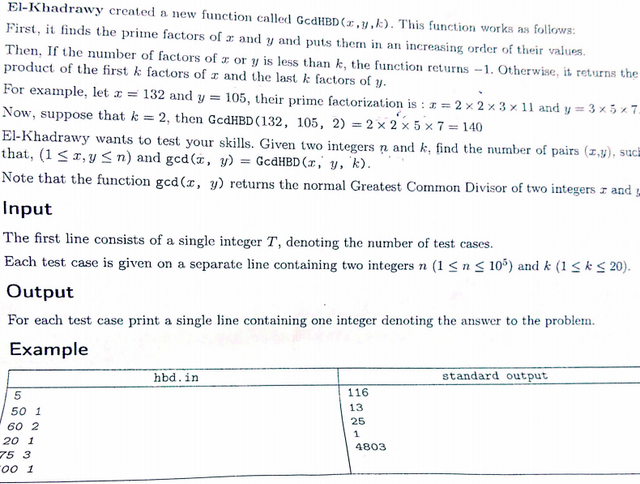
remove repeated lines
→ Обратите внимание
→ Трансляции
→ Лидеры (рейтинг)
| № | Пользователь | Рейтинг |
|---|---|---|
| 1 | jiangly | 3810 |
| 2 | Benq | 3676 |
| 3 | Kevin114514 | 3655 |
| 4 | maroonrk | 3463 |
| 5 | strapple | 3447 |
| 6 | Um_nik | 3387 |
| 7 | heuristica | 3322 |
| 8 | turmax | 3317 |
| 9 | tourist | 3307 |
| 10 | jiangbowen | 3291 |
| Страны | Города | Организации | Всё → |
→ Лидеры (вклад)
| № | Пользователь | Вклад |
|---|---|---|
| 1 | Qingyu | 156 |
| 2 | nik_exists | 150 |
| 2 | maspy | 150 |
| 4 | Um_nik | 141 |
| 5 | Errichto | 139 |
| 6 | adamant | 137 |
| 7 | AmShZ | 135 |
| 8 | BledDest | 132 |
| 9 | maroonrk | 131 |
| 10 | qwexd | 129 |
→ Найти пользователя
→ Прямой эфир


Codeforces (c) Copyright 2010-2026 Михаил Мирзаянов
Соревнования по программированию 2.0
Время на сервере: 24.09.2026 11:42:47 (g2).
Десктопная версия, переключиться на мобильную.
При поддержке


$$$gcd(x,y)$$$ equals to the multiplication of all the common factors between $$$x$$$ and $$$y$$$.
$$$gcdHBD(x,y)$$$ equals to the multiplication of the first $$$k$$$ factors of $$$x$$$ and the last $$$k$$$ factors of $$$y$$$ .
so $$$gcd(x,y)$$$ = $$$gcdHBD(x,y)$$$ iff the first $$$k$$$ factors of $$$x$$$ are common factors in $$$y$$$ and the last $$$k$$$ factors of $$$y$$$ are common in $$$x$$$.
so $$$x$$$ and $$$y$$$ should have at least $$$2k$$$ factors.
now let's get the maximum value of $$$k$$$ in the worst case: $$$gcd(x,y)$$$ <= $$$n$$$ and $$$n \lt =10^5$$$ in the worst case all the factors will be equals to $$$2$$$. so $$$k$$$ <= $$$log2(10^5)/2$$$ , $$$k$$$ <= $$$8$$$.
so if $$$k$$$ > $$$8$$$ the answer is $$$0$$$.
so what to do if $$$k$$$ <= $$$8$$$ ?
for each integer $$$x$$$ $$$[1,n]$$$
1- get it's factors.
2- remove the first $$$k$$$ factors from it ( that are common in $$$x$$$ and $$$y$$$ )
3- backtrack in these remaning factors to get the last $$$k$$$ factors ( that are common in $$$x$$$ and $$$y$$$ ).
4- make another backtrack to get another factors that are not in $$$x$$$ so can't affect the $$$gcd$$$ ( on primes from $$$2$$$ to $$$r$$$ where $$$r$$$ is the lowest factor in $$$y$$$ )
code : https://ideone.com/61h70N
Amazing solution, I worked on another approach which seems like it's more optimizable somehow. It works as follows:
"bad" factors ensures that besides $$$g$$$, there are no extra common factors between $$$x$$$, and $$$y$$$.
Intuitively, it seems the third backtracking does a lot of repeated work for many $$$x$$$, so this is where I see the improvement.
I haven't been able to prove the complexity, but it passes my trivial stress test.
https://ideone.com/4lgcAd
I think we have the same approach with different implementation way