Блог пользователя ironman7453

Автор ironman7453, история, 11 лет назад, По-английски

I found the following problem here.

f(x, n) = x21 + x22 + x23 + ... + x2n

Example: f(2, 10) mod 1000000007 = 180974681

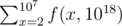
Calculate mod 1000000007.
We know that abc mod p = mod p.

The period of the sequence 2n mod 1000000006 is φ(1000000006) = 500000002.

The period is too large to calculate the sum. Help please?

  • Проголосовать: нравится
  • +14
  • Проголосовать: не нравится

»
11 лет назад, скрыть # |
 
Проголосовать: нравится +16 Проголосовать: не нравится

Let q = 5·108 + 3 and p = 2q + 1.

As 1018 = 1999999992(q - 1) + 16 we have

f(x, 1018) = (x2 + x4 + ... + x2q - 2)·1999999992 + x2 + ... + x216 =  - 1·1999999992 + x2 + ... + x216.

We used the fact that 2 is a primitive root modulo q and that

So we just have to compute 107·16 values which should be fine.

  • »
    »
    11 лет назад, скрыть # ^ |
     
    Проголосовать: нравится -8 Проголосовать: не нравится

    Unfortunately I am not getting the correct answer using this approach. I am getting the answer 224649977, which is incorrect. Here is my code:

    import java.io.*;
    import java.util.*;
    import java.math.*;
    
    public class sol {
        public static long mod = 1000000007L;
        public static long phi = 1000000006L;
        public static BigInteger MOD = new BigInteger("1000000007");
        public static BigInteger PHI = new BigInteger("1000000006");
        public static BigInteger a2 = new BigInteger("2");
        public static BigInteger b = new BigInteger("22"); // -1999999992 mod 1000000007
        public static ArrayList<BigInteger> pow = new ArrayList<BigInteger>();
        public static void main(String[] args) throws IOException {
    	double start = System.currentTimeMillis();
            long p = 2L;
            for (int i = 1; i <= 16; i++) {
                pow.add(BigInteger.valueOf(p));
                p *= 2L;
            }
            //System.out.println(pow);
            long res = 0L;
            for (long x = 2L; x <= 10000000L; x++) {
                if (x % 100000 == 0) System.out.println(x / 100000);
                long t = g(x);
                res += x;
                res %= mod;
            }
            if (res < 0) {
                res += mod;
            }
            System.out.println(res);
            double end = System.currentTimeMillis();
    	System.out.println("Time elapsed : " + ((end - start) / 1000d) + " seconds");
        }
    
        public static long g(long x) {
            BigInteger X = BigInteger.valueOf(x);
            BigInteger sum = BigInteger.valueOf(0);
            for (BigInteger p : pow) {
                sum = sum.add(X.modPow(p, MOD));
            }
            sum = sum.add(b);
            sum = sum.mod(MOD);
            return sum.longValue();
        }
    }
    
    • »
      »
      »
      11 лет назад, скрыть # ^ |
       
      Проголосовать: нравится +3 Проголосовать: не нравится

      I guess you have a bug here:
      Try instead of:

      res += x;
      

      put

      res += t;
      

      Well, and we don't have to use BigIntegers. We can compute those powers by simple squaring the previous one. The answer can be returned in ~1 second if we implement this in an efficient way.

      • »
        »
        »
        »
        11 лет назад, скрыть # ^ |
         
        Проголосовать: нравится 0 Проголосовать: не нравится

        Ohh, -_- What a silly mistake. I implemented using long. I thought I had overflow error. Sorry. Thanks again.

        • »
          »
          »
          »
          »
          11 лет назад, скрыть # ^ |
          ← Rev. 4  
          Проголосовать: нравится +3 Проголосовать: не нравится

          I calculated 1k + 2k + ... + nk using Faulhaber's formula for k = 21, 22, ..., 216, but it still takes 1 minute. How can I improve it?

          EDIT: Ok, I made significant improvement. Now it runs in 3.85 seconds. How can I make it faster? Below is my code:

          import java.io.*;
          import java.util.*;
          import java.math.*;
          
          public class sol {
              public static long mod = 1000000007L;
              public static void main(String[] args) throws IOException {
                  double start = System.currentTimeMillis();
                  long N = 10000000L;
                  long res = 21L * N;
                  for (long n = 2L; n <= N; n++) {
                      res += f(n);
                      res %= mod;
                  }
                  System.out.println(res);
                  double end = System.currentTimeMillis();
          	System.out.println("Time elapsed : " + ((end - start) / 1000d) + " seconds");
              }
          
              public static long f(long n) {
                  long t = n * n % mod;
                  long s = t;
                  for (int i = 1; i < 16; i++) {
                      t = t * t % mod;
                      s += t;
                      s %= mod;
                  }
                  if (s < 0) {
                      s += mod;
                  }
                  return s;
              }
          }