


Fenwick Tree in 5 minutes
Fenwick tree is a dynamic prefix sums array. You can:
- Add values to elements in $$$O(\log N)$$$
- Get prefix sum in $$$O(\log N)$$$
Structure
Fenwick tree is a single array. Each element $$$i$$$ has sum of elements on some range. Each range ends in its element, but they have different sizes.
Here's how the segments look for each element:

See a pattern? Sizes of ranges go like $$$1, 2, 1, 4, 1, 2, 1, 8, \dots$$$
How do we get size of range for element $$$i$$$?
So each element in fenwick array will keep the sum of its segment. Initially the array is filled with zeroes.
Adding Values
What happens when you add $$$x$$$ to element at position $$$i$$$? You need to increment $$${tre}[i]$$$ by $$$x$$$. But also, you need to update other ranges that contain this position. How do we find them?
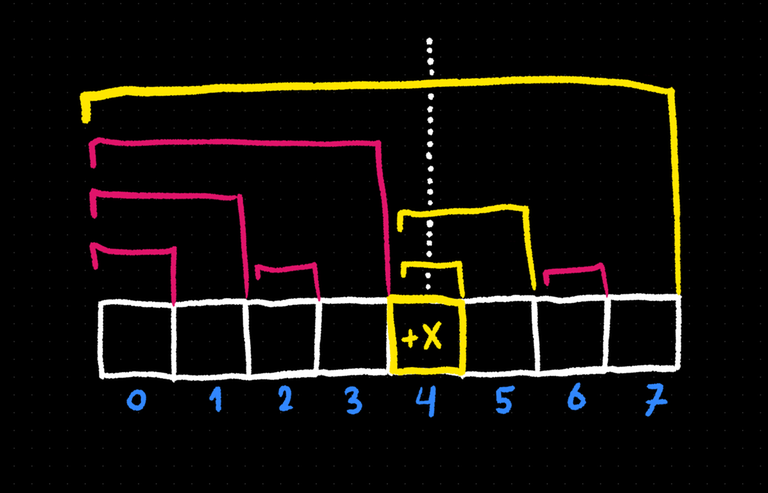
To find such index we'll use some binary magic. Try to figure this out for yourself.
Getting Prefix Sum
To get prefix sum of first $$$i$$$ elements, we'll start at position $$$i-1$$$. We'll take the sum on the range for that index, and jump to the next index.
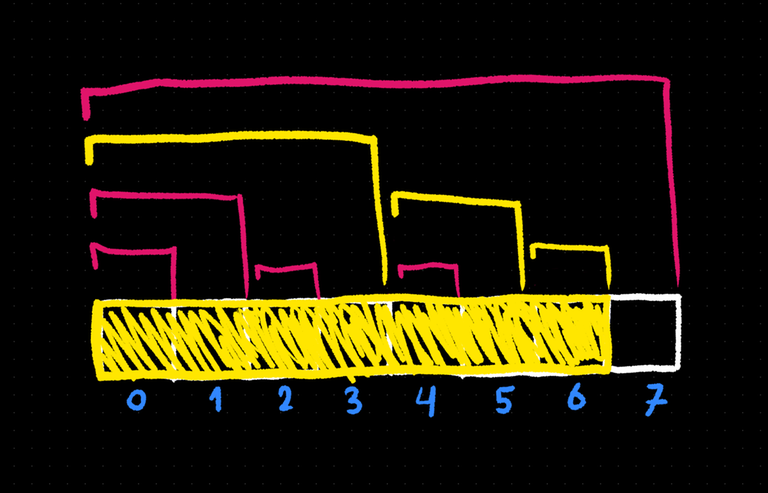
To do that, we simply subtract the range size. But, there is a cleaner solution, using bitwise magic again.
Time Complexity
As i said at the start, time complexity for both operations is $$$O(\log N)$$$. Why?
- For addition, every iteration turns one bit into a one. So number of iterations is at most number of bits, which is $$$O(\log N)$$$.
- For sum, every iteration increases the size of the segment of ones. So number of iterations is also at most number of bits. $$$O(\log N)$$$
Full Code
const int MAXN = 200005;
struct fenwick
{
int tre[MAXN];
fenwick() {}
inline void clear(int n)
{
for(int i = 0; i < n; i++)
{
tre[i] = 0;
}
}
inline void add(int i, int x)
{
    for(; i < MAXN; i |= (i+1))
    {
        tre[i] += x;
    }
}
inline int sum(int r)
{
r--;
int res = 0;
for(; r >= 0; r = (r & (r+1))-1)
{
res += tre[r];
}
return res;
}
};
Conclusion
Fenwick tree is used to keep a dynamic prefix sums array with every operation being $$$O(\log N)$$$.


Auto comment: topic has been updated by Jajceslav (previous revision, new revision, compare).
Auto comment: topic has been updated by Jajceslav (previous revision, new revision, compare).
"Segment trees are far more versatile, but the implementation for fenwick tree is much simpler and faster."
True, but the implementation for iterative segtree is is also very concise.
Here is mine:
Fenwick trees are also pretty cool :)
For add function, I use i+=i&-i, and for the sum function I use r-=r&-r. Much simpler as its the same thing for both just with direction changing.
You should add time complexity for creating a fenwick tree too.
orz blog tysm, can u do smth abt binary search tree later or segment tree