


→ Обратите внимание
→ Лидеры (рейтинг)
| № | Пользователь | Рейтинг |
|---|---|---|
| 1 | Benq | 3857 |
| 2 | jiangly | 3810 |
| 3 | maroonrk | 3534 |
| 4 | tourist | 3528 |
| 5 | Kevin114514 | 3510 |
| 6 | turmax | 3411 |
| 7 | Um_nik | 3387 |
| 8 | Radewoosh | 3367 |
| 9 | heuristica | 3322 |
| 10 | strapple | 3317 |
| Страны | Города | Организации | Всё → |
→ Лидеры (вклад)
| № | Пользователь | Вклад |
|---|---|---|
| 1 | Qingyu | 158 |
| 2 | maspy | 150 |
| 3 | Um_nik | 146 |
| 4 | Errichto | 139 |
| 5 | adamant | 136 |
| 6 | maroonrk | 134 |
| 7 | DNR | 133 |
| 8 | Dominater069 | 131 |
| 9 | Proof_by_QED | 130 |
| 9 | AmShZ | 130 |
→ Найти пользователя
→ Прямой эфир




Codeforces (c) Copyright 2010-2026 Михаил Мирзаянов
Соревнования по программированию 2.0
Время на сервере: 03.09.2026 14:36:57 (g2).
Десктопная версия, переключиться на мобильную.
При поддержке


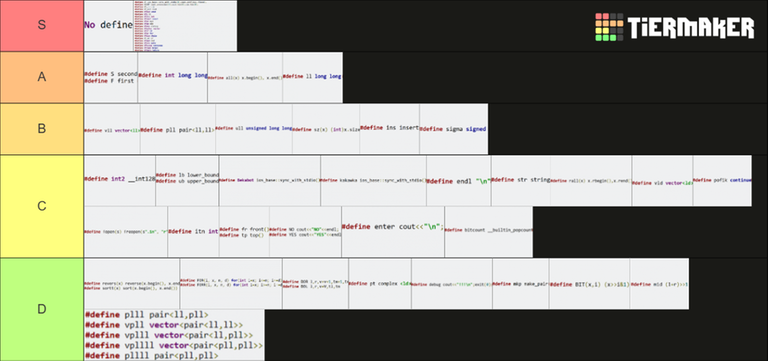
#define int long longis definitely S tier+1 TLE
Actually define int long long doesnt make your code slower in any way , it just makes memory more. I guess thats because of compiler optimizations.
then, +1 MLE.
On some computer that doesn't support 64bit they emulate that behavior with 32bit integers which costs way more CPU cycles.
Can you please stop spreading misinformation so confidently?
idiv(emitted for the integer operations/and%in C++) is significantly slower than 32-bitidivon x86-64 (a >= 2x difference in latency on some microarchitectures (32 bit latency table vs 64 bit latency table)).addandxorthat don't have a difference in latency between their 32 and 64 bit scalar versions).You might be right I am not an expert on the topic. Its just for me those points didnt mattered in the practice. Usually when I submit with define int long long i just get more memory and runtime stays roughly same.
As an example i used the last contest's C, my tight n^2logn solution (which got TLE with sets and got AC with priority_queues) ran even faster by 100ms when I used define int long long (it is probably faster because servers are overloaded in contests). I dont know if it is a special case but I really didnt cherry picked it , and this has been my experience with define int long long generally. I would really like to know if there is a case where define int long long makes the runtime significantly worse (excluding the case where memory becomes too high and causes TLE).
here are the submissions I mentioned:
https://codeforces.me/contest/2222/submission/372495229
https://codeforces.me/contest/2222/submission/372618056
actually I tried the same with F , and it was slower by roughyl 200ms so I think you are right:
https://codeforces.me/contest/2222/submission/372619351
https://codeforces.me/contest/2222/submission/372619285
Here are some code snippets that you can run in custom invocation (use g++ 20) where uncommenting
#define int int64_tmakes a huge difference in runtime (courtesy gpt, im too lazy):itn = int , sigma = signed and int = long long is 100% S+ tier
This is 100% S+.
#define ll long long#define all(x) x.begin(), x.end()#define rall(x) x.rbegin(), x.rend()#define yes cout << "YES\n"#define no cout << "NO\n"#define debug cout << "Debug\n"#define int23_t long longdefinitely traumatized me...S+ defines which i use
D all the rest
#define pofik continuein c tier is crazyye i think it should in D tier
I do #define long long long because I like being chaotic
S+ tier
really stops it from being anything but a disappointment
in interactive problems
should use endl it flushes automatically and personally $$$'\n'$$$ is more suitable for typing
I'd go for
#define ll intI generally prefer doing something like
using ll = long long;(actually,using ll = int64_t;) instead of#define ll long longbecause the later option doesn't admit functional style casts (in other words,long long (val)does not compile). Also, semantically speaking it is much nicer.Additionally,
#define int long longis quite evil from my perspective and I only use it in worst case scenarios. The reason why I don't appreciate it is that it admits laziness in terms of reasoning about types. Reasoning about types can often make you understand the problem and your solution better, which means that fixing bugs later on becomes easier (that is to say, if you have a better understanding, your code becomes more "maintainable" for you).I used to have this:
The usage is like:
And you can use the same thing to iterate backwards by using RFOR. As it was not really a good practice, I stopped using it lol.
The best one for me was:
vlector vulector is craze and rhyme
The defines in this submission should be on S++ tier.
bruh what the hell is this code crazy hehe
What the hell
Когда-то мне нравились такие)
Wait, no body uses typedef?
i use
how can i get this ranking/order that you made,
when i click cf's image it has very few pixels.
when i click the tierlist link it is not ranked
One of my define:
#define fast_io ios_base::sync_with_stdio(false); cin.tie(0);#define pb push_back