


Hello,
I created a project for training and analyzing your performance during contests: cp-trainer.com. I believe it has some unique features non-existent in competitive platforms and can provide as a more sensible tool for training, especially for more experienced users, who have participated already in a bunch of contests. Below I will briefly discuss its functionalities:
Problem recommender
In this section, we will discuss the heuristics used for problem recommender, the system offers for the user 10 problems with the highest value of this heuristics. First we need to introduce a couple of metrics:
- get_dict_accuracy — Dictionary of form (tag : average number of submissions to accept problem with this tag during contest)
- ratings_average_time_diffs — Dictionary of form (rating : average time in seconds to solve the problem with this rating during contest)
- tags_average_time_diffs — Dictionary of form (rating : average time in seconds to solve the problem with this tag during contest)
- problem_freshness — calculates the freshness of a problem by taking the contest in which it occurred (values normalized between 0,5 and 1)
- compute_tag_rating — Dictionary of form (tag : predicted user rating for this specific tag)
Now it is time to describe the heuristics:
- Let $$$r$$$ denote the rating of a problem, and let $$$\mathcal{T}$$$ denote the set of tags of that problem.
- Let
$$$A := \texttt{tags_average_time_diffs},\qquad Q := \texttt{get_dict_accuracy}$$$ be the dictionaries defined in the metrics. - Define:
$$$\sigma_{[L,H]} := \frac{H-L}{6},\qquad w_{[L,H]}(R,v) := \exp\!\left(-\tfrac{1}{2}\left(\frac{v-R}{\sigma_{[L,H]}}\right)^{2}\right).$$$ Where L and H are 800 and 3500 respectively (rating bounds). - Let
$$$\mathcal{M} := \texttt{compute_tag_rating}$$$ be the dictionary defined in the metrics, and let$$$\mathcal{T}' := \mathcal{T}\cap\operatorname{dom}(\mathcal{M}).$$$ Then define $$$h_1$$$ as$$$h_1 = \begin{cases} \dfrac{1}{|\mathcal{T}'|}\displaystyle\sum\limits_{t\in\mathcal{T}'} w_{[L,H]}\big(\mathcal{M}[t]+G,\, r\big), & \text{if } \mathcal{T}'\neq\varnothing, \\[1.2em] w_{[L,H]}(R_{\max}+G,\, r), & \text{otherwise.} \end{cases}$$$ where G is a constant set to 200 and $$$R_{\max}$$$ is the maximum rating of the user. - Let
$$$T := \mathcal{T}\cap\operatorname{dom}(A),\qquad S := \mathcal{T}\cap\operatorname{dom}(Q).$$$ - Let
$$$m_T := \frac{1}{|T|}\sum_{t\in T} A[t].$$$ For dictionary $$$A$$$ define normalization bounds$$$(\ell_A,u_A) := \big(\min_{x\in\operatorname{dom}(A)} A[x],\ \max_{x\in\operatorname{dom}(A)} A[x]\big).$$$ - Let
$$$m_Q := \frac{1}{|S|}\sum_{t\in S} Q[t],$$$ and for $$$Q$$$ define normalization bounds$$$(\ell_Q,u_Q) := \big(\min_{x\in\operatorname{dom}(Q)} Q[x],\ \max_{x\in\operatorname{dom}(Q)} Q[x]\big).$$$ - Define a normalization function (for $$$a\neq b$$$ and $$$x\in[a,b]$$$):
$$$\mathrm{Normalize}(a,b,x) := \frac{x-a}{\,b-a\,}.$$$ - Define
$$$h_2 := \mathrm{Normalize}(\ell_A,u_A,m_T),\qquad h_3 := \mathrm{Normalize}(\ell_Q,u_Q,m_Q).$$$
Intuitively, we want to recommend problems that reflect the user’s weaknesses, so $$$h_2$$$ and $$$h_3$$$ are larger, when problems with those tags typically take the user more time, and when the number of submissions required before accepting a problem for those tags is higher. - Let $$$c$$$ be the contest id. Define $$$\mathrm{fresh}(c)$$$ as the metric problem_freshness.
- Define
$$$\kappa(c) := \begin{cases} 0.4, & \text{if the contest is Div.4}, \\[4pt] 0.7, & \text{if the contest is Div.3}, \\[4pt] 1, & \text{otherwise.} \end{cases}$$$ Div.3 and Div.4 problems are treated as less interesting. - Let $$$U\sim\mathrm{Uniform}(0.3,0.4)$$$ be a random component introduced to diversify recommendations.
- The final heuristic $$$H(r)$$$ is
$$$H(r) = \kappa(c)\Big( h_1 * 3 + h_2 + h_3 + U + 1.5\cdot\mathrm{fresh}(c)\Big).$$$ (We add $$$1.5\cdot\mathrm{fresh}(c)$$$ rather than multiplying by $$$\mathrm{fresh}(c)$$$ to avoid giving very fresh contests an overwhelming advantage.)
Contest training picker
In this module user can choose one of the 4 contest modes depending on what he wants to train:
- Speed — The contest consists of 5 easy-medium problems. The problems' ratings are based on expected time to solve them i.e. the system expects the user to solve them in about 2000 seconds. The tags are chosen based on the weaknesses of the user (i.e. the tags, which take him more time on average). The idea is that the contestant during such contests will practice solving faster the easy-medium problems, so that will allow him to have more time on the harder ones.
- Hard problems — The contest consists of 3 problems from the list of 10 in the problem recommender.
- Weaknesses — The contest consists of 3 problems, all from topics, that user is weak at. The rough idea was to take the random 3 out of 5 tags with lowest value from the metrics compute_tag_rating and for each tag take the problem with rating as close as predicted rating on that tag + 200. In practice some comparator was used, which also takes into the account the freshness of the contest the problem comes from. (We rather want to solve the problems from fresher contests, since problems have changed a lot in past years).
- Upsolve — The contest consists of 3 problems, that contestant didn't solve during past contests (he either had rejected submissions on them or they were the first problems during the contest that he didn't get accepted) with the best quality according to problem recommender.
Note : The duration of the contest (never greater than 5 hours) is calculated automatically based on the expected time to solve the problems (user should solve some problems to not get discouraged, but of course not all). The contestant can limit this time by setting the max duration (he doesn't have to), however it is not very recommended, because the system will just discard some problems from the problemset to adjust the time.
User stats
In this mode there are presented plots, that show mainly different statistics about user's performance during the contests. Below we can see the sample statistic showing my average time to solve a problem during contest with specific tag. One can deduce that I have the most difficulties with problems including probabilities and schedules. What's important to mention is that it would be best to include this based on rating, however the data is too small, so we rely on the fact that it will average out across all ratings. Unfortunately with tags like flows, where problems mainly don't have low ratings, this won't be consistent, however with the most popular tags this should show good trends.
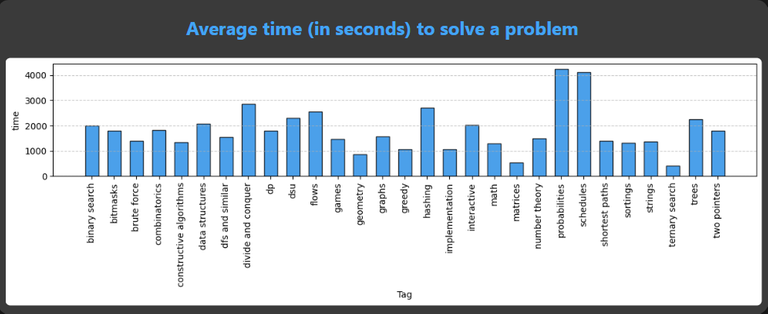
The included interesting statistics are (the time unit is measured in seconds):
- Average time to solve a problem by rating
- Average time to solve a problem by tag
- Average nr of attemps to solve a problem with specific tag — This is especially useful when we want to check on which problems we have difficulties with implementation/handling edge cases.
- User rating on a tag — For each tag we calculate the rating of a user on this type of problems based on the performance during contests.
- Average rating of solved/unsolved problems — This shows, what is the average highest solved problem during contests and the average lowest rating of the problem that user did not solve. It is useful e.g. when you want to check the rating of the average problem you're stuck on during contests and helps you to pick problems with appropriate rating during practice.
- Average rating change, when doing problems in order/not in order — This calculates the average rating change, when you do either the problems in order or not (e.g. you skip some problems etc.).
Compare yourself against the others
The idea for this section was to analyze for the user, how much he is worse than the average contestant with some specific rank. It was realized by taking statistics for 40 average random users across that specific rank , who participated in >=50 contests and were registered min 3 years ago. (that should approximate well the random user with some rank.)

We can see in the picture above the sample statistic of me compared with the average grandmaster, telling, what is the average time difference (in seconds) of solving problem with some specifing rating. As we can see, I am slower on the most of the ratings, especially on the hardest ones.
The included statistics are almost the same like in the user stats section, here we just take difference between the contestant and average user of some rank.
Note: The green bars mean there is contestant's advantage, red otherwise.
Summary
The goal was to create the tool which will analyze user's performance during live contests and then based on that recommends adequate problems for training. Most apps focus on the stats of the user also during practice, which in my opinion doesn't provide the best insight e.g. because outside the contest you have unlimited time and also you can look at editorial.
If you find any bugs, please let me know and I will try to fix them as soon as possible. Any constructive criticism is also appreciated. Thanks for checking out the platform.


Auto comment: topic has been updated by michao (previous revision, new revision, compare).
I have tested it already, and it works pretty cool. I recommend checking it out if you haven't done so.
internal server error
Could you tell me, when this occurred (everything seems fine when I checked)?
frontend side is working , but when we send any req to backend , it shows internal server error , no matter what you do ,adding handle , or get problem of xyz rating
for your username it does work (at least when I send request), did you check for your username or the other one (If it doesn't work for you, maybe it's location thing, I will try to check it) ? I saw for one username it didn't work (probably because he wrote only 1 contest, I am investigating it currently)
I will note that some devices add a space at the end when autocompleting information. It might be a good idea to strip surrounding spacing (assuming usernames can't start/end with a space?).
Yeah, for now they can't have space at the end. I will fix so it will work nonetheless (As I understand it works normally in U.S. , when there are no spaces, I see you are from Florida?)
pretty cool tho
I've experienced a downfall,hope to get back using it.
Hi,thanks for this CP trainer website it is really helpful and motivating to train. Could you add a "Toggle All Tags" button in the problem recommendations?
What advantages do you see in this feature besides quickly checking what types of problems the app suggests? Basically, I wouldn’t recommend toggling the tags most of the time.
I got it,not necessary, sorry for the suggestion
No problem, I was just wondering how adding this feature would help.
For example: I want to improve dp or data structures , i can toggle off all the tags and select dp and ds
Ah, you mean in the filter panel. I thought you meant on the page where the 10 problems are already chosen (so toggling to show the tags). That makes sense — I’ll try to implement it in my free time (probably by tomorrow).
Yes,that's what i meant.Thanks a lot for implementing it:)
Done.
500 error every time i type and submit my username
Because you have 1 contest and you solved 1 problem where there are not rating and tags for it yet, your account has essentialy zero data, I will release an update soon, so at least problem recommender and training contest picker won't get 500 error for you, however because you have so little contests, don't expect it to recommend very good problems.
Seems quite similar to MyCPTrainer :)
There is an issue with the url. Correct one is mycptrainer.com
Can you stop polluting the comment section naivedyam_mishra?
Everyone knows you're a cheater (source). I think you've contributed enough, so maybe you don't need to add more by posting a website you made slightly earlier than the author of this blog.
If you could add the feature to filter by years like year after 2022 or year>=2022, 2023 etc or maybe dates it would be great and also it would be great if these filters (date, divs) were present in training contest picker too
You mean to filter problems (in problem recommender and training contest picker) from some date range?
yes, generally newer problems are better so a lowerbound will suffice as in CF gyms.
The problem recommender and training contest picker are already implemented so they tend to favor newer problems (by giving the problems from fresher contests the greater value of heuristics). However date filter could be useful regardless (e.g. to make sure that only fresh problems appear or if user wants to train on older tasks). I will implement it in the near future.
Very Helpful
Does cp-trainer include unrated contests (for example, when a user’s rating is outside the participation range) in the performance analysis, or are only rated contests considered?
For now only rated contests are taken into account. It's a good idea to maybe make an option in the filters to include unrated contests, I will try to implement it in the near future.
Cool stuff! Pretty good insights for a profile. I got to know I am not as good as I think I am in binary search problems.
One thing I’m missing: stats don’t update when I grind problems via the Contest Picker. Right now the dashboard seems to reflect only live CF contests, so even if I practice a lot my “speed/weakness” metrics don’t move. (If I'm wrong there should be progress bar that differentiates progress stats and live contest stats)
Could you add an option to include timed practice sessions (from Contest Picker) in the analytics? A simple toggle would be perfect:
1. Option to include practice (Contest Picker) in stats — off by default
You could restrict this to runs done within only for Contest Picker sets. This one change would make the tool great for people trying to beat their previous stats between CF rounds.
Also showing what stat bars represent will help people who didn't read this blog and using the tool.
Basically in order to include "training contest picker" contests, I would have to probably include some database to store them somewhere (Or is there other way?). It would also be reasonable then to make login authentication and connect the user with cf account (and consequently change UI and interface) . Also it is not very clear, how to calculate some metrics (like user rating on tag, which is quite complicated), I have idea how to adjust it, but I would have to also test it empirically.
For now I will add the option of including virtual contests and non-official ones in the near future for users, that have small number of official contests. Moreover during some important metrics only the suffix of contests is considered, so when you will practice and take part in standard/virtual contests, asssuming you achieve good results, the metrics will update accordingly, so harder problems will be recommended to you.
Regarding the stat bars, I agree they could be described better, I will try to make clearer descriptions inside the app soon.
Thanks for this helpful website. Can you add an option to automatically finish the contest when all the problems are completed?
you can just restart the contest if you finish it before the time (this will forward you to the page with "choosing contest type" panel) or you mean something else?
No. I mean exactly that. But i thought if it told u itself. Just a suggestion.
one problem is there that it is picking that problem also which are solved in problem recommender due to them being in div1 while I solved them in div2 contest problemset, can u fix this bug
I will investigate it and fix it soon.
cool. 1 question. can you explain what the images, especially green and red bars mean in the comparison tab? also, what does the y axis values actually mean? maybe add legends to all the charts in this page. i'm struggling a bit to understand what they exactly mean (though i have a rough idea). otherwise, great job!
Basically when you have metrics in normal user stats it is just the difference between the values of the metrics between the contestant and average user of some rank (green bars mean the advantage is the contestant's, red otherwise), e.g. in "average time difference by rating" green bar of absolute value y on r rating means we solve on average the problem with rating r faster by y seconds than some user with considered rank. This is best to analyze for ranks quite near ours for most metrics. (e.g. for "average time difference by tag" because we just take the average time not considering the rating, it's not the best especially when the ranks are far away from each other. We could introduce here some weights, e.g. add some exponential weights for rating, but it would lose numerical sense.)
cool thing.
It reminds me of atcoder problems
the time thing is broken when trying to create a contest. it will be any random time no matter what I type in minutes
I will investigate it soon. This week should be uploaded most of the updates requested by users/ fixed bugs.
I checked different contests (by typing your username), and the time is always less than or equal to the limit you set. The value you enter represents the upper bound of the contest duration (in case you thought it was the exact duration).
Oh, my bad then. I thought it was exact time ...
Cool. Could you add the option for the compare to compare with another user, or set of users in specific rather than only "the average x rating"?
I will add this as the option soon (probably after other updates).
Currently it shows the following ERROR :
Cloudflare Error 525 (SSL handshake failed)
should be fixed.
Yeah, it's working fine now. Thanks!
I'm unable to access it (SSL Handshake failed). Please look into it.
It says SSL Handshake failed when I try to open the website, Any solution?
THANKS