This is a new editorial attempt. Only Two Principles.
Principle 1: Prior Knowledge is Important
Principle 2: Less Text, Even None
Good ExamplesIKEA Furniture Assembly Manual[1](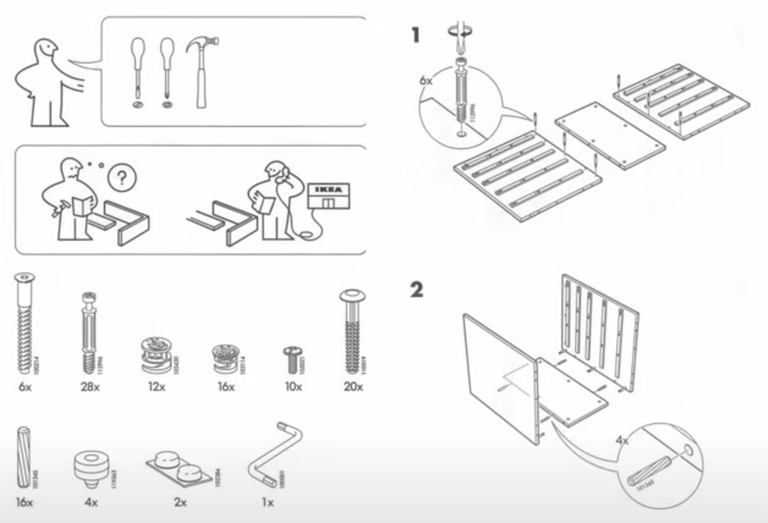 )
)
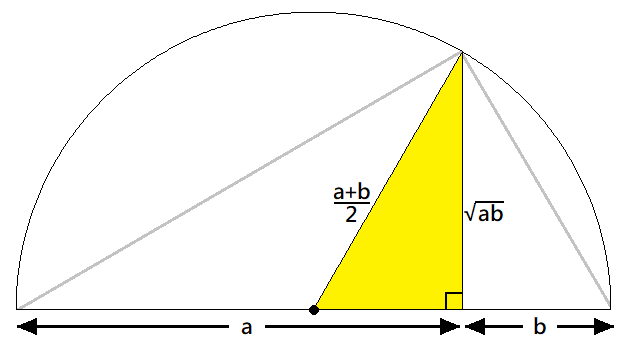
Prove that the arithmetic mean is greater than the geometric mean
1586F (2500)
Prior Knowledge The statement.
What is a directed graph.
What is an $$$x$$$-base number.
Important definition $$$k$$$: in the constructed scheme, the length (number of edges) of the path with the same color must smaller than $$$k$$$.
(Somehow CF doesn't support GIF images, so I can only provide the website address. I hope this can be fixed.)
1896F (2600)
Prior Knowledge The statement.
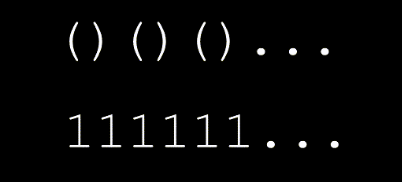
What is a regular (balanced) bracket sequence.
Important definition $$$s$$$: the given binary string in the statement.
Important definition $$$n$$$: the length of $$$s$$$ (which is a bit different from the original statement).
Important definition $$$ans_i$$$: Several regular bracket strings of length $$$n$$$, as your output answer.
2143E (2400)
Prior Knowledge The statement.
What is a regular (balanced) bracket sequence.
Important definition $$$s$$$: the given bracket string in the statement.
Important definition $$$n$$$: the length of $$$s$$$.
Important definition $$$f(s)$$$: The string obtained by flipping the brackets in even indices $$$s$$$ (and keeping the brackets in odd indices unchanged).
Important definition $$$ans$$$: A regular bracket string of length $$$n$$$ — your output answer.
All strings we are talking about are $$$1$$$-indexed.




Looks cool but is it beneficial learning new problems like this? Or should I follow my normal way of thinking on a point for 2 hours trying to figure out the next one before seeing it?
I like the format because I like visuals vs a wall of text.
Suggestions:
Please use videos instead of gifs. I absolutely hate gifs if they are more than 2-3s because you can't pause/forward/rewind them. You have to wait for the whole gif to end in case you miss something. Example: GIF 9 for 1896F (2600) has a lot of moving parts. Ideally, I'd want to focus on one $$$ans_i$$$ at a time, and rewind when I want to focus on another $$$ans_i$$$.
I think this method isn't feasible in CF since we don't have a native video player. It's annoying to click a link to open another tab, come back to open a link in another tab... too much clicking and back and forth. Better alternative: keeping the whole thing in one video, with timestamps for hints.
General: For some people, a visual explanation certainly works better than text. But those gifs are not working, just make a video.
I didn't look at the second problem; the first one was enough for me to hate what you did.
1. You didn't really use "less text". There was a lot of text, but somehow not enough.
2. You introduced $$$c[i][j]$$$ as a DP value, then calculated that DP for some coloring, then noticed that it looks like $$$k$$$-base representation and then just started using it as $$$k$$$-base representation without saying anything. $$$c[i][j]$$$ won't be a $$$k$$$-base representation for a different coloring, so what exactly are you doing here?
3. From that point onward, you are using $$$c[i][j]$$$ as both DP values and $$$k$$$-base representations. I guess it is possible to interpret it correctly, but I would say it is more natural to interpret it incorrectly. Because of your "less text" principle, you are just creating confusion between two interpretations.
4. The GIFs are so slow, you can't pause, you can't look back.
Separate Prior Knowledge stuff is amazing ... It would help many to first learn those topics (if haven't) and give one final attempt!
Hey! I also stumbled upon principle 1 like two weeks ago while studying philosophy of mind at my university! By using deductive reasoning, I feel like have been able to reduce my reliance on intuition and reason structurally which really helps me to see the solution for harder problems(1800-2200 for my level) as well!(Not that this comment would help anyone but I think the principle really helped me)
The addition of prior knowledge would be a great idea. I will finally be able to look at editorials without spoiling the problem