


Set theory
Set
- Collection of objects
- Set objects called
elementsormembers - Set elements can be anything: numbers, words, objects, or other sets.
- Set elements can be a mix of several types.
- Set elements are unique; so the set of
{1,2,2}is the same set of{1,2}. - Set elements are unordered; so the set of
{1,3,2}is the same set of{3,1,2}. - Set is denoted by a capital letter, often italicized as A, B, and so on.
Defining Sets
Restor notation
- It's a way to define a set by listing its elements inside curly braces.
- Can be inconvenient for large sets.
- We can abbreviate large numeric sets that have a clear, unambiguous pattern, like:
{1,2,3, ..., 998, 999, 1000}. - We can use the ellipsis character (
...) to say that this set will continue forever, with its clear, unambiguous pattern, like:{1,2,3,4, ...}or{..., -3,-2,-1,0}or{..., -2,-1,0,1,2, ...}. - The sets with will known fixed elements called: Finite set.
The sets that continue forever are called Infinite sets.
Examples
A =
{1,2,3,4}- B =
{"Ahmed", "Ali", "Osama"} - C =
{{2, "Musa"}, {1, "Mohamed"}} - D =
{1,2,3,...,99,100} - E =
{1,2,3, ...}
Description Notation
- It's a way to define a set by describing its elements within curly braces, like:
{calendar months}. The set description should be objective, not subjective. It means that the description should have the same sets always. So you can't tell that this set is well-defined:
{Great movies}Example
A =
{Numbers devisable by 2}
Special Sets
- They are predefined sets we can use and reference.
Example
- Set with no elements, its called: null set or empty set, and its equal to: {} or $$$\emptyset$$$.
- Set contains every element of interest: It means every element in the context, like:
{all school students}or{all rational numbers}. These sets are called universal set, and it's notated by U. - There are predefined sets for numbers that can be written with a special font Blackboard font. like these:
- $$$\mathbb{R}$$$ =
{real numbers} - $$$\mathbb{Q}$$$ =
{rational numbers} - $$$\mathbb{Z}$$$ =
{integers} - $$$\mathbb{N}$$$ =
{natural numbers} - $$$\mathbb{C}$$$ =
{complex numbers}
- $$$\mathbb{R}$$$ =
Set Builder Notaion
- A most formal way to define sets of numbers, in textbooks and papers. Example: A = {x: $$$x \in \mathbb{N}$$$, x < 6}
- In the Exmaple: A = {x: $$$x \in \mathbb{N}$$$, x < 6}. The Set A mean:
xis a member of a set A as long asxmeets the specified conditionsx<6& $$$x \in \mathbb{N}$$$. - If we will describe set A in this example: A = {x: $$$x \in \mathbb{N}$$$, x < 6}. We can say: A is the set of all x such that x is in $$$\mathbb{N}$$$ and
x<6. - We can write the previous example like this also: A = {x| $$$x \in \mathbb{N}$$$, x < 6}. You can note that we just replace
:with|. - The comma
,between conditions, is meansAND. This meansxshould achieve allANDconditions. - You can see that $$$x \in \mathbb{N}$$$ is define the type of the
x(natural number). And this is good, because you will be confused if this condition does not exist, and there is just this onex<6; Then you will think that ifxmeans just integers or includes natural or irrational numbers, or what?! - We can shortcut this expression: A = {x: $$$x \in \mathbb{N}$$$, x < 6} with: A = {$$$x \in \mathbb{N}$$$: x < 6}. This type of expression is common, You first express the type of the
x, and then the conditions. So both expressions are ok. and express the same set. - We can use a Describe notaion with Set Builder Notation like this: B = {x: x is square of an integer, x <= 100}
- We can use the
ORkeyword, within conditions like this: B = {$$$x \in \mathbb{N}$$$: x is the square of an integerORx <= 10}
Interval notation
- Is a compact way to reference or define sets of continuous Real numbers $$$\mathbb{R}$$$ over a range.
Is a shortened form of Set Builder Notation for continuous ranges of real numbers $$$\mathbb{R}$$$
Example
- W = {$$$x \in \mathbb{R}$$$: 0<=x<=1}
- Set W equal also to: W =
[0, 1]. - For the Interval notation, we use
[for the inclusive beginning and(for exclusive beginning. And]for the inclusive end and)for exclusive end.
Examples
- W = {$$$x \in \mathbb{R}$$$: 0<=x<=1} =
[0, 1]- W = {$$$x \in \mathbb{R}$$$: 0<x<=1} =
(0, 1]- W = {$$$x \in \mathbb{R}$$$: 0<=x<1} =
[0, 1)- W = {$$$x \in \mathbb{R}$$$: 0<x<1} =
(0, 1)
Cardinality
- Number of elements in a set.
- Its notation is $$$|S|$$$, and this means: the cardinality of set S.
- There are several ways to represent the cardinality, like:
- $$$|A|$$$
- n( A )
- # A
Example:
- A =
{3,4,5,6}, So $$$|A|$$$ = 4. - B =
{1,2,3,4,3}, So $$$|B|$$$ = 4. You can remember that there are no duplicate things in a set, even there are we ignore them, because duplicating things in a set is meaningless. - null set = {}, So $$$|\emptyset|$$$ = |{}| = 0. and this is Identity. [Identity: Is a statement that's always true.].
- C = {{}}. So $$$|C|$$$ = 1; The set contains null set, and this is 1 thing in the set.
Set Membership:
- You can say that 3 is an element of Set A by this notation: $$$3 \in A$$$
- If you reverse it like this: $$$A \ni 3$$$. It will mean: Set A contains 3.
- You can use $$$3 \notin A$$$ for saying: element 3 is not a member of set A.
- You can use $$$A \not\ni 3$$$ for saying: Set A not contains element 3.
Venn Diagrams
- It's a diagrammatic depiction of sets.
- Universal set U in Venn diagrams denoted by a large rectangle, and you can label the rectangle with U in the top left corner.
- Sets are usually drawn as ovals or circles within the rectangle. And you can put the set values inside the oval, or shade its interior.
- When you shade the inside of an oval of set B. Then the Venn diagram represents the set of B.
- When the hole of the rectangle is shaded, including the ovals inside it, we represent the U set ( universal set ).
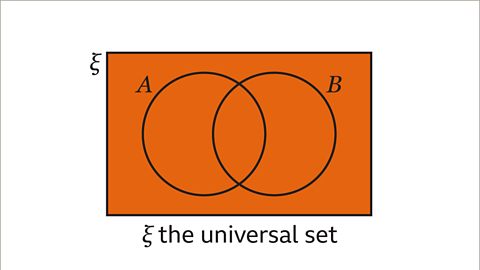
- When You shade nothing, so the Venn Diagram represents $$$\emptyset$$$.
- And there is more about shading, we will discover it during this blog post.
Subset
- If we have two sets A and B. And every element in set A is also in the set B. Then set A is a Subset of set B.
The subset symbole is: $$$ \subseteq$$$. So to say A is a subset of B we write: $$$A \subseteq B$$$.
Example
- A =
{1, 2, 3, 4} - B =
{1, 2, 3, 4, 5, 6}You can note that every element in set A is exist in set B, So $$$A \subseteq B$$$.
- A =
- To draw the subset in Venn Diagram for this relation: $$$A \subseteq B$$$. You will draw the A oval inside the B oval.

- If we have set A and set B and both of them have the same element, so each of them is a subset of each other. So $$$A \subseteq B$$$
AND$$$B \subseteq A$$$. - For subset we have three identities:
- Any set is a subset of itself: $$$A \subseteq A$$$
- $$$\emptyset$$$ =
{}is a subset of every set. Every set is a subset of U ( universal set )
Proper subset
In the relation of subset like this: $$$A \subseteq B$$$. Set B can be equal to A exactly.
- But with Proper subset ( $$$A \subset B$$$ ): Set B must contain all elements in Set A and more.
- From this you can know that if: $$$A \subset B$$$, Then: $$$|A| \lt |B|$$$
- You can realize that the set can't be a Proper subset of itself: $$$A \nsubset A$$$.
Superset
- The opisit of subset is superset, And this is its notation: $$$\supseteq$$$. So if $$$A \subseteq B$$$, then $$$B \supseteq A$$$.
- For superset we have three identities:
- Any set is a superset of itself: $$$A \supseteq A$$$
- Every set is a superset of the $$$\emptyset$$$.
- U ( universal set ) is the superset of every set.
Proper Superset
- In the relation of superset like this: $$$B \supseteq A$$$. Set B can be equal to A exactly.
- But with Proper superset ( $$$B \supset A$$$ ): Set B must contain all things in Set A and more.
- From this you can know that if: $$$B \supset A$$$, Then: $$$|A| \lt |B|$$$
- You can realize that the set can't be a Proper superset of itself: $$$A \nsupset A$$$.
Set Operations
- Used to create new sets from existing sets.
- We can perform set Operations on sets to get different sets. It's similar to arithmetic operations, when you operate on 2 numbers to get a new number.
Unary set Operations
- Unary set operations operate on one set.
Absolute Complement operation
- Produce a new set of elements that exist in the universal set U and do not exist in the set S.
- A set of elements that are not in the set.
- There are several ways to notation the Set complement:
- $$$A^c$$$
- $$$A'$$$
- $$$\overline{A}$$$
Example
- If universal set U = {1, 2, 3, 4, 5}
- And A = {1, 2, 5}
- Then $$$A^c$$$ = {3, 4}
- Always $$$|A|$$$ + |$$$A^c$$$| = $$$|U|$$$
- We can describe the complement of a set with a Set builder notation like this: $$$A^c$$$ = {x: $$$x \in U$$$, $$$x \notin A$$$}
- 2 Identities here:
- $$$\emptyset ^ c$$$ = $$${} ^ c$$$ = U
- $$$U ^ c $$$ = $$$\emptyset$$$ = $$${}$$$
Power Set
$$$\mathcal{P}(S)$$$ Produce a new set of all subsets of S.
Example
- S = {a, b}
- $$$\mathcal{P}(S) =$$$ {{}, {a}, {b}, {a, b}}.
- You may ask yourself how many subsets of a set with a large size, for sure I will not list them, so there is a mathematical rule for that, write?!
- That's true there is one: $$$|\mathcal{P}(S)| = 2 ^ {|S|}$$$
How do we get the math rule for calculating the number of subsets of a set?
- Basically, think of each element of the set, that it has 2 choices: (exist in a subset or not).
- So, if you imagine a set with 3 elements. Each of one have 2 choices, so the number of subsets you can create from them is $$$2 \cdot 2 \cdot 2 = 2^3$$$
- If you ask yourself why we used the multiply rule, you can imagine that the first element has two choices, and every one of the 2 choices of the 1st element has 2 choices for the 2nd element, and so on.
- So now our math rule is clear: the number of subsets of a set = $$$2 ^ {the length of the set (set cardinality)}$$$
- $$$|\mathcal{P}(S)| = 2 ^ {|S|}$$$
Binary Set Operations
- Binary set operations operate on 2 sets.
Intersection Operation
It produces a new set with common elements between 2 sets.
Example
- If you have set A = {a, b, c, d}. and set B = {a, f, c, d}.
- Then $$$A \cap B$$$ ( Set A intersect Set B. ) = {a, c, d}.
- So from the previous example we can see that: $$$A \cap B$$$ = {x: $$$x \in A$$$, $$$x \in B$$$}
- This is Venn Diagram for the Intersection operation:
- Some Idintities about Intersection operation:
- $$$A \cap A$$$ = A
- $$$A \cap \emptyset$$$ = $$$\emptyset$$$
- $$$A \cap U$$$ = A
- The intersection operation obeys the commutative law: $$$A \cap B$$$ = $$$B \cap A$$$.
- Disjoint sets are sets that have no elements in common; So if Sets A, and B are Disjoint sets, then $$$A \cap B$$$ = {} = $$$\emptyset$$$.
- The intersection set operation is analogous to the logical operator
AND; because an element must belong to both sets. In fact, very casually, $$$A \cap B$$$ is sometimes called: AANDB
Union Operation
- It produces a new set of all elements of the 2 sets.
- We can describe it by the Set Builder notation like this: $$$A \cup B$$$ = {x: $$$x \in A$$$
or$$$x \in B$$$}. We can translate this to: $$$A \cup B$$$ = All x values that belong to set A or set B. - The union operation obeys the commutative law: $$$A \cup B$$$ = $$$B \cup A$$$.
- Some Idintities about union operation:
- $$$A \cup A$$$ = A
- $$$A \cup \emptyset$$$ = A
- $$$A \cup U$$$ = U
- This is Venn Diagram for the Union operation:

- The Union set operation is analogous to the logical operator
OR, because an element must belong to one of the sets. In fact, very casually, $$$A \cup B$$$ is sometimes called: AORB
Inclusion-Exclusion Principle
The inclusion-exclusion principle is about how to make the union operation accurate.
You may ask: Why does the union operation need a special principle?
The reason is that the union operation, as we know, it includes all the elements of the sets in the operands of the operation.
So You might think $$$|A \cup B| = |A| + |B|$$$, but that only works when there's no overlap. You miss a small thing.
If sets A and B overlap, then both include the shared elements. So when you add $$$|A| + |B|$$$, the intersection $$$|A \cap B|$$$ is counted twice. To correct this, subtract it once.
So now you need to subtract $$$|A \cap B|$$$ from your last equation, so our new equation is: $$$|A \cup B| = |A|+|B|-|A \cap B|$$$
Note: Your previous one ( $$$|A \cup B| = |A| + |B|$$$ ) work, But just in case there no overlaps, but our new one ( $$$|A \cup B| = |A|+|B|-|A \cap B|$$$ ) can work for all situations.
Inclusive-exclusive principle It's called like that, because we include the sizes of the sets and then exclude the sizes of their overlaps (intersections) to avoid overcounting.
Now let us move on to a more complex question: $$$|A \cup B \cup C| = ??$$$
Here we need to know the cardinality of A union B union C. Let's take it easy, step by step:
- Firstly: we know that the union of 2 sets is a set with the elements of the 2 sets. What if there is a third one?
— Exactly, it includes all elements from A, B, and C.
— So $$$|A \cup B \cup C| = |A| + |B| + |C|$$$. At this point, you might be thinking: "Wait, isn't that wrong?" — and yes, it is!.
— That's incorrect, because any shared elements are counted twice.
— But now, there's something new:
— Now consider elements shared by all three sets: ( $$$A \cap B \cap C$$$ ).
— Can you estimate how many times these shared elements are counted?
- Secondly: how can we determine how often elements from intersections are counted when we sum all set cardinalities?!
— The basic way is to determine 2 things:
— 1st thing: Is the sum operation occurring, like here: $$$|A| + |B| + |C|$$$.
— 2nd thing: Is that intersection set, like this: $$$A \cap B \cap C$$$
— Then, for each time one of the sets that the intersection is part of it, and summed in the sum operation, you will count it as a +1 if it is added and -1 if it is subtracted.
— So in our example A, B, and C the intersection is a part of them and is added once; so your counter = 1; — So elements in this set $$$A \cap B \cap C$$$ calculated triple times. And this is logical, because $$$A \cap B \cap C$$$ produces the common elements between the 3 sets that are added.
— Now we discovered that: We added the intersection between every 2 sets twice, and between every 3 sets 3 times.
— From this, we realize an important fact: when we calculate the cardinalities of n sets and sum them up, any element that appears in multiple sets will be counted multiple times, exactly as the number of sets that contain it. (Let's call this: 1st rule)
- Thirdly If you have a common element between 3 sets, then it's also common between each combination of 2 sets of them.
— This is logical and can be generalized by saying that: If a number of elements is common between N sets, then it's common between each intersection of $$$N-1$$$ sets of them, until $$$N-(N-1)$$$. (Let's call this: 2nd rule)
Now let's try to solve the problem: $$$|A \cup B \cup C| = ??$$$
Firstly: I will sum the cardinalities of all sets: $$$|A| + |B| + |C|$$$
Now I know I sum every intersection of 2 sets twice and every 3 sets triple. And I need to sum them just once.
Secondly: I will subtract the cardinality of every intersection of 2 sets; So the equation is: $$$|A| + |B| + |C| - |A \cap B| - |A \cap C| - |B \cap C|$$$ Now I get rid of the repetition of every intersection of 2 sets, but what about the repetition in the intersection of the 3 sets?
It might seem right to subtract it three times, but that's incorrect, because our equation improved to $$$|A| + |B| + |C| - |A \cap B| - |A \cap C| - |B \cap A|$$$ That changes the total count of triple intersections.
If you remember our 2nd rule you find the following:
- we need our last equation: $$$|A| + |B| + |C| - |A \cap B| - |A \cap C| - |B \cap A|$$$.
- we need to determine the sets that are included our set $$$|A \cap B \cap C|$$$ from the equation: And they are A, B, and C, $$$|A \cap B|$$$, $$$|A \cap C|$$$ and $$$|B \cap A|$$$.
- let's apply our 2nd rule:
- So let's start by that I sumed $$$|A \cap B \cap C|$$$ zero times.
- The sets A, B and C cardinalities are summd so now I can say I sum $$$|A \cap B \cap C|$$$ 3 times.
- Then the sets $$$|A \cap B|$$$, $$$|A \cap C|$$$ and $$$|B \cap A|$$$ are subtracted so I will subtract 3, so I can say that I sumed $$$|A \cap B \cap C|$$$ zero times again. So the subtraction of all pairwise intersections cancels out the three-way intersection, which we must add back.
Thirdly: I will add every intersection of 3 sets. So now our equation is: $$$|A| + |B| + |C| - |A \cap B| - |A \cap C| - |B \cap A| + |A \cap B \cap C|$$$. And this is the right answer, because now we are sure that every element in all sets is summed just once.
Ok, it looks good, but long work, is there something faster?!
Of course, I will share it with you, while solving: $$$|A \cup B \cup C \cup D| = ??$$$
The mathematician discovered that there is a clear pattern:
- When we sum the cardinality of the sets of a union equation, we are always adding twice every 2 sets' intersection of the N-sets that are summed.
- And when we subtract them, we always accidentally remove every 3 sets' intersection of the N-sets that are summed.
- And when we add them, we are always adding twice every 4 sets' intersections of the N-sets that are summed.
- And so on, until you get rid of the repetition of the intersection of all sets in the union operation.
- So our equation answer is: $$$|A \cup B \cup C \cup D| = |A| + |B| + |C| + |D| - |A \cap B| - |A \cap C| - |A \cap D| - |B \cap C| - |B \cap D| - |C \cap D| + |A \cap B \cap C| + |A \cap B \cap D| + |A \cap C \cap D| + |B \cap C \cap D| - |A \cap B \cap C \cap D|$$$
Here’s a simple trick to make this easier:
If you aren't sure about getting all the intersections of N-sets. You can easily use the combination rule.
For example, you are not sure that you get all the 2 sets' intersections of 4 sets:
- You basicley use the combination rule: nCr = $$$ n! / ((n-r)! * r!)$$$.
- So 4C2 = $$$ 4! / ((4-2)! * 2!) = 4! / (2! * 2!) = (4 * 3 * 2!) / (2! * 2!) = (4 * 3) / 2! = 12/2 = 6$$$
- So now you see you should have 6 intersections of 2 sets of the 4 sets.
What about subtracting: If I have a universal set and I want to get its cardinality and subtract it from the cardinality of $$$|A \cup B \cup C \cup D|$$$
Basically, you can do one of these 2 choices:
1st choice: you can get the cardinality of $$$|A \cup B \cup C \cup D|$$$ like you learn and subtract it from the $$$|U|$$$.
2nd choice: you can subtract them one by one and apply the rule but reverse it, look like this: $$$|U| - |A| - |B| - |C| - |D| + |A \cap B| + |A \cap C| + |A \cap D| + |B \cap C| + |B \cap D| + |C \cap D| - |A \cap B \cap C| - |A \cap B \cap D| - |A \cap C \cap D| - |B \cap C \cap D| + |A \cap B \cap C \cap D|$$$
You can see we can reverse the Inclusion and Exclusion rule so we start with subtracting, then adding, then subtracting again, and so on.
Relative complement
- It produces a new set with all elements of a set, say A, and not in another set, say B.
The Relative complement operator is:
\Or-. So we can say: A-B = A\B.Example
If A = {1, 2, 3, 4}, B = {2, 3, 5, 6}
Then $$$A \setminus B$$$ = A not in B = **Relative complement of B with respect to A = Relative complement of A in B ={1, 4}
And we also can say that: $$$B \setminus A$$$ = B relative complement A ={5, 6}.
- Here is a Venn Diagram for the relation: $$$A \setminus B$$$

- You can relise the Set builder notation for relative complement for expression like this: $$$A \setminus B$$$ = {x: $$$x \in A$$$, $$$x \notin B$$$}.
- When you take a complement against the set U ( universal set ), So this is the Absolute complement ( $$$S ^ c$$$ ).
- Whan you take a complement against another set like B, So this is a Relative complement, like: $$$A \setminus B$$$.
- The relative complement operator does not obey the commutative law: $$$A \setminus B \ne B \setminus A$$$
- Try to imagine this truly relation: $$$A \setminus B$$$ = $$$A \cap B ^ c$$$.
Symmetric difference
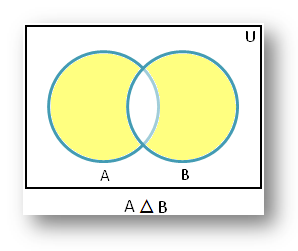
- It produces a new set with all elements of the operand sets except the common elements.
- The operation operator can be $$$\oplus$$$ ( XOR ) or $$$\bigtriangleup$$$ ( Delta ). So $$$A \bigtriangleup B$$$ = $$$A \oplus B$$$.
- The set builder notation for **Symetric difference for this expression: $$$A \bigtriangleup B$$$ = {x: $$$x \in A \oplus x \in B$$$.
- The XOR ( $$$\oplus$$$ ): is a logical operation like
ANDandOR, and it's mean that one of the condition should betrue, and the other isfalse, It not accept that both betruetofalse. - Below is the Venn diagram for Symmetric Difference to relise this truly expression: $$$A \oplus B$$$ = $$$(A \cup B) \setminus (A \cap B)$$$ = $$$(A \setminus B) \cup (B \setminus A)$$$
- Symmetric Difference obey the commutative law: $$$A \oplus B = B \oplus A$$$.
Cartesian Product (Cross Product)
- Produce a new set of combinations of each element in the left operand set with each element in the right operand set, in parentheses or angle-brackets, and the elements separated with a comma.
- Produce a new set of ordered pairs of the elements of the 2 sets in the operation.
The Cross Product operator is: $$$\times$$$
Example
- A = {a, b}
- B = {1, 2, 3}
- $$$A \times B$$$ = {(a, 1), (b, 1), (a, 2), (b, 2), (a, 3), (b, 3)}
- We can express it by Set Builder Notation: $$$A \times B$$$ = {(x,y): $$$x \in A$$$, $$$y \in B$$$}.
- Note: {1, 2} is not an ordered pair, because a set is not ordered by definition. But this (1, 2) is an ordered pair. So {1, 2} $$$=$$$ {2, 1}, But $$$(1, 2) \ne (2, 1)$$$.
- $$$|A \times B| = |A| \cdot |B|$$$: The cardinality of cross product of 2 sets = The product of the cardinalities of both sets.
- The cross product does not obay commutative law: $$$A \times B \ne B \times A$$$.
- The cross product cardinalies obay commutative law: $$$|A \times B| = |B \times A|$$$.
More than 2 operands (2 Sets)
When you try to manipulate more than 2 sets, there are some rules you need to know to be sure that you get the right set that you need.
Associative Law
- You can use Union operation between multiple sets in any order; because Union operationI obays the Associative Law, Like: $$$A \cup B \cup C = B \cup C \cup A$$$
- It's the same for Intersection operation: $$$A \cap B \cap C = B \cap C \cap A$$$
- It's the same for Symmetric difference operation: $$$A \oplus B \oplus C = B \oplus C \oplus A$$$. I will share the Venn diagram for this operation because it may confuse you:
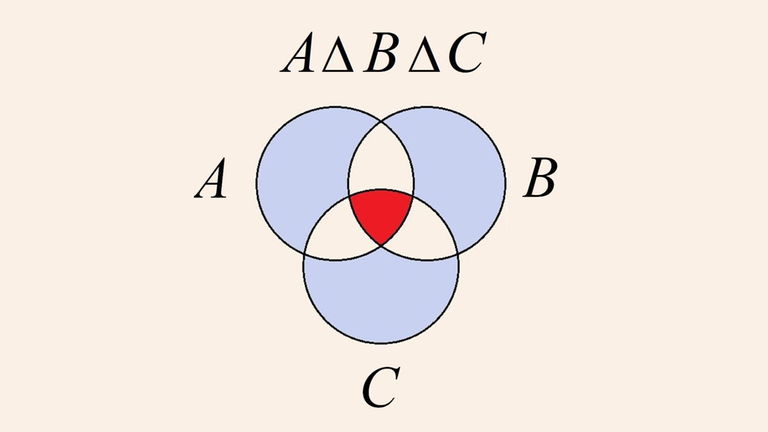
I expect that maybe you are confused about the shaded center area, maybe you think that all intersecting areas should not be shaded, but let me clarify this for you: - First: you can choose any 2 of the sets and make the Symmetric difference operation between them. You will get 2 shaded sets, except for the intersection area between them.
- Secondly, you will make the Symmetric difference operation between the result of the last step and the remaining set. You will recognised that the center area is being not shaded in the last result, but in the same time it's a part of the set that not involve to the previous operation, so now the elements of the center area is belong to the remainder set and not belong to the last result, so it can be shaded respected for the Symmetric difference operation.
Distributive Law
- When we use the Union and intersection operations, we should pay attention to the order of operations, which can be established with parentheses.
- We need the pay attention to the order; because the mix of these operations does not respect the Associative Law. So $$$(A \cup B) \cap C \ne A \cup (B \cap C)$$$
- Expression with union and intersection obay the Distributive Law, So:
- $$$A \cup (B \cap C) = (A \cup B) \cap (A \cup C)$$$. It's like $a \cdot (b + c) = (a \cdot b) + (a \cdot c).
- $$$A \cap (B \cup C) = (A \cap B) \cup (A \cap C)$$$.
- It's called Distributive because what is outside parentheses is distributed inside them.
De Morgan's Laws
- They are Identities about sets complemetns:
The complement of the union = The intersection of complements.
Example
$$$(A \cup B) ^ c = A ^ c \cap B ^ c$$$.
We can translate this rule to logical words:NOT( AORB ) =NOTAANDNOTB. — The complement of the intersection = The union of the complements.Example:
$$$(A \cap B) ^ c = A ^ c \cup B ^ c$$$.
We can translate this rule to logical words:NOT( AANDB ) =NOTAORNOTB.


 Комментарии (0)


