


I received an email about an event.
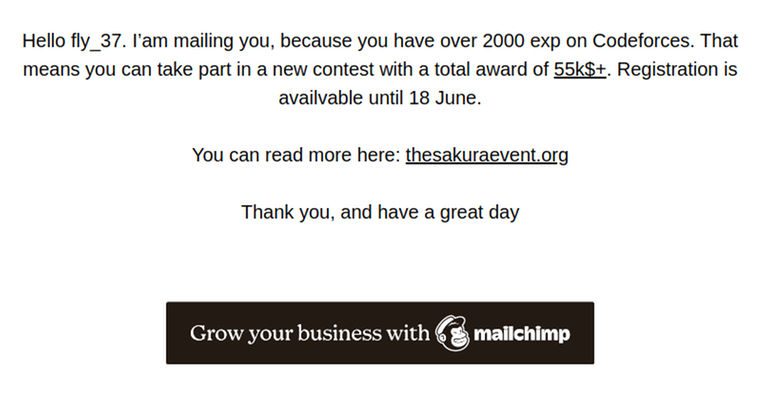
Be careful not to provide your password there! This is a scam. After clicking on register page you are NOT getting redirected to codeforces!
| # | User | Rating |
|---|---|---|
| 1 | Benq | 3676 |
| 2 | jiangly | 3670 |
| 3 | Kevin114514 | 3657 |
| 4 | maroonrk | 3355 |
| 5 | Um_nik | 3353 |
| 6 | squareOf105 | 3346 |
| 7 | tourist | 3343 |
| 8 | strapple | 3324 |
| 9 | heuristica | 3322 |
| 10 | jiangbowen | 3291 |
| # | User | Contrib. |
|---|---|---|
| 1 | Qingyu | 158 |
| 2 | nik_exists | 150 |
| 2 | maspy | 150 |
| 4 | AmShZ | 143 |
| 4 | Um_nik | 143 |
| 6 | Errichto | 139 |
| 7 | adamant | 137 |
| 8 | BledDest | 134 |
| 9 | maroonrk | 133 |
| 10 | qwexd | 130 |
I received an email about an event.
Be careful not to provide your password there! This is a scam. After clicking on register page you are NOT getting redirected to codeforces!
Hello!
Some time ago I created a problem for local programming competition. Unfortunately it turned out that I had incomplete proof of one lemma, that I can not show even to this day.
Lemma: Given an increasing array of $$$N$$$ arbitrary large numbers we define its cost as sum of lengths of all non-trivial, maximal arithmetic progressions starting at the first element. The cost of any array is $$$\mathcal{O}(N\log{N})$$$.
For example for array $$$[0, 2, 3, 4, 6, 8, 9]$$$ — the total cost is $$$|[0, 2, 4, 6, 8]| + |[0, 3, 6, 9]| + |[0, 4, 8]| + |[0, 6]| + |[0, 8]| + |[0, 9]| = 5 + 4 + 3 + 2 + 2 + 2= 18$$$.
It is easy to see, that if we simply take $$$N$$$ consecutive natural numbers we get $$$\mathcal{O}(N\log{N})$$$ cost, but I was not able to prove that this is the worst case scenario.
Best complexity I can show is $$$\mathcal{o}(N^2)$$$, but still far from the goal...
Can anyone show if the lemma is true or false?


