Misère Nim: Just like normal Nim game but last player to make a move loses
What are the equivalent grundy values for this game?
My Thought Process
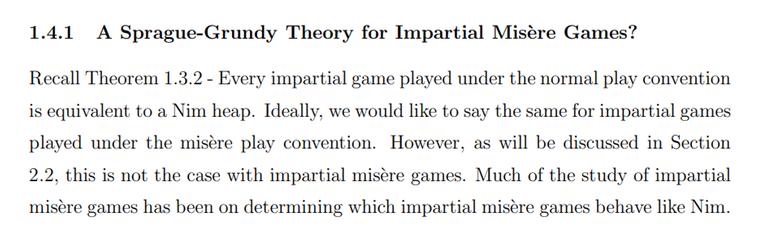
UPD: Found a relevant thesis on it.
TLDR


Misère Nim: Just like normal Nim game but last player to make a move loses
What are the equivalent grundy values for this game?
UPD: Found a relevant thesis on it.
| # | User | Rating |
|---|---|---|
| 1 | Benq | 3676 |
| 2 | Kevin114514 | 3659 |
| 3 | jiangly | 3640 |
| 4 | turmax | 3450 |
| 5 | tourist | 3382 |
| 6 | strapple | 3360 |
| 7 | Um_nik | 3354 |
| 8 | squareOf105 | 3348 |
| 9 | maroonrk | 3312 |
| 10 | idontwannadothis…e | 3191 |
| # | User | Contrib. |
|---|---|---|
| 1 | Qingyu | 156 |
| 2 | nik_exists | 151 |
| 3 | maspy | 149 |
| 4 | AmShZ | 145 |
| 5 | Um_nik | 143 |
| 6 | Errichto | 139 |
| 7 | BledDest | 136 |
| 8 | adamant | 135 |
| 9 | maroonrk | 132 |
| 10 | cry | 130 |