


Overlooking the captivating blend of myriads of vernal hues, Arkady the painter lays out a long, long canvas.
Arkady has a sufficiently large amount of paint of three colours: cyan, magenta, and yellow. On the one-dimensional canvas split into n consecutive segments, each segment needs to be painted in one of the colours.
Arkady has already painted some (possibly none or all) segments and passes the paintbrush to you. You are to determine whether there are at least two ways of colouring all the unpainted segments so that no two adjacent segments are of the same colour. Two ways are considered different if and only if a segment is painted in different colours in them.
The first line contains a single positive integer n (1 ≤ n ≤ 100) — the length of the canvas.
The second line contains a string s of n characters, the i-th of which is either 'C' (denoting a segment painted in cyan), 'M' (denoting one painted in magenta), 'Y' (one painted in yellow), or '?' (an unpainted one).
If there are at least two different ways of painting, output "Yes"; otherwise output "No" (both without quotes).
You can print each character in any case (upper or lower).
5
CY??Y
Yes
5
C?C?Y
Yes
5
?CYC?
Yes
5
C??MM
No
3
MMY
No
For the first example, there are exactly two different ways of colouring: CYCMY and CYMCY.
For the second example, there are also exactly two different ways of colouring: CMCMY and CYCMY.
For the third example, there are four ways of colouring: MCYCM, MCYCY, YCYCM, and YCYCY.
For the fourth example, no matter how the unpainted segments are coloured, the existing magenta segments will prevent the painting from satisfying the requirements. The similar is true for the fifth example.
There is a rectangular grid of n rows of m initially-white cells each.
Arkady performed a certain number (possibly zero) of operations on it. In the i-th operation, a non-empty subset of rows Ri and a non-empty subset of columns Ci are chosen. For each row r in Ri and each column c in Ci, the intersection of row r and column c is coloured black.
There's another constraint: a row or a column can only be chosen at most once among all operations. In other words, it means that no pair of (i, j) (i < j) exists such that  or
 , where
 denotes intersection of sets, and
 denotes the empty set.
You are to determine whether a valid sequence of operations exists that produces a given final grid.
The first line contains two space-separated integers n and m (1 ≤ n, m ≤ 50) — the number of rows and columns of the grid, respectively.
Each of the following n lines contains a string of m characters, each being either '.' (denoting a white cell) or '#' (denoting a black cell), representing the desired setup.
If the given grid can be achieved by any valid sequence of operations, output "Yes"; otherwise output "No" (both without quotes).
You can print each character in any case (upper or lower).
5 8
.#.#..#.
.....#..
.#.#..#.
#.#....#
.....#..
Yes
5 5
..#..
..#..
#####
..#..
..#..
No
5 9
........#
#........
..##.#...
.......#.
....#.#.#
No
For the first example, the desired setup can be produced by 3 operations, as is shown below.

For the second example, the desired setup cannot be produced, since in order to colour the center row, the third row and all columns must be selected in one operation, but after that no column can be selected again, hence it won't be possible to colour the other cells in the center column.
An atom of element X can exist in n distinct states with energies E1 < E2 < ... < En. Arkady wants to build a laser on this element, using a three-level scheme. Here is a simplified description of the scheme.
Three distinct states i, j and k are selected, where i < j < k. After that the following process happens:
- initially the atom is in the state i,
- we spend Ek - Ei energy to put the atom in the state k,
- the atom emits a photon with useful energy Ek - Ej and changes its state to the state j,
- the atom spontaneously changes its state to the state i, losing energy Ej - Ei,
- the process repeats from step 1.
Let's define the energy conversion efficiency as  , i. e. the ration between the useful energy of the photon and spent energy.
Due to some limitations, Arkady can only choose such three states that Ek - Ei ≤ U.
Help Arkady to find such the maximum possible energy conversion efficiency within the above constraints.
The first line contains two integers n and U (3 ≤ n ≤ 105, 1 ≤ U ≤ 109) — the number of states and the maximum possible difference between Ek and Ei.
The second line contains a sequence of integers E1, E2, ..., En (1 ≤ E1 < E2... < En ≤ 109). It is guaranteed that all Ei are given in increasing order.
If it is not possible to choose three states that satisfy all constraints, print -1.
Otherwise, print one real number η — the maximum possible energy conversion efficiency. Your answer is considered correct its absolute or relative error does not exceed 10 - 9.
Formally, let your answer be a, and the jury's answer be b. Your answer is considered correct if 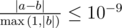 .
4 4
1 3 5 7
0.5
10 8
10 13 15 16 17 19 20 22 24 25
0.875
3 1
2 5 10
-1
In the first example choose states 1, 2 and 3, so that the energy conversion efficiency becomes equal to 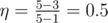 .
In the second example choose states 4, 5 and 9, so that the energy conversion efficiency becomes equal to  .
Arkady decides to observe a river for n consecutive days. The river's water level on each day is equal to some real value.
Arkady goes to the riverside each day and makes a mark on the side of the channel at the height of the water level, but if it coincides with a mark made before, no new mark is created. The water does not wash the marks away. Arkady writes down the number of marks strictly above the water level each day, on the i-th day this value is equal to mi.
Define di as the number of marks strictly under the water level on the i-th day. You are to find out the minimum possible sum of di over all days. There are no marks on the channel before the first day.
The first line contains a single positive integer n (1 ≤ n ≤ 105) — the number of days.
The second line contains n space-separated integers m1, m2, ..., mn (0 ≤ mi < i) — the number of marks strictly above the water on each day.
Output one single integer — the minimum possible sum of the number of marks strictly below the water level among all days.
6
0 1 0 3 0 2
6
5
0 1 2 1 2
1
5
0 1 1 2 2
0
In the first example, the following figure shows an optimal case.

Note that on day 3, a new mark should be created because if not, there cannot be 3 marks above water on day 4. The total number of marks underwater is 0 + 0 + 2 + 0 + 3 + 1 = 6.
In the second example, the following figure shows an optimal case.

Arkady the air traffic controller is now working with n planes in the air. All planes move along a straight coordinate axis with Arkady's station being at point 0 on it. The i-th plane, small enough to be represented by a point, currently has a coordinate of xi and is moving with speed vi. It's guaranteed that xi·vi < 0, i.e., all planes are moving towards the station.
Occasionally, the planes are affected by winds. With a wind of speed vwind (not necessarily positive or integral), the speed of the i-th plane becomes vi + vwind.
According to weather report, the current wind has a steady speed falling inside the range [ - w, w] (inclusive), but the exact value cannot be measured accurately since this value is rather small — smaller than the absolute value of speed of any plane.
Each plane should contact Arkady at the exact moment it passes above his station. And you are to help Arkady count the number of pairs of planes (i, j) (i < j) there are such that there is a possible value of wind speed, under which planes i and j contact Arkady at the same moment. This value needn't be the same across different pairs.
The wind speed is the same for all planes. You may assume that the wind has a steady speed and lasts arbitrarily long.
The first line contains two integers n and w (1 ≤ n ≤ 100 000, 0 ≤ w < 105) — the number of planes and the maximum wind speed.
The i-th of the next n lines contains two integers xi and vi (1 ≤ |xi| ≤ 105, w + 1 ≤ |vi| ≤ 105, xi·vi < 0) — the initial position and speed of the i-th plane.
Planes are pairwise distinct, that is, no pair of (i, j) (i < j) exists such that both xi = xj and vi = vj.
Output a single integer — the number of unordered pairs of planes that can contact Arkady at the same moment.
5 1
-3 2
-3 3
-1 2
1 -3
3 -5
3
6 1
-3 2
-2 2
-1 2
1 -2
2 -2
3 -2
9
In the first example, the following 3 pairs of planes satisfy the requirements:
- (2, 5) passes the station at time 3 / 4 with vwind = 1;
- (3, 4) passes the station at time 2 / 5 with vwind = 1 / 2;
- (3, 5) passes the station at time 4 / 7 with vwind = - 1 / 4.
In the second example, each of the 3 planes with negative coordinates can form a valid pair with each of the other 3, totaling 9 pairs.