"Night gathers, and now my watch begins. It shall not end until my death. I shall take no wife, hold no lands, father no children. I shall wear no crowns and win no glory. I shall live and die at my post. I am the sword in the darkness. I am the watcher on the walls. I am the shield that guards the realms of men. I pledge my life and honor to the Night's Watch, for this night and all the nights to come." — The Night's Watch oath.
With that begins the watch of Jon Snow. He is assigned the task to support the stewards.
This time he has n stewards with him whom he has to provide support. Each steward has his own strength. Jon Snow likes to support a steward only if there exists at least one steward who has strength strictly less than him and at least one steward who has strength strictly greater than him.
Can you find how many stewards will Jon support?
First line consists of a single integer n (1 ≤ n ≤ 105) — the number of stewards with Jon Snow.
Second line consists of n space separated integers a1, a2, ..., an (0 ≤ ai ≤ 109) representing the values assigned to the stewards.
Output a single integer representing the number of stewards which Jon will feed.
2
1 5
0
3
1 2 5
1
In the first sample, Jon Snow cannot support steward with strength 1 because there is no steward with strength less than 1 and he cannot support steward with strength 5 because there is no steward with strength greater than 5.
In the second sample, Jon Snow can support steward with strength 2 because there are stewards with strength less than 2 and greater than 2.
Jon fought bravely to rescue the wildlings who were attacked by the white-walkers at Hardhome. On his arrival, Sam tells him that he wants to go to Oldtown to train at the Citadel to become a maester, so he can return and take the deceased Aemon's place as maester of Castle Black. Jon agrees to Sam's proposal and Sam sets off his journey to the Citadel. However becoming a trainee at the Citadel is not a cakewalk and hence the maesters at the Citadel gave Sam a problem to test his eligibility.
Initially Sam has a list with a single element n. Then he has to perform certain operations on this list. In each operation Sam must remove any element x, such that x > 1, from the list and insert at the same position  ,
 , sequentially. He must continue with these operations until all the elements in the list are either 0 or 1.
Now the masters want the total number of 1s in the range l to r (1-indexed). Sam wants to become a maester but unfortunately he cannot solve this problem. Can you help Sam to pass the eligibility test?
The first line contains three integers n, l, r (0 ≤ n < 250, 0 ≤ r - l ≤ 105, r ≥ 1, l ≥ 1) – initial element and the range l to r.
It is guaranteed that r is not greater than the length of the final list.
Output the total number of 1s in the range l to r in the final sequence.
7 2 5
4
10 3 10
5
Consider first example:

Elements on positions from 2-nd to 5-th in list is [1, 1, 1, 1]. The number of ones is 4.
For the second example:

Elements on positions from 3-rd to 10-th in list is [1, 1, 1, 0, 1, 0, 1, 0]. The number of ones is 5.
Jon Snow now has to fight with White Walkers. He has n rangers, each of which has his own strength. Also Jon Snow has his favourite number x. Each ranger can fight with a white walker only if the strength of the white walker equals his strength. He however thinks that his rangers are weak and need to improve. Jon now thinks that if he takes the bitwise XOR of strengths of some of rangers with his favourite number x, he might get soldiers of high strength. So, he decided to do the following operation k times:
- Arrange all the rangers in a straight line in the order of increasing strengths.
- Take the bitwise XOR (is written as
 ) of the strength of each alternate ranger with x and update it's strength.
- The strength of first ranger is updated to
 , i.e. 7.
- The strength of second ranger remains the same, i.e. 7.
- The strength of third ranger is updated to
 , i.e. 11.
- The strength of fourth ranger remains the same, i.e. 11.
- The strength of fifth ranger is updated to
 , i.e. 13.
Now, Jon wants to know the maximum and minimum strength of the rangers after performing the above operations k times. He wants your help for this task. Can you help him?
First line consists of three integers n, k, x (1 ≤ n ≤ 105, 0 ≤ k ≤ 105, 0 ≤ x ≤ 103) — number of rangers Jon has, the number of times Jon will carry out the operation and Jon's favourite number respectively.
Second line consists of n integers representing the strengths of the rangers a1, a2, ..., an (0 ≤ ai ≤ 103).
Output two integers, the maximum and the minimum strength of the rangers after performing the operation k times.
5 1 2
9 7 11 15 5
13 7
2 100000 569
605 986
986 605
Jon Snow is on the lookout for some orbs required to defeat the white walkers. There are k different types of orbs and he needs at least one of each. One orb spawns daily at the base of a Weirwood tree north of the wall. The probability of this orb being of any kind is equal. As the north of wall is full of dangers, he wants to know the minimum number of days he should wait before sending a ranger to collect the orbs such that the probability of him getting at least one of each kind of orb is at least  , where ε < 10 - 7.
To better prepare himself, he wants to know the answer for q different values of pi. Since he is busy designing the battle strategy with Sam, he asks you for your help.
First line consists of two space separated integers k, q (1 ≤ k, q ≤ 1000) — number of different kinds of orbs and number of queries respectively.
Each of the next q lines contain a single integer pi (1 ≤ pi ≤ 1000) — i-th query.
Output q lines. On i-th of them output single integer — answer for i-th query.
1 1
1
1
2 2
1
2
2
2
Sam has been teaching Jon the Game of Stones to sharpen his mind and help him devise a strategy to fight the white walkers. The rules of this game are quite simple:
- The game starts with n piles of stones indexed from 1 to n. The i-th pile contains si stones.
- The players make their moves alternatively. A move is considered as removal of some number of stones from a pile. Removal of 0 stones does not count as a move.
- The player who is unable to make a move loses.
Now Jon believes that he is ready for battle, but Sam does not think so. To prove his argument, Sam suggested that they play a modified version of the game.
In this modified version, no move can be made more than once on a pile. For example, if 4 stones are removed from a pile, 4 stones cannot be removed from that pile again.
Sam sets up the game and makes the first move. Jon believes that Sam is just trying to prevent him from going to battle. Jon wants to know if he can win if both play optimally.
First line consists of a single integer n (1 ≤ n ≤ 106) — the number of piles.
Each of next n lines contains an integer si (1 ≤ si ≤ 60) — the number of stones in i-th pile.
Print a single line containing "YES" (without quotes) if Jon wins, otherwise print "NO" (without quotes)
1
5
NO
2
1
2
YES
In the first case, Sam removes all the stones and Jon loses.
In second case, the following moves are possible by Sam: 
In each of these cases, last move can be made by Jon to win the game as follows: 
Tarly has two different type of items, food boxes and wine barrels. There are f food boxes and w wine barrels. Tarly stores them in various stacks and each stack can consist of either food boxes or wine barrels but not both. The stacks are placed in a line such that no two stacks of food boxes are together and no two stacks of wine barrels are together.
The height of a stack is defined as the number of items in the stack. Two stacks are considered different if either their heights are different or one of them contains food and other contains wine.
Jon Snow doesn't like an arrangement if any stack of wine barrels has height less than or equal to h. What is the probability that Jon Snow will like the arrangement if all arrangement are equiprobably?
Two arrangement of stacks are considered different if exists such i, that i-th stack of one arrangement is different from the i-th stack of the other arrangement.
The first line of input contains three integers f, w, h (0 ≤ f, w, h ≤ 105) — number of food boxes, number of wine barrels and h is as described above. It is guaranteed that he has at least one food box or at least one wine barrel.
Output the probability that Jon Snow will like the arrangement. The probability is of the form  , then you need to output a single integer p·q - 1 mod (109 + 7).
1 1 1
0
1 2 1
666666672
In the first example f = 1, w = 1 and h = 1, there are only two possible arrangement of stacks and Jon Snow doesn't like any of them.
In the second example f = 1, w = 2 and h = 1, there are three arrangements. Jon Snow likes the (1) and (3) arrangement. So the probabilty is  .

Given a rooted tree with n nodes. The Night King removes exactly one node from the tree and all the edges associated with it. Doing this splits the tree and forms a forest. The node which is removed is not a part of the forest.
The root of a tree in the forest is the node in that tree which does not have a parent. We define the strength of the forest as the size of largest tree in forest.
Jon Snow wants to minimize the strength of the forest. To do this he can perform the following operation at most once.
He removes the edge between a node and its parent and inserts a new edge between this node and any other node in forest such that the total number of trees in forest remain same.
For each node v you need to find the minimum value of strength of the forest formed when node v is removed.
The first line of the input contains an integer n (1 ≤ n ≤ 105) — the number of vertices in the tree. Each of the next n lines contains a pair of vertex indices ui and vi (1 ≤ ui, vi ≤ n) where ui is the parent of vi. If ui = 0 then vi is the root.
Print n line each containing a single integer. The i-th of them should be equal to minimum value of strength of forest formed when i-th node is removed and Jon Snow performs the operation described above at most once.
10
0 1
1 2
1 3
1 4
2 5
2 6
3 7
4 8
4 9
5 10
3
4
5
5
5
9
9
9
9
9
2
2 1
0 2
1
1
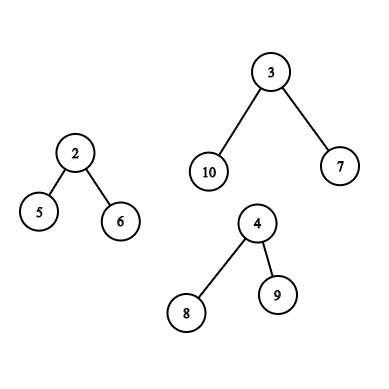
The tree for first test case is depicted below.  When you remove the first node, the tree splits to form the following forest. The strength of this forest is 4.
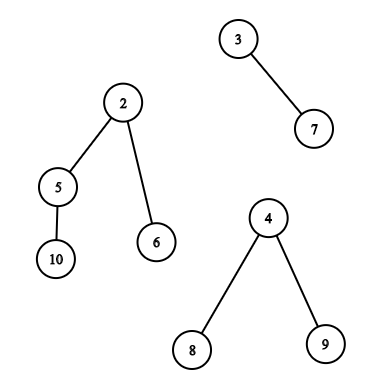 Jon Snow now changes the parent of vertex 10 from 5 to 3. The strength of forest now becomes 3.