


Limak is a little polar bear. He loves connecting with other bears via social networks. He has n friends and his relation with the i-th of them is described by a unique integer ti. The bigger this value is, the better the friendship is. No two friends have the same value ti.
Spring is starting and the Winter sleep is over for bears. Limak has just woken up and logged in. All his friends still sleep and thus none of them is online. Some (maybe all) of them will appear online in the next hours, one at a time.
The system displays friends who are online. On the screen there is space to display at most k friends. If there are more than k friends online then the system displays only k best of them — those with biggest ti.
Your task is to handle queries of two types:
- "1 id" — Friend id becomes online. It's guaranteed that he wasn't online before.
- "2 id" — Check whether friend id is displayed by the system. Print "YES" or "NO" in a separate line.
Are you able to help Limak and answer all queries of the second type?
The first line contains three integers n, k and q (1 ≤ n, q ≤ 150 000, 1 ≤ k ≤ min(6, n)) — the number of friends, the maximum number of displayed online friends and the number of queries, respectively.
The second line contains n integers t1, t2, ..., tn (1 ≤ ti ≤ 109) where ti describes how good is Limak's relation with the i-th friend.
The i-th of the following q lines contains two integers typei and idi (1 ≤ typei ≤ 2, 1 ≤ idi ≤ n) — the i-th query. If typei = 1 then a friend idi becomes online. If typei = 2 then you should check whether a friend idi is displayed.
It's guaranteed that no two queries of the first type will have the same idi becuase one friend can't become online twice. Also, it's guaranteed that at least one query will be of the second type (typei = 2) so the output won't be empty.
For each query of the second type print one line with the answer — "YES" (without quotes) if the given friend is displayed and "NO" (without quotes) otherwise.
4 2 8
300 950 500 200
1 3
2 4
2 3
1 1
1 2
2 1
2 2
2 3
NO
YES
NO
YES
YES
6 3 9
50 20 51 17 99 24
1 3
1 4
1 5
1 2
2 4
2 2
1 1
2 4
2 3
NO
YES
NO
YES
In the first sample, Limak has 4 friends who all sleep initially. At first, the system displays nobody because nobody is online. There are the following 8 queries:
- "1 3" — Friend 3 becomes online.
- "2 4" — We should check if friend 4 is displayed. He isn't even online and thus we print "NO".
- "2 3" — We should check if friend 3 is displayed. Right now he is the only friend online and the system displays him. We should print "YES".
- "1 1" — Friend 1 becomes online. The system now displays both friend 1 and friend 3.
- "1 2" — Friend 2 becomes online. There are 3 friends online now but we were given k = 2 so only two friends can be displayed. Limak has worse relation with friend 1 than with other two online friends (t1 < t2, t3) so friend 1 won't be displayed
- "2 1" — Print "NO".
- "2 2" — Print "YES".
- "2 3" — Print "YES".
A tree is a connected undirected graph consisting of n vertices and n - 1 edges. Vertices are numbered 1 through n.
Limak is a little polar bear and Radewoosh is his evil enemy. Limak once had a tree but Radewoosh stolen it. Bear is very sad now because he doesn't remember much about the tree — he can tell you only three values n, d and h:
- The tree had exactly n vertices.
- The tree had diameter d. In other words, d was the biggest distance between two vertices.
- Limak also remembers that he once rooted the tree in vertex 1 and after that its height was h. In other words, h was the biggest distance between vertex 1 and some other vertex.
The distance between two vertices of the tree is the number of edges on the simple path between them.
Help Limak to restore his tree. Check whether there exists a tree satisfying the given conditions. Find any such tree and print its edges in any order. It's also possible that Limak made a mistake and there is no suitable tree – in this case print "-1".
The first line contains three integers n, d and h (2 ≤ n ≤ 100 000, 1 ≤ h ≤ d ≤ n - 1) — the number of vertices, diameter, and height after rooting in vertex 1, respectively.
If there is no tree matching what Limak remembers, print the only line with "-1" (without the quotes).
Otherwise, describe any tree matching Limak's description. Print n - 1 lines, each with two space-separated integers – indices of vertices connected by an edge. If there are many valid trees, print any of them. You can print edges in any order.
5 3 2
1 2
1 3
3 4
3 5
8 5 2
-1
8 4 2
4 8
5 7
2 3
8 1
2 1
5 6
1 5
Below you can see trees printed to the output in the first sample and the third sample.

Limak is a little polar bear. He doesn't have many toys and thus he often plays with polynomials.
He considers a polynomial valid if its degree is n and its coefficients are integers not exceeding k by the absolute value. More formally:
Let a0, a1, ..., an denote the coefficients, so  . Then, a polynomial P(x) is valid if all the following conditions are satisfied:
- ai is integer for every i;
- |ai| ≤ k for every i;
- an ≠ 0.
Limak has recently got a valid polynomial P with coefficients a0, a1, a2, ..., an. He noticed that P(2) ≠ 0 and he wants to change it. He is going to change one coefficient to get a valid polynomial Q of degree n that Q(2) = 0. Count the number of ways to do so. You should count two ways as a distinct if coefficients of target polynoms differ.
The first line contains two integers n and k (1 ≤ n ≤ 200 000, 1 ≤ k ≤ 109) — the degree of the polynomial and the limit for absolute values of coefficients.
The second line contains n + 1 integers a0, a1, ..., an (|ai| ≤ k, an ≠ 0) — describing a valid polynomial . It's guaranteed that P(2) ≠ 0.
Print the number of ways to change one coefficient to get a valid polynomial Q that Q(2) = 0.
3 1000000000
10 -9 -3 5
3
3 12
10 -9 -3 5
2
2 20
14 -7 19
0
In the first sample, we are given a polynomial P(x) = 10 - 9x - 3x2 + 5x3.
Limak can change one coefficient in three ways:
- He can set a0 = - 10. Then he would get Q(x) = - 10 - 9x - 3x2 + 5x3 and indeed Q(2) = - 10 - 18 - 12 + 40 = 0.
- Or he can set a2 = - 8. Then Q(x) = 10 - 9x - 8x2 + 5x3 and indeed Q(2) = 10 - 18 - 32 + 40 = 0.
- Or he can set a1 = - 19. Then Q(x) = 10 - 19x - 3x2 + 5x3 and indeed Q(2) = 10 - 38 - 12 + 40 = 0.
In the second sample, we are given the same polynomial. This time though, k is equal to 12 instead of 109. Two first of ways listed above are still valid but in the third way we would get |a1| > k what is not allowed. Thus, the answer is 2 this time.
Codeforces is a wonderful platform and one its feature shows how much someone contributes to the community. Every registered user has contribution — an integer number, not necessarily positive. There are n registered users and the i-th of them has contribution ti.
Limak is a little polar bear and he's new into competitive programming. He doesn't even have an account in Codeforces but he is able to upvote existing blogs and comments. We assume that every registered user has infinitely many blogs and comments.
- Limak can spend b minutes to read one blog and upvote it. Author's contribution will be increased by 5.
- Limak can spend c minutes to read one comment and upvote it. Author's contribution will be increased by 1.
Note that it's possible that Limak reads blogs faster than comments.
Limak likes ties. He thinks it would be awesome to see a tie between at least k registered users. To make it happen he is going to spend some time on reading and upvoting. After that, there should exist an integer value x that at least k registered users have contribution exactly x.
How much time does Limak need to achieve his goal?
The first line contains four integers n, k, b and c (2 ≤ k ≤ n ≤ 200 000, 1 ≤ b, c ≤ 1000) — the number of registered users, the required minimum number of users with the same contribution, time needed to read and upvote a blog, and time needed to read and upvote a comment, respectively.
The second line contains n integers t1, t2, ..., tn (|ti| ≤ 109) where ti denotes contribution of the i-th registered user.
Print the minimum number of minutes Limak will spend to get a tie between at least k registered users.
4 3 100 30
12 2 6 1
220
4 3 30 100
12 2 6 1
190
6 2 987 789
-8 42 -4 -65 -8 -8
0
In the first sample, there are 4 registered users and Limak wants a tie between at least 3 of them. Limak should behave as follows.
- He spends 100 minutes to read one blog of the 4-th user and increase his contribution from 1 to 6.
- Then he spends 4·30 = 120 minutes to read four comments of the 2-nd user and increase his contribution from 2 to 6 (four times it was increaded by 1).
In the given scenario, Limak spends 100 + 4·30 = 220 minutes and after that each of users 2, 3, 4 has contribution 6.
In the second sample, Limak needs 30 minutes to read a blog and 100 minutes to read a comment. This time he can get 3 users with contribution equal to 12 by spending 100 + 3·30 = 190 minutes:
- Spend 2·30 = 60 minutes to read two blogs of the 1-st user to increase his contribution from 2 to 12.
- Spend 30 + 100 minutes to read one blog and one comment of the 3-rd user. His contribution will change from 6 to 6 + 5 + 1 = 12.
Limak is a big polar bear. He prepared n problems for an algorithmic contest. The i-th problem has initial score pi. Also, testers said that it takes ti minutes to solve the i-th problem. Problems aren't necessarily sorted by difficulty and maybe harder problems have smaller initial score but it's too late to change it — Limak has already announced initial scores for problems. Though it's still possible to adjust the speed of losing points, denoted by c in this statement.
Let T denote the total number of minutes needed to solve all problems (so, T = t1 + t2 + ... + tn). The contest will last exactly T minutes. So it's just enough to solve all problems.
Points given for solving a problem decrease linearly. Solving the i-th problem after x minutes gives exactly  points, where
 is some real constant that Limak must choose.
Let's assume that c is fixed. During a contest a participant chooses some order in which he or she solves problems. There are n! possible orders and each of them gives some total number of points, not necessarily integer. We say that an order is optimal if it gives the maximum number of points. In other words, the total number of points given by this order is greater or equal than the number of points given by any other order. It's obvious that there is at least one optimal order. However, there may be more than one optimal order.
Limak assumes that every participant will properly estimate ti at the very beginning and will choose some optimal order. He also assumes that testers correctly predicted time needed to solve each problem.
For two distinct problems i and j such that pi < pj Limak wouldn't be happy to see a participant with strictly more points for problem i than for problem j. He calls such a situation a paradox.
It's not hard to prove that there will be no paradox for c = 0. The situation may be worse for bigger c. What is the maximum real value c (remember that ) for which there is no paradox possible, that is, there will be no paradox for any optimal order of solving problems?
It can be proved that the answer (the maximum c as described) always exists.
The first line contains one integer n (2 ≤ n ≤ 150 000) — the number of problems.
The second line contains n integers p1, p2, ..., pn (1 ≤ pi ≤ 108) — initial scores.
The third line contains n integers t1, t2, ..., tn (1 ≤ ti ≤ 108) where ti is the number of minutes needed to solve the i-th problem.
Print one real value on a single line — the maximum value of c that and there is no optimal order with a paradox. Your answer will be considered correct if its absolute or relative error does not exceed 10 - 6.
Namely: let's assume that your answer is a, and the answer of the jury is b. The checker program will consider your answer correct if 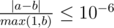 .
3
4 3 10
1 1 8
0.62500000000
4
7 20 15 10
7 20 15 10
0.31901840491
2
10 20
10 1
1.00000000000
In the first sample, there are 3 problems. The first is (4, 1) (initial score is 4 and required time is 1 minute), the second problem is (3, 1) and the third one is (10, 8). The total time is T = 1 + 1 + 8 = 10.
Let's show that there is a paradox for c = 0.7. Solving problems in order 1, 2, 3 turns out to give the best total score, equal to the sum of:
- solved 1 minute after the start:

- solved 2 minutes after the start:

- solved 10 minutes after the start:

So, this order gives 3.72 + 2.58 + 3 = 9.3 points in total and this is the only optimal order (you can calculate total scores for other 5 possible orders too see that they are lower). You should check points for problems 1 and 3 to see a paradox. There is 4 < 10 but 3.72 > 3. It turns out that there is no paradox for c = 0.625 but there is a paradox for any bigger c.
In the second sample, all 24 orders are optimal.
In the third sample, even for c = 1 there is no paradox.
Limak is a smart brown bear who loves chemistry, reactions and transforming elements.
In Bearland (Limak's home) there are n elements, numbered 1 through n. There are also special machines, that can transform elements. Each machine is described by two integers ai, bi representing two elements, not necessarily distinct. One can use a machine either to transform an element ai to bi or to transform bi to ai. Machines in Bearland aren't very resistant and each of them can be used at most once. It is possible that ai = bi and that many machines have the same pair ai, bi.
Radewoosh is Limak's biggest enemy and rival. He wants to test Limak in the chemistry. They will meet tomorrow and both of them will bring all their machines. Limak has m machines but he doesn't know much about his enemy. They agreed Radewoosh will choose two distinct elements, let's denote them as x and y. Limak will be allowed to use both his and Radewoosh's machines. He may use zero or more (maybe even all) machines to achieve the goal, each machine at most once. Limak will start from an element x and his task will be to first get an element y and then to again get an element x — then we say that he succeeds. After that Radewoosh would agree that Limak knows the chemistry (and Radewoosh would go away).
Radewoosh likes some particular non-empty set of favorite elements and he will choose x, y from that set. Limak doesn't know exactly which elements are in the set and also he doesn't know what machines Radewoosh has. Limak has heard q gossips (queries) though and each of them consists of Radewoosh's machines and favorite elements. For each gossip Limak wonders if he would be able to succeed tomorrow for every pair x, y chosen from the set of favorite elements. If yes then print "YES" (without the quotes). But if there exists a pair (x, y) from the given set that Limak wouldn't be able to succeed then you should print "NO" (without the quotes).
The first line contains three integers n, m and q (1 ≤ n, q ≤ 300 000, 0 ≤ m ≤ 300 000) — the number of elements, the number of Limak's machines and the number of gossips, respectively.
Each of the next m lines contains two integers ai and bi (1 ≤ ai, bi ≤ n) describing one of Limak's machines.
Then, the description of q gossips follows.
The first line of the description of the i-th gossip contains two integers ni and mi (1 ≤ ni ≤ 300 000, 0 ≤ mi ≤ 300 000). The second line contains ni distinct integers xi, 1, xi, 2, ..., xi, ni (1 ≤ xi, j ≤ n) — Radewoosh's favorite elements in the i-th gossip. Note that ni = 1 is allowed, in this case there are no pairs of distinct elements, so Limak automatically wins (the answer is "YES"). Then mi lines follow, each containing two integers ai, j, bi, j (1 ≤ ai, j, bi, j) describing one of Radewoosh's machines in the i-th gossip.
The sum of ni over all gossips won't exceed 300 000. Also, the sum of mi over all gossips won't exceed 300 000.
Important: Because we want you to process the gossips online, in order to know the elements in Radewoosh's favorite set and elements that his machines can transform, for on each number that denotes them in the input you should use following function:
int rotate(int element)
{
   element=(element+R)%n;

   if (element==0) {
       element=n;
   }

   return element;
}
where R is initially equal to 0 and is increased by the number of the query any time the answer is "YES". Queries are numbered starting with 1 in the order they appear in the input.
You should print q lines. The i-th of them should contain "YES" (without quotes) if for the i-th gossip for each pair of elements x and y (in the set xi, 1, xi, 2, ..., xi, ni) Limak is able to succeed. Otherwise you should print "NO" (without quotes).
6 5 4
1 2
2 3
3 4
2 4
5 6
2 0
4 2
2 1
6 2
3 4
3 2
6 3 4
2 5
4 6
2 1
1 2
1 2
YES
NO
YES
YES
7 6 2
1 2
1 3
2 4
2 5
3 6
3 7
7 2
1 2 3 4 5 6 7
4 5
6 7
7 2
1 2 3 4 5 6 7
4 6
5 7
NO
YES
Lets look at first sample:
In first gossip Radewoosh's favorite set is {4, 2} and he has no machines. Limak can tranform element 4 into 2 (so half of a task is complete) and then 2 into 3, and 3 into 4. Answer is "YES", so R is increased by 1.
In second gossip set in the input is denoted by {6, 2} and machine by (3, 4), but R is equal to 1, so set is {1, 3} and machine is (4, 5). Answer is "NO", so R isn't changed.
In third gossip set {6, 4, 3} and machines (2, 5) and (4, 6) are deciphered to be {1, 5, 4}, (3, 6) and (5, 1).
Consider Radewoosh's choices:
- If he chooses elements 1 and 5, then Limak is able to transform 1 into 5, then 6 into 3, 3 into 2 and 2 into 1.
- If he chooses elements 5 and 4, then Limak is able to transform 5 into 6, 6 into 3, 3 into 4 (half way already behind him), 4 into 2, 2 into 1, 1 into 5.
- If he chooses elements 1 and 4, then Limak is able to transform 1 into 2, 2 into 4, 4 into 3, 3 into 6, 6 into 5 and 5 into 1.
So Limak is able to execute task. Answer is "YES" and R is increased by 3 (it's equal to 4 now).
In last gossip {1, 2} and (1, 2) are deciphered to be {5, 6} and (5, 6). Now there are 2 machines (5, 6) so Limak is able to execute task again.