


Vasya and Petya are playing a simple game. Vasya thought of number x between 1 and n, and Petya tries to guess the number.
Petya can ask questions like: "Is the unknown number divisible by number y?".
The game is played by the following rules: first Petya asks all the questions that interest him (also, he can ask no questions), and then Vasya responds to each question with a 'yes' or a 'no'. After receiving all the answers Petya should determine the number that Vasya thought of.
Unfortunately, Petya is not familiar with the number theory. Help him find the minimum number of questions he should ask to make a guaranteed guess of Vasya's number, and the numbers yi, he should ask the questions about.
A single line contains number n (1 ≤ n ≤ 103).
Print the length of the sequence of questions k (0 ≤ k ≤ n), followed by k numbers — the questions yi (1 ≤ yi ≤ n).
If there are several correct sequences of questions of the minimum length, you are allowed to print any of them.
4
3
2 4 3
6
4
2 4 3 5
The sequence from the answer to the first sample test is actually correct.
If the unknown number is not divisible by one of the sequence numbers, it is equal to 1.
If the unknown number is divisible by 4, it is 4.
If the unknown number is divisible by 3, then the unknown number is 3.
Otherwise, it is equal to 2. Therefore, the sequence of questions allows you to guess the unknown number. It can be shown that there is no correct sequence of questions of length 2 or shorter.
A tree of size n is an undirected connected graph consisting of n vertices without cycles.
Consider some tree with n vertices. We call a tree invariant relative to permutation p = p1p2... pn, if for any two vertices of the tree u and v the condition holds: "vertices u and v are connected by an edge if and only if vertices pu and pv are connected by an edge".
You are given permutation p of size n. Find some tree size n, invariant relative to the given permutation.
The first line contains number n (1 ≤ n ≤ 105) — the size of the permutation (also equal to the size of the sought tree).
The second line contains permutation pi (1 ≤ pi ≤ n).
If the sought tree does not exist, print "NO" (without the quotes).
Otherwise, print "YES", and then print n - 1 lines, each of which contains two integers — the numbers of vertices connected by an edge of the tree you found. The vertices are numbered from 1, the order of the edges and the order of the vertices within the edges does not matter.
If there are multiple solutions, output any of them.
4
4 3 2 1
YES
4 1
4 2
1 3
3
3 1 2
NO
In the first sample test a permutation transforms edge (4, 1) into edge (1, 4), edge (4, 2) into edge (1, 3) and edge (1, 3) into edge (4, 2). These edges all appear in the resulting tree.
It can be shown that in the second sample test no tree satisfies the given condition.
On a plane are n points (xi, yi) with integer coordinates between 0 and 106. The distance between the two points with numbers a and b is said to be the following value:  (the distance calculated by such formula is called Manhattan distance).
We call a hamiltonian path to be some permutation pi of numbers from 1 to n. We say that the length of this path is value 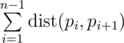 .
Find some hamiltonian path with a length of no more than 25 × 108. Note that you do not have to minimize the path length.
The first line contains integer n (1 ≤ n ≤ 106).
The i + 1-th line contains the coordinates of the i-th point: xi and yi (0 ≤ xi, yi ≤ 106).
It is guaranteed that no two points coincide.
Print the permutation of numbers pi from 1 to n — the sought Hamiltonian path. The permutation must meet the inequality  .
If there are multiple possible answers, print any of them.
It is guaranteed that the answer exists.
5
0 7
8 10
3 4
5 0
9 12
4 3 1 2 5
In the sample test the total distance is:

(|5 - 3| + |0 - 4|) + (|3 - 0| + |4 - 7|) + (|0 - 8| + |7 - 10|) + (|8 - 9| + |10 - 12|) = 2 + 4 + 3 + 3 + 8 + 3 + 1 + 2 = 26
In the country there are exactly n cities numbered with positive integers from 1 to n. In each city there is an airport is located.
Also, there is the only one airline, which makes m flights. Unfortunately, to use them, you need to be a regular customer of this company, namely, you have the opportunity to enjoy flight i from city ai to city bi only if you have already made at least di flights before that.
Please note that flight i flies exactly from city ai to city bi. It can not be used to fly from city bi to city ai. An interesting fact is that there may possibly be recreational flights with a beautiful view of the sky, which begin and end in the same city.
You need to get from city 1 to city n. Unfortunately, you've never traveled by plane before. What minimum number of flights you have to perform in order to get to city n?
Note that the same flight can be used multiple times.
The first line contains two integers, n and m (2 ≤ n ≤ 150, 1 ≤ m ≤ 150) — the number of cities in the country and the number of flights the company provides.
Next m lines contain numbers ai, bi, di (1 ≤ ai, bi ≤ n, 0 ≤ di ≤ 109), representing flight number i from city ai to city bi, accessible to only the clients who have made at least di flights.
Print "Impossible" (without the quotes), if it is impossible to get from city 1 to city n using the airways.
But if there is at least one way, print a single integer — the minimum number of flights you need to make to get to the destination point.
3 2
1 2 0
2 3 1
2
2 1
1 2 100500
Impossible
3 3
2 1 0
2 3 6
1 2 0
8
Note the unusual memory limit for this problem.
You are given an undirected graph consisting of n vertices and m edges. The vertices are numbered with integers from 1 to n, the edges are numbered with integers from 1 to m. Each edge can be unpainted or be painted in one of the k colors, which are numbered with integers from 1 to k. Initially, none of the edges is painted in any of the colors.
You get queries of the form "Repaint edge ei to color ci". At any time the graph formed by the edges of the same color must be bipartite. If after the repaint this condition is violated, then the query is considered to be invalid and edge ei keeps its color. Otherwise, edge ei is repainted in color ci, and the query is considered to valid.
Recall that the graph is called bipartite if the set of its vertices can be divided into two parts so that no edge connected vertices of the same parts.
For example, suppose you are given a triangle graph, that is a graph with three vertices and edges (1, 2), (2, 3) and (3, 1). Suppose that the first two edges are painted color 1, and the third one is painted color 2. Then the query of "repaint the third edge in color 1" will be incorrect because after its execution the graph formed by the edges of color 1 will not be bipartite. On the other hand, it is possible to repaint the second edge in color 2.
You receive q queries. For each query, you should either apply it, and report that the query is valid, or report that the query is invalid.
The first line contains integers n, m, k, q (2 ≤ n ≤ 5·105, 1 ≤ m, q ≤ 5·105, 1 ≤ k ≤ 50) — the number of vertices, the number of edges, the number of colors and the number of queries.
Then follow m edges of the graph in the form ai, bi (1 ≤ ai, bi ≤ n).
Then follow q queries of the form ei, ci (1 ≤ ei ≤ m, 1 ≤ ci ≤ k).
It is guaranteed that the graph doesn't contain multiple edges and loops.
For each query print "YES" (without the quotes), if it is valid, or "NO" (without the quotes), if this query destroys the bipartivity of the graph formed by the edges of some color.
3 3 2 5
1 2
2 3
1 3
1 1
2 1
3 2
3 1
2 2
YES
YES
YES
NO
YES