


You have $$$n$$$ rectangular wooden blocks, which are numbered from $$$1$$$ to $$$n$$$. The $$$i$$$-th block is $$$1$$$ unit high and $$$\lceil \frac{i}{2} \rceil$$$ units long.
Here, $$$\lceil \frac{x}{2} \rceil$$$ denotes the result of division of $$$x$$$ by $$$2$$$, rounded up. For example, $$$\lceil \frac{4}{2} \rceil = 2$$$ and $$$\lceil \frac{5}{2} \rceil = \lceil 2.5 \rceil = 3$$$.
For example, if $$$n=5$$$, then the blocks have the following sizes: $$$1 \times 1$$$, $$$1 \times 1$$$, $$$1 \times 2$$$, $$$1 \times 2$$$, $$$1 \times 3$$$.
 The available blocks for $$$n=5$$$
Find the maximum possible side length of a square you can create using these blocks, without rotating any of them. Note that you don't have to use all of the blocks.
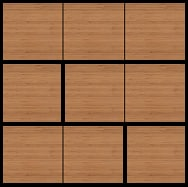 One of the ways to create $$$3 \times 3$$$ square using blocks $$$1$$$ through $$$5$$$
Each test contains multiple test cases. The first line contains a single integer $$$t$$$ ($$$1 \le t \le 10^4$$$) — the number of test cases.
The first line of each test case contains a single integer $$$n$$$ ($$$1 \le n \le 10^9$$$) — the number of blocks.
For each test case, print one integer — the maximum possible side length of a square you can create.
325197654321
1
3
98827161
In the first test case, you can create a $$$1 \times 1$$$ square using only one of the blocks.
In the second test case, one of the possible ways to create a $$$3 \times 3$$$ square is shown in the statement. It is impossible to create a $$$4 \times 4$$$ or larger square, so the answer is $$$3$$$.
A non-empty digit string is diverse if the number of occurrences of each character in it doesn't exceed the number of distinct characters in it.
For example:
- string "7" is diverse because 7 appears in it $$$1$$$ time and the number of distinct characters in it is $$$1$$$;
- string "77" is not diverse because 7 appears in it $$$2$$$ times and the number of distinct characters in it is $$$1$$$;
- string "1010" is diverse because both 0 and 1 appear in it $$$2$$$ times and the number of distinct characters in it is $$$2$$$;
- string "6668" is not diverse because 6 appears in it $$$3$$$ times and the number of distinct characters in it is $$$2$$$.
You are given a string $$$s$$$ of length $$$n$$$, consisting of only digits $$$0$$$ to $$$9$$$. Find how many of its $$$\frac{n(n+1)}{2}$$$ substrings are diverse.
A string $$$a$$$ is a substring of a string $$$b$$$ if $$$a$$$ can be obtained from $$$b$$$ by deletion of several (possibly, zero or all) characters from the beginning and several (possibly, zero or all) characters from the end.
Note that if the same diverse string appears in $$$s$$$ multiple times, each occurrence should be counted independently. For example, there are two diverse substrings in "77" both equal to "7", so the answer for the string "77" is $$$2$$$.
Each test contains multiple test cases. The first line contains a single integer $$$t$$$ ($$$1 \le t \le 10^4$$$) — the number of test cases.
The first line of each test case contains a single integer $$$n$$$ ($$$1 \le n \le 10^5$$$) — the length of the string $$$s$$$.
The second line of each test case contains a string $$$s$$$ of length $$$n$$$. It is guaranteed that all characters of $$$s$$$ are digits from $$$0$$$ to $$$9$$$.
It is guaranteed that the sum of $$$n$$$ over all test cases does not exceed $$$10^5$$$.
For each test case print one integer — the number of diverse substrings of the given string $$$s$$$.
71727741010501100639999652345618789987887987998798
1
2
10
12
10
15
106
In the first test case, the diverse substring is "7".
In the second test case, the only diverse substring is "7", which appears twice, so the answer is $$$2$$$.
In the third test case, the diverse substrings are "0" ($$$2$$$ times), "01", "010", "1" ($$$2$$$ times), "10" ($$$2$$$ times), "101" and "1010".
In the fourth test case, the diverse substrings are "0" ($$$3$$$ times), "01", "011", "0110", "1" ($$$2$$$ times), "10", "100", "110" and "1100".
In the fifth test case, the diverse substrings are "3", "39", "399", "6", "9" ($$$4$$$ times), "96" and "996".
In the sixth test case, all $$$15$$$ non-empty substrings of "23456" are diverse.
The score of an array $$$v_1,v_2,\ldots,v_n$$$ is defined as the number of indices $$$i$$$ ($$$1 \le i \le n$$$) such that $$$v_1+v_2+\ldots+v_i = 0$$$.
You are given an array $$$a_1,a_2,\ldots,a_n$$$ of length $$$n$$$. You can perform the following operation multiple times:
- select an index $$$i$$$ ($$$1 \le i \le n$$$) such that $$$a_i=0$$$;
- then replace $$$a_i$$$ by an arbitrary integer.
What is the maximum possible score of $$$a$$$ that can be obtained by performing a sequence of such operations?
Each test contains multiple test cases. The first line contains a single integer $$$t$$$ ($$$1 \le t \le 10^4$$$) — the number of test cases.
The first line of each test case contains one integer $$$n$$$ ($$$1 \le n \le 2 \cdot 10^5$$$) — the length of the array $$$a$$$.
The second line of each test case contains $$$n$$$ integers $$$a_1,a_2,\ldots,a_n$$$ ($$$-10^9 \le a_i \le 10^9$$$) — array $$$a$$$.
It is guaranteed that the sum of $$$n$$$ over all test cases does not exceed $$$2 \cdot 10^5$$$.
For each test case, print the maximum possible score of the array $$$a$$$ after performing a sequence of operations.
552 0 1 -1 031000000000 1000000000 040 0 0 083 0 2 -10 10 -30 30 091 0 0 1 -1 0 1 0 -1
3
1
4
4
5
In the first test case, it is optimal to change the value of $$$a_2$$$ to $$$-2$$$ in one operation.
The resulting array $$$a$$$ will be $$$[2,-2,1,-1,0]$$$, with a score of $$$3$$$:
- $$$a_1+a_2=2-2=0$$$;
- $$$a_1+a_2+a_3+a_4=2-2+1-1=0$$$;
- $$$a_1+a_2+a_3+a_4+a_5=2-2+1-1+0=0$$$.
In the second test case, it is optimal to change the value of $$$a_3$$$ to $$$-2\,000\,000\,000$$$, giving us an array with a score of $$$1$$$.
In the third test case, it is not necessary to perform any operations.
You are given three integers $$$a$$$, $$$b$$$, and $$$d$$$. Your task is to find any integer $$$x$$$ which satisfies all of the following conditions, or determine that no such integers exist:
- $$$0 \le x \lt 2^{60}$$$;
- $$$a|x$$$ is divisible by $$$d$$$;
- $$$b|x$$$ is divisible by $$$d$$$.
Here, $$$|$$$ denotes the bitwise OR operation.
Each test contains multiple test cases. The first line of input contains one integer $$$t$$$ ($$$1 \le t \le 10^4$$$) — the number of test cases.
Each test case consists of one line, containing three integers $$$a$$$, $$$b$$$, and $$$d$$$ ($$$1 \le a,b,d \lt 2^{30}$$$).
For each test case print one integer. If there exists an integer $$$x$$$ which satisfies all of the conditions from the statement, print $$$x$$$. Otherwise, print $$$-1$$$.
If there are multiple solutions, you may print any of them.
812 39 56 8 14100 200 2003 4 62 2 218 27 3420 666 69987654321 123456789 999999999
18
14
-1
-1
0
11
25599
184470016815529983
In the first test case, $$$x=18$$$ is one of the possible solutions, since $$$39|18=55$$$ and $$$12|18=30$$$, both of which are multiples of $$$d=5$$$.
In the second test case, $$$x=14$$$ is one of the possible solutions, since $$$8|14=6|14=14$$$, which is a multiple of $$$d=14$$$.
In the third and fourth test cases, we can show that there are no solutions.
The position of the leftmost maximum on the segment $$$[l; r]$$$ of array $$$x = [x_1, x_2, \ldots, x_n]$$$ is the smallest integer $$$i$$$ such that $$$l \le i \le r$$$ and $$$x_i = \max(x_l, x_{l+1}, \ldots, x_r)$$$.
You are given an array $$$a = [a_1, a_2, \ldots, a_n]$$$ of length $$$n$$$. Find the number of integer arrays $$$b = [b_1, b_2, \ldots, b_n]$$$ of length $$$n$$$ that satisfy the following conditions:
- $$$1 \le b_i \le m$$$ for all $$$1 \le i \le n$$$;
- for all pairs of integers $$$1 \le l \le r \le n$$$, the position of the leftmost maximum on the segment $$$[l; r]$$$ of the array $$$b$$$ is equal to the position of the leftmost maximum on the segment $$$[l; r]$$$ of the array $$$a$$$.
Since the answer might be very large, print its remainder modulo $$$10^9+7$$$.
Each test contains multiple test cases. The first line contains a single integer $$$t$$$ ($$$1 \le t \le 10^3$$$) — the number of test cases.
The first line of each test case contains two integers $$$n$$$ and $$$m$$$ ($$$2 \le n,m \le 2 \cdot 10^5$$$, $$$n \cdot m \le 10^6$$$).
The second line of each test case contains $$$n$$$ integers $$$a_1,a_2,\ldots,a_n$$$ ($$$1 \le a_i \le m$$$) — the array $$$a$$$.
It is guaranteed that the sum of $$$n \cdot m$$$ over all test cases doesn't exceed $$$10^6$$$.
For each test case print one integer — the number of arrays $$$b$$$ that satisfy the conditions from the statement, modulo $$$10^9+7$$$.
43 31 3 24 22 2 2 26 96 9 6 9 6 99 10010 40 20 20 100 60 80 60 60
8
5
11880
351025663
In the first test case, the following $$$8$$$ arrays satisfy the conditions from the statement:
- $$$[1,2,1]$$$;
- $$$[1,2,2]$$$;
- $$$[1,3,1]$$$;
- $$$[1,3,2]$$$;
- $$$[1,3,3]$$$;
- $$$[2,3,1]$$$;
- $$$[2,3,2]$$$;
- $$$[2,3,3]$$$.
In the second test case, the following $$$5$$$ arrays satisfy the conditions from the statement:
- $$$[1,1,1,1]$$$;
- $$$[2,1,1,1]$$$;
- $$$[2,2,1,1]$$$;
- $$$[2,2,2,1]$$$;
- $$$[2,2,2,2]$$$.
You have an array $$$a_0, a_1, \ldots, a_{n-1}$$$ of length $$$n$$$. Initially, $$$a_i = 2^i$$$ for all $$$0 \le i \lt n$$$. Note that array $$$a$$$ is zero-indexed.
You want to reverse this array (that is, make $$$a_i$$$ equal to $$$2^{n-1-i}$$$ for all $$$0 \le i \lt n$$$). To do this, you can perform the following operation no more than $$$250\,000$$$ times:
- Select an integer $$$i$$$ ($$$0 \le i \lt n$$$) and replace $$$a_i$$$ by $$$a_i \oplus a_{(i+1)\bmod n}$$$.
Here, $$$\oplus$$$ denotes the bitwise XOR operation.
Your task is to find any sequence of operations that will result in the array $$$a$$$ being reversed. It can be shown that under the given constraints, a solution always exists.
The first line contains a single integer $$$n$$$ ($$$2 \le n \le 400$$$) — the length of the array $$$a$$$.
On the first line print one integer $$$k$$$ ($$$0 \le k \le 250\,000$$$) — the number of operations performed.
On the second line print $$$k$$$ integers $$$i_1,i_2,\ldots,i_k$$$ ($$$0 \le i_j \lt n$$$). Here, $$$i_j$$$ should be the integer selected on the $$$j$$$-th operation.
Note that you don't need to minimize the number of operations.
2
3
1 0 1
3
9
1 0 1 0 2 1 0 1 0
In the notes, the elements on which the operations are performed are colored red.
In the first test case, array $$$a$$$ will change in the following way:
$$$[1,\color{red}{2}] \rightarrow [\color{red}{1},3] \rightarrow [2,\color{red}{3}] \rightarrow [2,1]$$$.
In the second test case, array $$$a$$$ will change in the following way:
$$$[1,\color{red}{2},4] \rightarrow [\color{red}{1},6,4] \rightarrow [7,\color{red}{6},4] \rightarrow [\color{red}{7},2,4] \rightarrow [5,2,\color{red}{4}] \rightarrow [5,\color{red}{2},1] \rightarrow [\color{red}{5},3,1] \rightarrow [6,\color{red}{3},1] \rightarrow [\color{red}{6},2,1] \rightarrow [4,2,1]$$$.