


JATC and his friend Giraffe are currently in their room, solving some problems. Giraffe has written on the board an array $$$a_1$$$, $$$a_2$$$, ..., $$$a_n$$$ of integers, such that $$$1 \le a_1 \lt a_2 \lt \ldots \lt a_n \le 10^3$$$, and then went to the bathroom.
JATC decided to prank his friend by erasing some consecutive elements in the array. Since he doesn't want for the prank to go too far, he will only erase in a way, such that Giraffe can still restore the array using the information from the remaining elements. Because Giraffe has created the array, he's also aware that it's an increasing array and all the elements are integers in the range $$$[1, 10^3]$$$.
JATC wonders what is the greatest number of elements he can erase?
The first line of the input contains a single integer $$$n$$$ ($$$1 \le n \le 100$$$) — the number of elements in the array.
The second line of the input contains $$$n$$$ integers $$$a_i$$$ ($$$1 \le a_1 \lt a_2 \lt \dots \lt a_n \le 10^3$$$) — the array written by Giraffe.
Print a single integer — the maximum number of consecutive elements in the array that JATC can erase.
If it is impossible to erase even a single element, print $$$0$$$.
6
1 3 4 5 6 9
2
3
998 999 1000
2
5
1 2 3 4 5
4
In the first example, JATC can erase the third and fourth elements, leaving the array $$$[1, 3, \_, \_, 6, 9]$$$. As you can see, there is only one way to fill in the blanks.
In the second example, JATC can erase the second and the third elements. The array will become $$$[998, \_, \_]$$$. Because all the elements are less than or equal to $$$1000$$$, the array is still can be restored. Note, that he can't erase the first $$$2$$$ elements.
In the third example, JATC can erase the first $$$4$$$ elements. Since all the elements are greater than or equal to $$$1$$$, Giraffe can still restore the array. Note, that he can't erase the last $$$4$$$ elements.
JATC's math teacher always gives the class some interesting math problems so that they don't get bored. Today the problem is as follows. Given an integer $$$n$$$, you can perform the following operations zero or more times:
- mul $$$x$$$: multiplies $$$n$$$ by $$$x$$$ (where $$$x$$$ is an arbitrary positive integer).
- sqrt: replaces $$$n$$$ with $$$\sqrt{n}$$$ (to apply this operation, $$$\sqrt{n}$$$ must be an integer).
You can perform these operations as many times as you like. What is the minimum value of $$$n$$$, that can be achieved and what is the minimum number of operations, to achieve that minimum value?
Apparently, no one in the class knows the answer to this problem, maybe you can help them?
The only line of the input contains a single integer $$$n$$$ ($$$1 \le n \le 10^6$$$) — the initial number.
Print two integers: the minimum integer $$$n$$$ that can be achieved using the described operations and the minimum number of operations required.
20
10 2
5184
6 4
In the first example, you can apply the operation mul $$$5$$$ to get $$$100$$$ and then sqrt to get $$$10$$$.
In the second example, you can first apply sqrt to get $$$72$$$, then mul $$$18$$$ to get $$$1296$$$ and finally two more sqrt and you get $$$6$$$.
Note, that even if the initial value of $$$n$$$ is less or equal $$$10^6$$$, it can still become greater than $$$10^6$$$ after applying one or more operations.
JATC loves Banh-mi (a Vietnamese food). His affection for Banh-mi is so much that he always has it for breakfast. This morning, as usual, he buys a Banh-mi and decides to enjoy it in a special way.
First, he splits the Banh-mi into $$$n$$$ parts, places them on a row and numbers them from $$$1$$$ through $$$n$$$. For each part $$$i$$$, he defines the deliciousness of the part as $$$x_i \in \{0, 1\}$$$. JATC's going to eat those parts one by one. At each step, he chooses arbitrary remaining part and eats it. Suppose that part is the $$$i$$$-th part then his enjoyment of the Banh-mi will increase by $$$x_i$$$ and the deliciousness of all the remaining parts will also increase by $$$x_i$$$. The initial enjoyment of JATC is equal to $$$0$$$.
For example, suppose the deliciousness of $$$3$$$ parts are $$$[0, 1, 0]$$$. If JATC eats the second part then his enjoyment will become $$$1$$$ and the deliciousness of remaining parts will become $$$[1, \_, 1]$$$. Next, if he eats the first part then his enjoyment will become $$$2$$$ and the remaining parts will become $$$[\_, \_, 2]$$$. After eating the last part, JATC's enjoyment will become $$$4$$$.
However, JATC doesn't want to eat all the parts but to save some for later. He gives you $$$q$$$ queries, each of them consisting of two integers $$$l_i$$$ and $$$r_i$$$. For each query, you have to let him know what is the maximum enjoyment he can get if he eats all the parts with indices in the range $$$[l_i, r_i]$$$ in some order.
All the queries are independent of each other. Since the answer to the query could be very large, print it modulo $$$10^9+7$$$.
The first line contains two integers $$$n$$$ and $$$q$$$ ($$$1 \le n, q \le 100\,000$$$).
The second line contains a string of $$$n$$$ characters, each character is either '0' or '1'. The $$$i$$$-th character defines the deliciousness of the $$$i$$$-th part.
Each of the following $$$q$$$ lines contains two integers $$$l_i$$$ and $$$r_i$$$ ($$$1 \le l_i \le r_i \le n$$$) — the segment of the corresponding query.
Print $$$q$$$ lines, where $$$i$$$-th of them contains a single integer — the answer to the $$$i$$$-th query modulo $$$10^9 + 7$$$.
4 2
1011
1 4
3 4
14
3
3 2
111
1 2
3 3
3
1
In the first example:
- For query $$$1$$$: One of the best ways for JATC to eats those parts is in this order: $$$1$$$, $$$4$$$, $$$3$$$, $$$2$$$.
- For query $$$2$$$: Both $$$3$$$, $$$4$$$ and $$$4$$$, $$$3$$$ ordering give the same answer.
In the second example, any order of eating parts leads to the same answer.
You are given a positive integer $$$n$$$ greater or equal to $$$2$$$. For every pair of integers $$$a$$$ and $$$b$$$ ($$$2 \le |a|, |b| \le n$$$), you can transform $$$a$$$ into $$$b$$$ if and only if there exists an integer $$$x$$$ such that $$$1 \lt |x|$$$ and ($$$a \cdot x = b$$$ or $$$b \cdot x = a$$$), where $$$|x|$$$ denotes the absolute value of $$$x$$$.
After such a transformation, your score increases by $$$|x|$$$ points and you are not allowed to transform $$$a$$$ into $$$b$$$ nor $$$b$$$ into $$$a$$$ anymore.
Initially, you have a score of $$$0$$$. You can start at any integer and transform it as many times as you like. What is the maximum score you can achieve?
A single line contains a single integer $$$n$$$ ($$$2 \le n \le 100\,000$$$) — the given integer described above.
Print an only integer — the maximum score that can be achieved with the transformations. If it is not possible to perform even a single transformation for all possible starting integers, print $$$0$$$.
4
8
6
28
2
0
In the first example, the transformations are $$$2 \rightarrow 4 \rightarrow (-2) \rightarrow (-4) \rightarrow 2$$$.
In the third example, it is impossible to perform even a single transformation.
The company $$$X$$$ has $$$n$$$ employees numbered from $$$1$$$ through $$$n$$$. Each employee $$$u$$$ has a direct boss $$$p_u$$$ ($$$1 \le p_u \le n$$$), except for the employee $$$1$$$ who has no boss. It is guaranteed, that values $$$p_i$$$ form a tree. Employee $$$u$$$ is said to be in charge of employee $$$v$$$ if $$$u$$$ is the direct boss of $$$v$$$ or there is an employee $$$w$$$ such that $$$w$$$ is in charge of $$$v$$$ and $$$u$$$ is the direct boss of $$$w$$$. Also, any employee is considered to be in charge of himself.
In addition, for each employee $$$u$$$ we define it's level $$$lv(u)$$$ as follow:
- $$$lv(1)=0$$$
- $$$lv(u)=lv(p_u)+1$$$ for $$$u \neq 1$$$
In the near future, there are $$$q$$$ possible plans for the company to operate. The $$$i$$$-th plan consists of two integers $$$l_i$$$ and $$$r_i$$$, meaning that all the employees in the range $$$[l_i, r_i]$$$, and only they, are involved in this plan. To operate the plan smoothly, there must be a project manager who is an employee in charge of all the involved employees. To be precise, if an employee $$$u$$$ is chosen as the project manager for the $$$i$$$-th plan then for every employee $$$v \in [l_i, r_i]$$$, $$$u$$$ must be in charge of $$$v$$$. Note, that $$$u$$$ is not necessary in the range $$$[l_i, r_i]$$$. Also, $$$u$$$ is always chosen in such a way that $$$lv(u)$$$ is as large as possible (the higher the level is, the lower the salary that the company has to pay the employee).
Before any plan is operated, the company has JATC take a look at their plans. After a glance, he tells the company that for every plan, it's possible to reduce the number of the involved employees exactly by one without affecting the plan. Being greedy, the company asks JATC which employee they should kick out of the plan so that the level of the project manager required is as large as possible. JATC has already figured out the answer and challenges you to do the same.
The first line contains two integers $$$n$$$ and $$$q$$$ ($$$2 \le n \le 100\,000$$$, $$$1 \le q \le 100\,000$$$) — the number of employees and the number of plans, respectively.
The second line contains $$$n-1$$$ integers $$$p_2, p_3, \dots, p_n$$$ ($$$1 \le p_i \le n$$$) meaning $$$p_i$$$ is the direct boss of employee $$$i$$$.
It is guaranteed, that values $$$p_i$$$ form a directed tree with the root of $$$1$$$.
Each of the following $$$q$$$ lines contains two integers $$$l_i$$$ and $$$r_i$$$ ($$$1 \le l_i \lt r_i \le n$$$) — the range of the employees, involved in the corresponding plan.
Print $$$q$$$ lines, each containing two integers — the number of the employee which should be kicked from the corresponding plan and the maximum possible level of the project manager in that case.
If there are more than one way to choose that employee, print any of them.
11 5
1 1 3 3 3 4 2 7 7 6
4 6
4 8
1 11
9 11
8 11
4 1
8 1
1 0
11 3
8 1
In the example:
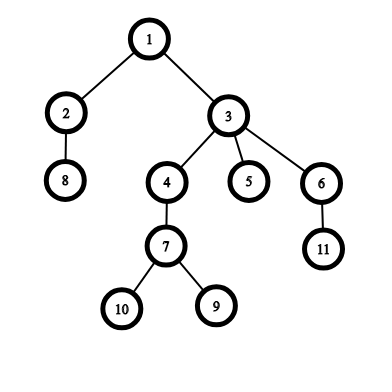
In the second query, if we choose any employee other than the employee $$$8$$$, the project manager will be $$$1$$$. If we choose $$$8$$$, the project manager will be $$$3$$$. Since $$$lv(3)=1 \gt lv(1)=0$$$, choosing $$$8$$$ is the best strategy.
In the third query, no matter how we choose the employee, the project manager will always be $$$1$$$.
In the fourth query, if we choose $$$9$$$ or $$$10$$$ then the project manager will be $$$3$$$. If we choose $$$11$$$ then the project manager will be $$$7$$$. Since $$$lv(7)=3 \gt lv(3)=1$$$, we choose $$$11$$$ as the answer.
There are $$$n$$$ cities in the kingdom $$$X$$$, numbered from $$$1$$$ through $$$n$$$. People travel between cities by some one-way roads. As a passenger, JATC finds it weird that from any city $$$u$$$, he can't start a trip in it and then return back to it using the roads of the kingdom. That is, the kingdom can be viewed as an acyclic graph.
Being annoyed by the traveling system, JATC decides to meet the king and ask him to do something. In response, the king says that he will upgrade some cities to make it easier to travel. Because of the budget, the king will only upgrade those cities that are important or semi-important. A city $$$u$$$ is called important if for every city $$$v \neq u$$$, there is either a path from $$$u$$$ to $$$v$$$ or a path from $$$v$$$ to $$$u$$$. A city $$$u$$$ is called semi-important if it is not important and we can destroy exactly one city $$$v \neq u$$$ so that $$$u$$$ becomes important.
The king will start to act as soon as he finds out all those cities. Please help him to speed up the process.
The first line of the input contains two integers $$$n$$$ and $$$m$$$ ($$$2 \le n \le 300\,000$$$, $$$1 \le m \le 300\,000$$$) — the number of cities and the number of one-way roads.
Next $$$m$$$ lines describe the road system of the kingdom. Each of them contains two integers $$$u_i$$$ and $$$v_i$$$ ($$$1 \le u_i, v_i \le n$$$, $$$u_i \neq v_i$$$), denoting one-way road from $$$u_i$$$ to $$$v_i$$$.
It is guaranteed, that the kingdoms' roads make an acyclic graph, which doesn't contain multiple edges and self-loops.
Print a single integer — the number of cities that the king has to upgrade.
7 7
1 2
2 3
3 4
4 7
2 5
5 4
6 4
4
6 7
1 2
2 3
3 4
1 5
5 3
2 6
6 4
4
In the first example:
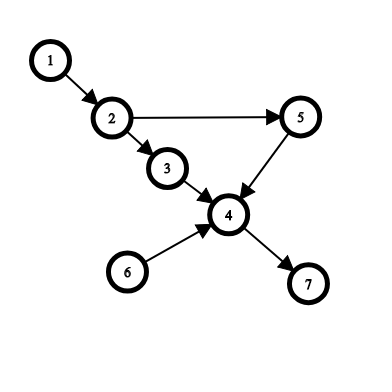
- Starting at the city $$$1$$$ we can reach all the other cities, except for the city $$$6$$$. Also, from the city $$$6$$$ we cannot reach the city $$$1$$$. Therefore, if we destroy the city $$$6$$$ then the city $$$1$$$ will become important. So $$$1$$$ is a semi-important city.
- For city $$$2$$$, the set of cities that cannot reach $$$2$$$ and cannot be reached by $$$2$$$ is $$$\{6\}$$$. Therefore, destroying city $$$6$$$ will make the city $$$2$$$ important. So city $$$2$$$ is also semi-important.
- For city $$$3$$$, the set is $$$\{5, 6\}$$$. As you can see, destroying either city $$$5$$$ or $$$6$$$ will not make the city $$$3$$$ important. Therefore, it is neither important nor semi-important.
- For city $$$4$$$, the set is empty. So $$$4$$$ is an important city.
- The set for city $$$5$$$ is $$$\{3, 6\}$$$ and the set for city $$$6$$$ is $$$\{3, 5\}$$$. Similarly to city $$$3$$$, both of them are not important nor semi-important.
- The city $$$7$$$ is important since we can reach it from all other cities.
In the second example, the important cities are $$$1$$$ and $$$4$$$. The semi-important cities are $$$2$$$ and $$$3$$$.