


| # | User | Rating |
|---|---|---|
| 1 | Benq | 3676 |
| 2 | Kevin114514 | 3657 |
| 3 | jiangly | 3638 |
| 4 | turmax | 3442 |
| 5 | tourist | 3380 |
| 6 | Um_nik | 3353 |
| 7 | strapple | 3350 |
| 8 | squareOf105 | 3346 |
| 9 | heuristica | 3322 |
| 10 | maroonrk | 3310 |
| # | User | Contrib. |
|---|---|---|
| 1 | Qingyu | 158 |
| 2 | nik_exists | 151 |
| 3 | maspy | 150 |
| 4 | AmShZ | 143 |
| 4 | Um_nik | 143 |
| 6 | Errichto | 139 |
| 7 | adamant | 137 |
| 8 | BledDest | 133 |
| 8 | maroonrk | 133 |
| 10 | Proof_by_QED | 131 |


|
+11
Oh, I realized something just a few minutes ago I guess you are same to me : observe that $$$b$$$ will be sorted, and we will find a way to put $$$b[i]$$$ in $$$a$$$. But we actually skip a few things. Let $$$best[i]$$$ is the best position for $$$b[i]$$$ to put in array a, which mean : if we put $$$b[i]$$$ at $$$best[i]$$$, the numbers inversion of $$$b[i]$$$ for $$$a$$$ will be minimum (notice that we not consider the numbers inversion in array $$$b$$$) assume that we find a pair $$$i$$$ and $$$j$$$ such that $$$b[i]$$$ < $$$b[j]$$$ and $$$best[i]$$$ $$$ \gt $$$ $$$best[j]$$$, it will be a contradition. Why ? Because why don't move $$$best[j]$$$ to $$$best[i]$$$ ? Yup, by answer this question, we will get what we want. (why don't you write some example on paper to see something ?) The important is : $$$best[i]$$$ $$$ \lt =$$$ $$$best[i + 1]$$$ (for sorted $$$b$$$) |

|
+11
I guess it relate to dp optimize technique (you can see it here : https://codeforces.me/blog/entry/8219 ) We want to prove $$$best[i] \lt = best[i + 1]$$$ where $$$best[i]$$$ is the best position to put $$$b[i]$$$. But how can we prove it? I don't know... |
|
+64
that's so hurt, guy. I just want to archive and share... |
|
+11
Auto comment: topic has been updated by ngk_manh (previous revision, new revision, compare). |
|
+11
Auto comment: topic has been updated by ngk_manh (previous revision, new revision, compare). |
|
0
Thanks for amz explain. I realize that I had some missunderstand in the way we calc $$$P(reach\ A\ before\ B)$$$ This's exactly what in my mind one day ago: let $$$s = ...a...b...$$$ where $$$a$$$ and $$$b$$$ is node $$$a$$$ and node $$$b$$$, "$$$...$$$" mean some node between them which we chose them in exactly that order, or in other word, $$$s$$$ is state represent what we chose (exact in this order) I think $$$P(reach\ A\ before\ B)$$$ (or $$$P(A \lt B)$$$) must be calculate in this way : $$$P(A \lt B) = \sum_{\substack{all\ s\ which\ a \lt b}} P(s)$$$ But unfortunately, it's wrong (may be, or I still missunderstanding) $$$P(A) = \sum_{\substack{all\ B[i]\ \subseteq\ A}} P(B[i])$$$ if and only if all $$$B[i]$$$ are distinct |
|
-8
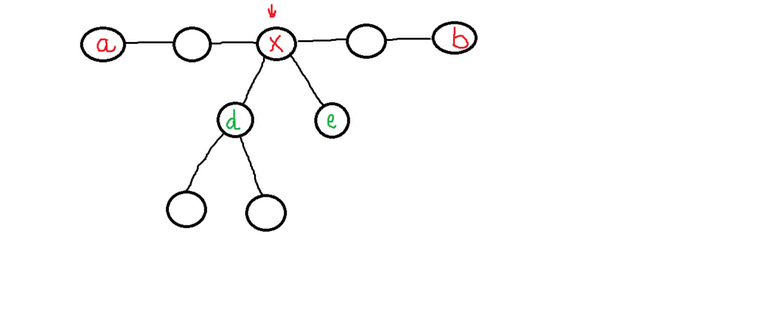
Can you explain this? Assume $$$X$$$ is initially node we chose. Then define a function $$$g$$$ : $$$g[a][b][STATE]$$$ = probability to reach a before b while state of the tree we reach is $$$STATE$$$, and $$$a$$$, $$$b$$$ is length of path.
follow the image, I can see : $$$g[a][b][STATE_x] = \frac{1}{4} (g[a][b][STATE_d] + g[a][b][STATE_e] + g[a — 1][b][closer_a] + g[a][b — 1][closer_b])$$$ It can easy see that the probability can change. Or I wrong in some where? |
|
On
ngk_manh →
How to figure out a solution and improve thinking skill in constructive problem, 5 years ago
0
Auto comment: topic has been updated by ngk_manh (previous revision, new revision, compare). |
|
On
ngk_manh →
How to figure out a solution and improve thinking skill in constructive problem, 5 years ago
0
Auto comment: topic has been updated by ngk_manh (previous revision, new revision, compare). |
|
0
oh, I was realize that, we only can make bamboo tree or cycle (only 1 cycle) with this graph, how stupid! Now i understand how to solve, thank u! |
|
0
huhmm... I still don't understand the solution above(why it's correct), but I will think about that and try by my best thank u! // the problem is in a Vietnamese website and I was change it (a little bit) to this question |
|
0
n = 2 your solution is 2 but correct answer is 1 // but in anyway, thank you for reading and answer my question |
|
0
Auto comment: topic has been updated by ngk_manh (previous revision, new revision, compare). |
|
0
here : https://oj.vnoi.info/problem/vosgame but it's a vietnamese web |
|
0
I think math problem can be too difficult to solve if we don't think "right way". Problem B is an example. d = a[i] — a[i — 1] can be easily to see that it only equal c or c — m. But if you think about "if a[1] = 0, What will happen?". Yeah, a[2] = c. It lead me to try -a[1] to all a[i] and got a big stuck in B. There is an exit for math problem? What thing I can do to improve that? |
|
0
Auto comment: topic has been updated by ngk_manh (previous revision, new revision, compare). |
|
-10
Can you explain why does C[x][j]+C[y][j+1] ≤ C[y][j]+C[x][j+1] is a contradiction in < case? May be C[i][j] has a special property? thank you! |
|
+5
Let x[i] = log2(a[i]) then b[i] = 2^x[i]. It can be prove that sum of all 2*|a[i] — b[i]| always <= S This problem can be extend to k*|a[i] — b[i]| <= S. It will be so funny XD |
|
+2
another approach for B is 2^k |
|
-26
I solved D and I didn't know how I can. Did someone in me for a while? After read editorial, i was confusing:(((((( |
|
0
Here is a another clean approach for Tree Distances II which I also like that! |
|
0
Auto comment: topic has been updated by ngk_manh (previous revision, new revision, compare). |
|
0
That works! Thank you very much. I was checked it as careful as I can. But it still has a big mistake. Thank you again! |
|
0
me too |
|
0
Someone please help me with the tutorial for E. I don't understand because may be the code was not follow the tutorial |


