


| # | User | Rating |
|---|---|---|
| 1 | jiangly | 3810 |
| 2 | Benq | 3676 |
| 3 | Kevin114514 | 3655 |
| 4 | maroonrk | 3463 |
| 5 | strapple | 3447 |
| 6 | Um_nik | 3387 |
| 7 | heuristica | 3322 |
| 8 | turmax | 3317 |
| 9 | tourist | 3307 |
| 10 | jiangbowen | 3291 |
| # | User | Contrib. |
|---|---|---|
| 1 | Qingyu | 156 |
| 2 | nik_exists | 150 |
| 2 | maspy | 150 |
| 4 | Um_nik | 143 |
| 5 | Errichto | 139 |
| 6 | adamant | 137 |
| 7 | AmShZ | 135 |
| 8 | maroonrk | 133 |
| 9 | BledDest | 132 |
| 10 | qwexd | 129 |


|
0
I haven't received anything related to t-shirt, although I'm in top 512. Is it normal? |

|
0
It didn't work for me either even though I was logged in. |
|
+30
Thanks a lot for the effort :) I think it would be great if you can add interesting sample problems for each topic and also add some more advanced techniques and algorithms. By the way, I would love to donate and to translate it into Turkish. |
|
+5
My solution has O(N * 2N) time complexity and O(2N) space complexity. |
|
+45
Is it just me or are this year's COCI rounds significantly harder than the last year's? |
|
0
I agree with you. I think D is much easier than C. Simple solutions aren't necessarily easy. |
|
0
My O(nC2) solution with memoization got TLE on one of the sample test cases; therefore, I had to rewrite it in a bottom-up approach. I was very surprised when I saw O(nC3) solutions could pass. Maybe this is the reason why they wanted to extend the time limit a bit (which ultimately caused asymptotically slow solutions to pass). |
|
+37
In no particular order: UPD: Sorry for listing 10 people instead of 5. I just couldn't resist. |
|
0
Using that approximation you need to find a new function f that gives the partial sum. After that you need to find the inverse of it so that you can find the x such that f(x) = randomly selected number. |
|
0
Thank you for great explanation! Btw, this is the updated version, do you think it is correct now? |
|
0
Oops. I didn't realize that. Thanks! To fix the distribution I need to find the number of ways it can be done for each case, right? Then, it will become O(n2). |
|
0
|
|
+3
No. You need to write your solution to an external file. |
|
+3
You just send the source code. |
|
0
Where did you provide your email? I can't remember if I did that. |
|
+45
Kotlin is too common to be fair. People who are familiar with the language (or even with Java) has a clear advantage. |
|
+11
I haven't received it yet either. |
|
0
What does it say in the Russian version? |
|
+5
Everybody makes mistakes :P |
|
+5
Thank you very much. |
|
0
It's because of the compiler optimization. I ran the code on my computer. It took 2.1 seconds to run when compiled without -02 flag, but it took 0.3 seconds with the flag. |
|
0
Same :/ |
|
0
When will the final standings (three rounds combined) be released? UPD: It's out! |
|
0
My solution gets UPD: I've found the error! I should've printed one query per line. |
|
0
There is an O(X + Y + TlogMOD) solution for the 6th problem. |
|
0
You need to binary search the answer for each query. To speed it up, you need to do these binary searches simultaneously. Complexity: O(mlogm + logm(qlogq + nlog2n + m + qlogn)) |
|
-15
It's not about how civilized it is. |
|
+5
convex hull trick, maybe? |
|
+3
The interesting thing is when I searched "da vinci" on OEIS, only fibonacci thing came up. Now it shows the other one. Maybe I didn't wait enough for all search results to come :/ |
|
+17
When registering during the extra time a participant is automatically assigned to a random room (among suitable for its role). |
|
+21
Unfortunately, it's. But as far as I know, Syria isn't any different. |
|
+8
It's one of 2 university entrance exams in Turkey. (The other is LYS) |
|
+3
It was a really nice problemset. Thanks! |
|
0
We iterate the array. For ith index we will find the best position j, left to the i (it could be right instead of left, but we will compute the right in another iteration), which maximizes As I said before we do the same thing (almost the same thing, equations are little different of course) for right. Then, the answer is the value of the original array + max(0, max of all changes). To find the best j for a particular i, we need to fiddle with the equations a little and represent every element as a linear line: ps[0] = - ar[0] ps[i] = ps[i - 1] - ar[i]
max1 ≤ j < i{ps[i] - ps[j] - ar[j] * j + ar[j] * i} = ps[i] + max1 ≤ j < i{( - ps[j] - ar[j] * j) + ar[j] * i} Now we can represent ith element as a linear line. ith line equals to y = ar[i] * x + ( - ps[i] - ar[i] * i). We first add the line 1. We then start iterating from index 2. When we're done with i (computed the result for it), we add the line i to our structure. (To find the result for that position) When we're at a new position, let's again call it as i, we find the line which has the highest value for x = i. We also need to increase this value by ps[i]. To find the best line, we can use the convex hull trick on a segment tree, since slopes aren't non-decreasing like in the case of traditional convex hull trick. Time complexity: O(NlogN) |
 (this equals to change of the value of the array when we move jth element to ith position).
|
0
Can someone explain the solution of the fifth problem, Combining Rice Balls? |
|
+8
Something like 10^12 10^12. My error was because of integer overflow. |
|
+9
Please read the blog before commenting. The problem is similar to the ones that are being solved by VeeRoute daily. As the competition format is very different from a standard Codeforces round, the contest will be unrated. |
|
+13
What you say is a really bad way of learning. |
|
0
Generators and validators are different things. How can you be so sure even when their source codes are different by the way? |
|
0
Can you please translate it? There is a translation below but it's not better than a google-translate translation. |
|
0
I commented the same thing twice, sorry. |
|
0
Since n ≤ 104, a normal dfs do just fine. I got full score. |
|
0
I did dfs. |
|
+9
|
|
0
Auto comment: topic has been updated by determinism (previous revision, new revision, compare). |
|
+1
I think that two ways you mention are really good and can be used together (similar to the current system for non-interactive problems). I'm not sure about the complexity of implementation though (especially manually interacting, automated interactor stuff is something already implemented I think). |
|
+5
N can be up to 200. How is that wiki enough? Am I missing something? UPD: There is a link to a related paper on that wiki page. I wrote this too early I guess. |
|
0
There is another section called magic. |
|
+40
Here's a sentence that I never thought I would say it: "Finally, I can be a nutella!" |
|
+5
Oops, I didn't realize it. Thank you! |
|
+6
What's the solution of High Card Low Card (platinum)? |
|
0
" The old bronze, silver, and gold divisions will be scaled down in difficulty accordingly, so that bronze contests will provide an easier entry-level experience for our new competitors (we've received overwhelming feedback requesting this) and so it will be less of a discontinuity for students to compete in higher divisions after promotion. Platinum-level contests will be roughly comparable to the difficulty level of prior-year gold contests. " |
|
+9
Aren't there infinitely many solutions if we don't assume it? |
|
+12
I think it is compatible because f(n, k - 1) + f(n - k, k) = f(n - k, k) + f(n - k + 1, k - 1) + ... + f(n - 1, 1). For example when k = 3:
Its time complexity is O(K6logN). |


|
+4
Wouldn't you get a O(NK) solution with that? By the way, I already thought of an O(NK) solution: |

|
+21
It's one of the most detailed editorials I have seen. Awesome! Problemset was also really good. Congratulations! |
|
+16
What's the solution of Div1 B? |
|
+6
For problem D, I assumed that m = (6x + n3 - n) / (3n2 + 3n) is decreasing because data seemed like it. So n's upper bound is when Graph of the first test case of the problem:
UPD: Nevermind me :D I don't know how I couldn't see n is always bigger than m after intersection (even though m starts to increase again, it increases more slowly compared to n) by looking at that graph. |
 . When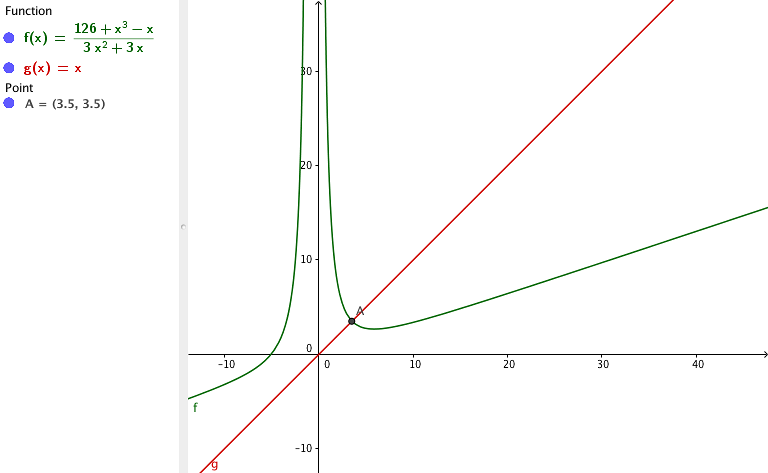
|
0
Mine is still at system testing too. |
|
0
Cartoon for idiots? I loved Sponge Bob when I was a kid. |
|
0
Mine is same. |
|
+14
He performed really well, that's why. |
|
0
Yes. Probably because magnets are rectangle in real-life. |
|
+21
Can you please explain in a detailed way what modeled solution was and why it's wrong? Because I was really sure about my solution for Div1A. |
|
+4
I think problem Div1A is really nice. |
|
0
Did you use any data structure? |
|
0
I can't remember the problem, but once I wrote it without ranks, and I got TLE. When I added ranks to it, it passed. That's why I don't think it's always a good idea. |
|
0
It didn't get WA, but it's because of my luck. If they can touch, this solution is wrong. Didn't problem say they can't touch? |
|
+23
I didn't know that. Sorry. |
|
+16
You used to be purple :D It's not funny when it's told to you, isn't it? |
|
0
I think it's not that neat, but let me share my solution: I first check if their projections on x axis intersect. If not, then they don't block each other. Then I think them as lines instead of line segments and find their equations. Then I choose the bigger one of left ends of segments as common x value that both have y values. I plug that common x into their equations. The line segment with the less value is the one which blocks the other, so we should remove it first. The only tricky situation is when a line segment doesn't have a slope. In that case, instead of using equation, we can use any value between y1 and y2 of that line segment. |
|
0
What do you think is the problem of my solution for SAVEZ? It gets WA on 1C. |
|
0
Don't be silly. Hashing is one of the most fundamental and most flexible techniques; that's why, it's as "real" as it gets. |
|
+18
Heavy Light Decomposition is what you're looking for:
Btw, did you create a new account to ask a question? If so, why? |
|
+3
Thank you for your effort. It's an amazing extension. |
|
+6
After system test, the extension was showing that I will get -8, but instead I got +6. I think there is difference between your and Codeforces' algorithm (unless some people was banned from leaderboard because of cheating after systest; I'm not sure about that) |
|
0
What are the upper bounds of number of all steps and number of steps that we need to compute divisors? |
|
+13
It depends on the person. I think that the new system is more motivating. |
|
+17
Exactly! I feel like the same way. I also think that in the new system it's less probable for someone to get lucky and have a higher rating than their actual skill or vice versa. |
|
0
Thank you for informing :) I didn't know that. |
|
+1
No, it's like pretests. You need to click on "run system test" button. UPD: I was wrong. As riadwaw said, it's not like pretests. You'll get positive score anyway. |
|
+9
Even though it's confusing, I think it's a nice feature because it lets users to measure themselves in terms of speed. |
|
+16
|
|
+61
" If your solution can not deal with the train of size 1, your solution may not good enough~~ "
|

|
0
Can someone explain the solution of A? I've looked at the solution slide, but I didn't understand it (except the first insight; I've already found it). |
|
+1
Then you (maybe without realizing) assumed that there is always valid p2 and p3 whose sum equals to n — p1. Problem guarantees there is a solution. It doesn't guarantee there is a valid (p2, p3) pair; that's why, you need to know Goldbach's conjecture. |
|
+1
What's the complexity of finding the closest prime number? |
|
+1
How to solve D? |
|
+3
Thank you really much :) |
|
+11
I don't know if it's only me, but the link doesn't work. |
|
+2
Won't new formulas be applied to old contests? |
|
+26
I think calling it "square root decomposition on queries" is a better choice, since not specifying it implies that decomposition happens on the array itself. (Of course, we store queries on another array but I mean the main array.) |
|
0
Why do you suggest to watch to it there? They're basically the same. |
|
0
That's totally logical. Thanks for answering. |
|
+32
Since it's IOI 2013 syllabus, it just means that the intended solutions won't use them. There might be conceptually easier solutions using them, that's why I think learning those algorithms would be a better idea. |
|
+5
Thanks for info! What's your suggestion? Which one would be better to learn in terms of easiness to write etc.? |
|
+5
Is learning one of balanced BSTs (in your case treap) enough to solve problems that can be solved with BBSTs? Or do some problems need some specific BBSTs? |
|
+5
What are your priorities while studying IOI? (I'm asking this since you said you have higher priorities of training.) |
|
0
Thanks for nice tip. Btw, how do you use binary search for B part? |
|
0
Auto comment: topic has been updated by determinism (previous revision, new revision, compare). |


