By I_love_Hoang_Yen, 11 years ago, In English

Today I came across this article, in which "Peter Norvig said that one thing that was surprising to him was that being a winner at programming contests was a negative factor for performing well on the job".

Normally I don't care about these topics, but this is from Google — where they have good population of high rated competitive programmers and the claim is backed with data.

The article mentioned one point: "programming contest winners are used to cranking solutions out fast and that you performed better at the job if you were more reflective and went slowly and made sure things were right". Though I don't think this is true. For example, being competitive programmer taught me:

  1. bugs can be everywhere & we must code carefully
  2. many problems have amazing solutions, and it's not a good idea to start coding anything that comes to mind.

Some comments talked about how competitive programmers write unmaintainable code or appear arrogant. Having lots of friends who are competitive programmers and read lots of comments here, I believe that these are also not the case.

  • Yes, amongst rude comments made on Codeforces, many are from reds, but many are also from yellows, purples, blues, greens... and I think majority of high rated people here are very reasonable & nice.
  • I think most people have some moments when we come back to read our old code writen in contests, and have no idea what we did. Since we've been there, it's not natural to think that we would write such code when we know that we need to maintain them.

I understand that the points I made above are probably biased. So what do you think? Do you believe that being good competitive programmer correlates negatively with being good on the job?

Full text and comments »

  • Vote: I like it
  • +380
  • Vote: I do not like it

By viktork, 12 years ago, translation, In English

Hello, Codeforces!

The problems were suggested by users roosephu and Sunayuki. The great help in preparing was provided by Aksenov239, GlebsHP and Codeforces team. ZeptoLab Team did its best while working on statements.

The round will use smoother dynamic problem scores with 250 points steps.

In 2014 we hosted our first programming contest together with Codeforces, and we liked it!

Let me shortly remind you how it was. The contest consisted of 6 problems, 2.5 hours were given to solve (you can have a look at the problems of the previous year and try to solve them here).

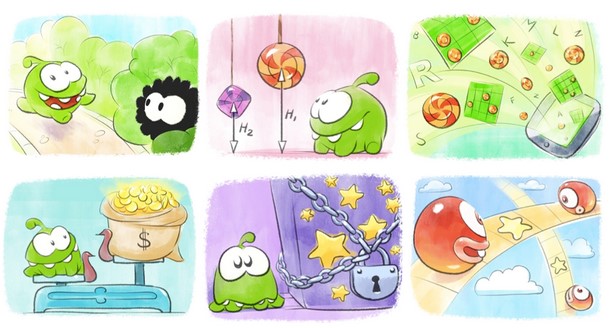
Of course, even on a purely coding event we stayed true to ourselves, so all problems were designed based on our games, and, of course, we illustrated them with care:

Zepto Code Rush 2014 broke the existing Codeforces record of round popularity. Also we were glad to read a positive feedback about problems. By the way, the first three places were taken by developers from Russia. Some of them even came to pick up the prizes at the office, where they had a mini-tour and the highlight of the program: of course, the game in a giant Cut The Rope and our standard corporate "going green" welcome kit at the entrance (we call "going green" a welcome kit, full of fun gizmos of our corporate green color).

Full text and comments »

Announcement of ZeptoLab Code Rush 2015
  • Vote: I like it
  • +886
  • Vote: I do not like it

By zeliboba, 12 years ago, translation, In English

Hello everyone!

Congratulations from AIM Fund to Codeforces on their 5th anniversary! Many of our employees take part in competitive programming, so we took the opportunity to support the crowdfunding campaign run by Codeforces. We appreciate what we have learned here and we are grateful for the enjoyable moments that we spent solving interesting problems. Within the next month, we are planning to run our round and will do our best to create challenging problems.

Our company specialises in proprietary trading, the key concepts in our work are big data, low latency and high frequency. Our team mainly consists of graduates from the MSU Faculty of Mechanics and Mathematics and Moscow Institute of Physics and Technology (MIPT).

Full text and comments »

  • Vote: I like it
  • +360
  • Vote: I do not like it

By Nickolas, 12 years ago, translation, In English

This round features Picat, a language somewhat similar to Prolog. We tried to make most of our problems convenient to solve using declarative approach.

The traditional A+B program (A and B are space-separated) looks as follows:

main =>
  A = read_int(),
  B = read_int(),
  C = A + B,
  println(C).

The main source of information about language is http://picat-lang.org/ The contest uses version 0.9.

Full text and comments »

  • Vote: I like it
  • +140
  • Vote: I do not like it

By fcspartakm, 12 years ago, translation, In English

Hello, Codeforces!

I'd like to invite you to Codeforces Round #297 (Div. 2). It'll be held on Thursday, March 26 at 19:30 MSK and as usual Div. 1 participants can join out of competition.

Great thanks to Maxim Akhmedov (Zlobober) for helping me preparing the contest, to Maria Belova (Delinur) for translating the statements into English, to Mike Mirzayanov (MikeMirzayanov) for the great Polygon platform and ideas of some problems and to my old friends Pavel Kholkin (HolkinPV), Ilya Los (IlyaLos), Vitaliy Kudasov (kuviman) and Arthur Svechnikov (ikar) for writing solutions.

The scoring distribution will be announced later. Good luck everyone!

UPD The scoring is smooth dynamic (with steps of 250 points). More information about this can be found here. Tasks will be arranged in order of ascending supposed difficulty.

UPD2 Competition completed! Thank you all!

UPD3 You can find editorial here.

UPD4 Congratulations to the winners!

  1. cikofte
  2. fcspartakm_2
  3. stealife
  4. GITLER228
  5. alpq654321

Full text and comments »

  • Vote: I like it
  • +175
  • Vote: I do not like it