Rynical's blog

By Rynical, history, 3 months ago, In English

It's been some time... So anyways

You've learned every basic Hiragana character.

Now it's finally time to understand your first Japanese sentence.

Topic marker and Copula

The simplest Japanese sentence follows this pattern:

Topic は Description です。

Here, です (desu) simply means "**is**" or "**am**".

For example:

わたし は がくせい です。

Meaning:

I am a student.

Let's break it down.

わたし

means:

I / Me

is called the Topic Marker.

It tells us what the sentence is about.

In this sentence, the topic is:

わたし

Then,

がくせい

means:

student

This is the word that describes the topic.

So in this sentence, you're saying what you are — a student.

Finally,

です

makes the sentence polite and means something close to "is" or "am"

So:

わたし は がくせい です。

literally becomes:

As for me,
student
am.

which we translate as:

I am a student.

This might seem a little confusing, so let's break it down.

I am a student.

For English:

Subject = I

Copula or Linking Verb = am

Subject Complement = a student

So English follows SVC (Subject + Verb + Complement).

For Japanese:

わたし は がくせい です。

you can analyze it as:

Subject = わたし

Copula = です

Complement = がくせい

So Japanese follows SCV (Subject + Complement + Verb)

Ok, time for practice.

But before you are given these exercises, here are some words you should know.

  • ねこ — Cat
  • かわいい — Cute
  • さくら — Cherry Blossom
  • きれい — Beautiful
  • ほん — Book
  • おもしろい — Interesting / Funny

Now translate the following into English:

  • ねこ は かわいい です。
  • さくら は きれい です。
  • ほん は おもしろい です。
Answers

Congratulations!

You've just read your first complete Japanese sentences.

This, That, Here and There

Now that you know how to make simple sentences, let's learn one of the most useful word families in Japanese.

Japanese distinguishes things based on distance.

There are three levels:

  • Near me
  • Near you
  • Away from both of us

Fortunately, the pattern is very easy to remember.

Meaning Near Me Near You Far Away
Thing これ (kore) それ (sore) あれ (are)
This/That + Noun この (kono) その (sono) あの (ano)
Place ここ (koko) そこ (soko) あそこ (asoko)

A simple trick to remember them:

Ko → Close to me
So → Close to you
A → Away from both

これ, それ and あれ

These words can stand on their own.

これ は ほん です。

This is a book.

それ は ねこ です。

That is a cat.

あれ は やま です。

That (over there) is a mountain.

この, その and あの

Unlike the previous three, these cannot stand alone.

They must always be followed by a noun.

この ほん は おもしろい です。

This book is interesting.

その ねこ は かわいい です。

That cat is cute.

あの やま は きれい です。

That mountain over there is beautiful.

Notice the difference.

これ は ほん です。

This is a book.

この ほん は おもしろい です。

This book is interesting.

ここ, そこ and あそこ

These refer to places.

ここ は がっこう です。

Here is a school.

そこ は へや です。

There is a room.

あそこ は やま です。

Over there is a mountain.

Ok, time for practice.

But before you are given these exercises, here are some words you should know.

  • はこ — Box
  • やま — Mountain
  • がっこう — School
  • へや — Room

Translate these into English.

  • この ほん は おもしろい です。
  • その ねこ は かわいい です。
  • あの やま は きれい です。
  • ここ は がっこう です。
  • そこ は へや です。
  • あそこ は やま です。
Answers

Congratulations!

You've just learned one of the most useful patterns in Japanese.

Once you know Ko → So → A, you'll start noticing it everywhere.

Full text and comments »

  • Vote: I like it
  • 0
  • Vote: I do not like it

By Rynical, history, 3 months ago, In English

The H Column

Now let's learn the H-column.

A I U E O
ha hi fu he ho

And yes, Japanese has decided to be weird again.

Instead of:

ha hi hu he ho

we get:

ha hi fu he ho

The culprit this time is:

ふ = fu

Visual mnemonics:

  • は — Ha — Looks like H on a.
  • ひ — Hi — Looks like a smiling face laughing hihihihihihi.
  • ふ — Fu — Looks like Mount Fuji.
  • へ — He — Looks like an arrow pointing at heaven.
  • ほ — Ho — Looks like a flag on a hotel.

There is one more thing worth mentioning.

Remember when I said Japanese sometimes likes being weird?

は = ha
へ = he

Most of the time.

But when used as particles, they are pronounced:

は → wa
へ → e

Don't worry about that for now. We'll learn particles later.

Let's practice reading some words:

  • はこ — Box
  • ひと — Person
  • ふね — Ship
  • ひきこもり — Shut in.
  • ほし — Star
  • はな — Flower
Answers

Congratulations!

You can now read:

ほし

The Japanese word for "star".

Which means you're one step closer to understanding anime song lyrics.

The B Column

Now that we know the H-column, learning the B-column is easy.

Simply add Dakuten to the H-column:

H B

Or:

H → B

Just like before, we don't need to learn completely new characters. We simply add Dakuten to a column we already know.

  • ば — Ba
  • び — Bi
  • ぶ — Bu
  • べ — Be
  • ぼ — Bo

Let's practice reading some words:

  • ばか — Fool / Idiot
  • びじん — Beautiful Person
  • ぶた — Pig
  • ひび — Daily life
  • ぼうし — Hat
  • べに — Crimson
Answers

Congratulations!

You can now read:

ばか

Which represents you!

Handakuten (゜)

Remember Dakuten (゛)?

Handakuten is its smaller, round cousin:

゛ = Dakuten

゜ = Handakuten

Dakuten turns an unvoiced sound into a voiced sound, Handakuten changes the H sound into a P sound.

While Dakuten changes:

K → G
S → Z
T → D
H → B

Handakuten changes:

H → P

For example:

は → ぱ
ひ → ぴ
ふ → ぷ
へ → ぺ
ほ → ぽ

Just like Dakuten, we simply modify characters we already know.

Think of Handakuten as turning a soft "h" sound into a stronger "p" sound.

The P Column

Now that we know what Handakuten are, learning the P-column is easy.

Simply add Handakuten to the H-column:

H P

Or:

H → P

Just like Dakuten, we are not learning completely new characters.

  • ぱ — Pa
  • ぴ — Pi
  • ぷ — Pu
  • ぺ — Pe
  • ぽ — Po

Let's practice reading some words:

  • ぱぱ — Papa / Dad
  • ぴかぴか — Sparkling / Shiny
  • ぺこぺこ — Hungry
  • ぺらぺら — Fluent
  • ぽかぽか — Warm and Pleasant
  • きっぷ — Ticket
Answers

I swear the P column has the best words.

Congratulations! You now know all three versions of the H-column:

The Y Column

Now let's learn the Y-column.

A I U E O
ya yu yo

You may notice something strange.

Just like the Japanese language itself, this column decided not to be complete.

We only have:

ya yu yo

There are no Hiragana for:

yi
ye

Thankfully, that means fewer characters to learn.

Visual mnemonics:

  • や — Ya — Looks like someone raising both hands and shouting ya!. It also looks like a yak.
  • ゆ — Yu — Looks like a unicorn.
  • よ — Yo — looks like a yo-yo hanging from a string

Let's practice reading some words:

  • やま — Mountain
  • ゆき — Snow
  • よる — Night
  • やさい — Vegetable
  • ゆめ — Dream
  • よこ — Side
Answers

Notice how common these characters are.

Even though there are only three of them, they appear in many everyday Japanese words.

Congratulations!

You can now read:

ゆめ

Which you must achieve.

Yōon (拗音)

Remember the Y-column?

Japanese allows certain kana ending in the i sound to combine with a small や, ゆ, or よ.

These combinations are called Yōon (拗音).

For example:

き + や = きや (kiya)

き + ゃ = きゃ (kya)

Notice the difference.

きや = kiya
きゃ = kya

The small ゃ combines with the previous kana and creates a new sound.

The same applies to:

ゃ
ゅ
ょ

The table:

Ya (ゃ) Yu (ゅ) Yo (ょ)
K きゃ (kya) きゅ (kyu) きょ (kyo)
G ぎゃ (gya) ぎゅ (gyu) ぎょ (gyo)
S しゃ (sha) しゅ (shu) しょ (sho)
Z じゃ (ja) じゅ (ju) じょ (jo)
T ちゃ (cha) ちゅ (chu) ちょ (cho)
N にゃ (nya) にゅ (nyu) にょ (nyo)
H ひゃ (hya) ひゅ (hyu) ひょ (hyo)
B びゃ (bya) びゅ (byu) びょ (byo)
P ぴゃ (pya) ぴゅ (pyu) ぴょ (pyo)
M みゃ (mya) みゅ (myu) みょ (myo)
R りゃ (rya) りゅ (ryu) りょ (ryo)

Thankfully, there is almost no memorization involved.

Just remember:

i-column kana + small ゃゅょ

Let's practice reading some words:

  • きょう — Today
  • しゅみ — Hobby
  • ちょこ — Chocolate
  • みゃく — Pulse
  • りょこう — Travel
  • きゅう — Nine
Answers

Notice how many common Japanese words use Yōon.

Without them, Japanese would sound very different.

The W Column

We're almost done.

The W-column is one of the smallest columns in modern Japanese.

A I U E O
wa wo

You may notice that most of the column is missing.

Historically, Japanese had more W-sounds, but over time they disappeared from everyday use.

That leaves us with only:

  • わ — Wa
  • を — Wo

There is one important thing to know.

Even though を is written as:

wo

it is almost always pronounced:

o

The spelling is kept mainly for historical reasons.

Visual mnemonics:

  • わ — Wa — Looks like a scared cat, saying "**wa!**" in surprise.
  • を — Wo — Looks like... yeah you are on your own on this lil bro.

Let's practice reading some words:

  • わたし — I / Me
  • わに — Crocodile
  • わかめ — Seaweed
  • わざ — Skill / Technique
  • わく — Frame / Boundary
Answers

Fortunately, を is rarely used inside words.

Its main purpose is acting as a grammatical particle, which we'll learn much later.

The Standalone N (ん)

Congratulations!

You have reached the final Hiragana character.

Meet:

Unlike every other Hiragana we've learned so far, ん is not a consonant-vowel combination.

It simply represents the following:

n

This makes it unique among all Hiragana.

Examples:

か = ka
な = na
ま = ma

ん = n

Visual mnemonic:

  • ん — N — Looks like a n, italicized.

Let's practice reading some words:

  • ほん — Book
  • にほん — Japan
  • あんこ — Red Bean Paste
  • てんき — Weather
  • かんじ — Kanji
  • みんな — Everyone
Answers

One final thing worth mentioning.

The pronunciation of ん changes slightly depending on the sound that follows it.

For example, before:

m
b
p

it may sound closer to an "m".

Don't worry about memorizing those details for now.

Just read it as:

n

and you'll be understood.

Congratulations!

You now know every basic Hiragana character.

You can read Japanese.

You may not understand it. You may not speak it. You may not survive Kanji.

But you can read it.

Final Practice

Try reading these sentences.

  • わたし は にほんご が すき。 — I like Japanese.
  • きょう は いい てんき。 — The weather is nice today.
  • ほん を よむ。 — Read a book.
  • やま へ いく。 — Go to the mountain.
  • みんな で いこう! — Let's go together!
  • ねこ は かわいい。 — The cat is cute.
Romaji

Full text and comments »

  • Vote: I like it
  • -27
  • Vote: I do not like it

By Rynical, history, 3 months ago, In English

The T Column

Now let's learn the T-column.

A I U E O
ta chi tsu te to

You may notice that Japanese has decided to be weird again.

Instead of:

ta ti tu te to

We get:

ta chi tsu te to

Just like し became "shi", we have a couple more exceptions here.

Visual mnemonics:

  • た — Ta — Looks literally like Ta.
  • ち — Chi — Looks like a cheeky smile.
  • つ — Tsu — Looks like a wave from a tsunami.
  • て — Te — Looks like a dog's tail.
  • と — To — Looks like a toe sticking out.

Let's practice reading some words:

  • した — Below
  • ちかい — Near
  • つき — Moon
  • てき — Enemy
  • とけい — Clock
  • かたち — Shape
  • たすけて — Help Me!
Answers

The important things to remember are:

ち = chi
つ = tsu

Everything else behaves exactly as expected.

The D Column

Now that we know the T-column, learning the D-column is easy.

Simply add Dakuten to the T-column:

T D

Or:

T → D

The middle two characters are a little special.

ち → ぢ
つ → づ

In modern Japanese, ぢ is usually pronounced the same as じ, and づ is usually pronounced the same as ず.

Thankfully, these characters are quite rare, so you won't see them very often.

  • だ — Da
  • ぢ — Ji
  • づ — Zu
  • で — De
  • ど — Do

Let's practice reading some words:

  • だいがく — University
  • どこ — Where?
  • かど — Corner
  • どいて — Move aside!
  • であい — Encounter
Answers

Just like the G-column and Z-column, we simply applied Dakuten to a column we already knew.

The Small Tsu (っ)

Congratulations! You now know enough Hiragana to learn one of the most important special characters in Japanese.

Meet the Small Tsu:

つ → っ

Unlike normal Hiragana, the small tsu does not have a sound of its own.

Instead, it doubles the consonant that comes after it.

For example:

かこ
kako

かっこ
kakko

Notice how we pause briefly before saying the second "k".

ka...ko

becomes

kakko

Here are some more examples:

きて
kite

きって
kitte
さか
saka

さっか
sakka
がこう
gakou

がっこう
gakkou

Let's practice reading some words:

  • きって — Stamp
  • がっこう — School
  • ざっし — Magazine
  • けっか — Result
  • さっか — Author / Writer
  • どっち — Which one?
Answers

Just remember one thing:

っ ≠ tsu

When written small, it is no longer pronounced "tsu".

The N Column

Now let's learn the N-column.

A I U E O
na ni nu ne no

Thankfully, Japanese has decided to behave itself this time.

na ni nu ne no

No weird pronunciations. No exceptions. Just exactly what you'd expect.

Visual mnemonics:

  • な — Na — Looks like someone saying "**nah**" with crossed arms.
  • に — Ni — Looks like a knee.
  • ぬ — Nu — Looks like a tangled noodle held with chopstick.
  • ね — Ne — Looks like a snail behind a rod.
  • の — No — Looks like the word sign no you see on roads.

Let's practice reading some words:

  • なつ — Summer
  • にく — Meat
  • ぬの — Cloth
  • ねこ — Cat
  • のこぎり — Saw
  • かに — Crab
Answers

Notice how much easier this column was to learn. No Dakuten. No strange pronunciations. No tricks. Sometimes Japanese decides to be nice.

The M Column

Now let's learn the M-column.

A I U E O
ma mi mu me mo

Just like the N-column, this one is nice and straightforward.

ma mi mu me mo

No exceptions. No weird pronunciations. No Dakuten.

Visual mnemonics:

  • ま — Ma — Looks like a person wearing mask.
  • み — Mi — Looks like a musical note. Remember the note, Mi.
  • む — Mu — Looks like a cow saying moo.
  • め — Me — Looks like Nu right, but without the loop. The noodle now fell from the chopstick and now caused mess.
  • も — Mo — Looks like a fishing hook with more worms attached.

Let's practice reading some words:

  • みみ — Ear
  • むし — Insect
  • まど — Window
  • めかた — Weight
  • もも — Peach
  • なみ — Wave
Answers

Notice how many common words can now be read using only the kana we've learned so far.

The R Column

Now let's learn the R-column.

A I U E O
ra ri ru re ro

There is one thing worth mentioning.

Japanese R is not exactly the same as the English R.

It sounds somewhere between an English R, L, and D.

Don't worry too much about getting it perfect. If you're a beginner, just think of it as an R sound.

ra ri ru re ro

Visual mnemonics:

  • ら — Ra — Looks like a rabbit's ear.
  • り — Ri — Looks like two grains of rice. Another form of this character looks like river.
  • る — Ru — Looks like a hand holding a ruby.
  • れ — Re — Looks like a camel behind a railing.
  • ろ — Ro — Looks like the hand, but there is no ruby! Well now, the ruby is robbed.

Let's practice reading some words:

  • さくら — Cherry Blossom
  • とり — Bird
  • くるま — Car
  • れきし — History
  • こころ — Heart
  • かれ — He / Boyfriend
Answers

Congratulations! You can now read:

さくら

One of the most famous Japanese words and the name of approximately half the anime characters ever created.

You now know:

Vowels K-column G-column S-column Z-column T-column D-column N-column M-column R-column

That's 35 Hiragana characters and 50 sounds!

Full text and comments »

  • Vote: I like it
  • +9
  • Vote: I do not like it

By Rynical, history, 3 months ago, In English

I learnt about formatting

The K Column

Now that we know the vowels, let's learn our first consonant column: the K column.

A I U E O
ka ki ku ke ko

As before, we will learn them one by one.

  • か — Ka — Looks like someone holding a katana.
  • き — Ki — Looks like a key with a few extra lines attached.
  • く — Ku — Looks like a bird's beak, Remember Cuckoo's beak.
  • け — Ke — Looks like outline of a Keg.
  • こ — Ko — Looks like two coins stacked on top of each other, or two Koi fish chasing each other's tail.

Now let's practice reading a few words:

  • あか — Red
  • かお — Face
  • きく — To listen
  • こい — Love
  • いけ — Pond
  • あき — Autumn
Answers

Notice how we didn't learn any new vowels. We simply combined the K sound with the vowels we already know. This is how most of Hiragana works.

Dakuten

Dakuten (゛) are two small marks that can be added to certain Hiragana characters.

They change an unvoiced consonant into a voiced consonant.

For example:

K → G
S → Z
T → D
H → B

If you don't know what "voiced" means, place your hand on your throat and say:

ka ka ka ka

Then say:

ga ga ga ga

You should feel more vibration in your throat while saying "ga".

That vibration is called voicing, and Dakuten are the marks that add it.

For example:

か → が
さ → ざ
た → だ
は → ば

Fortunately, we don't need to learn new characters. We simply add two small marks to an existing character.

The G Column

Now that we know what Dakuten are, learning the G-column is easy.

Simply add Dakuten to the K-column:

K G

Or:

K → G

Since these characters are just modified versions of the K-column, we'll focus on remembering their sounds rather than inventing entirely new mnemonics.

  • が — Ga
  • ぎ — Gi
  • ぐ — Gu
  • げ — Ge
  • ご — Go

Let's practice reading some words:

  • かぎ — Key
  • えいご — English
  • がいこく — Foreign country
  • ごご — Afternoon
  • ぎかい — Assembly
  • ぐあい — Condition
Answers

Notice how much easier this column was to learn.

The S Column

Now let's learn the S-column.

A I U E O
sa shi su se so

You may notice something strange.

Most Hiragana follow the pattern:

consonant + vowel

So we might expect:

sa si su se so

But Japanese decided that:

si → shi

Don't worry too much about it. There are only a few characters like this.

Visual mnemonics:

  • さ — Sa — Looks like a smug face.
  • し — Shi — Looks like a Fishing Hook. Fi shi ng hook.
  • す — Su — Looks like a superhero cape flowing behind someone.
  • せ — Se — Looks like someone saying see? while pointing. It also looks like a syringe injected in arm.
  • そ — So — Looks like a sewing needle and thread.

Let's practice reading some words:

  • すし — Sushi
  • あさ — Morning
  • しお — Salt
  • うそ — Lie
  • せかい — World
  • あし — Foot / Leg
Answers

Congratulations! You can now write いせかい — Your favorite Genre!!

The Z Column

Now that we know the S-column, learning the Z-column is easy.

Simply add Dakuten to the S-column:

S Z

Or:

S → Z

The only thing worth noting is:

し → じ
shi → ji

Apart from that, everything works exactly as expected.

  • ざ — Za
  • じ — Ji
  • ず — Zu
  • ぜ — Ze
  • ぞ — Zo

Let's practice reading some words:

  • かぜ — Wind
  • すず — Bell
  • じこ — Accident
  • ぞう — Elephant
  • いざ — Now then! / Come on!
  • あじ — Flavor
Answers

Notice how much easier this column was to learn.

Just like the G-column, we didn't learn five completely new characters. We simply applied Dakuten to the S-column.

You now know:

  • Vowels
  • K-column
  • G-column
  • S-column
  • Z-column

That's 15 Hiragana characters, and 25 new sounds already!

Btw, I have written notes of japanese, which I wrote for practice. Do you want it?

Full text and comments »

  • Vote: I like it
  • -5
  • Vote: I do not like it

By Rynical, history, 3 months ago, In English

Inspired from greateric's Math series.

So, we programmers have a thing in common: we are weebs. And weebs wish to learn Japanese. So, I give you one.

Here is the YouTube Video I referred to learn Hiragana. You may either follow this, or read this blog.

So, what is the Japanese script?

Like in English, we got 2 — Uppercase and lowercase. Japanese got 3 — Hiragana, Katakana and Kanji

Hiragana is the script that is mainly used to write in Japanese.

Katakana is the 'uppercase' of hiragana, but it's used to write loan words, i.e., words that were not in Japanese originally. Eg — Aisu (Ice). It's also used to show emphasis and by companies to write their names.

Every Hiragana has a Katakana counterpart, just like lower and uppercase. Together they are referred as Kana

Kanji is the third writing script, which is the direct use of the Chinese script. (Kana was derived from Chinese script, but Kanji is using Chinese script itself.)

Kanji is used to differentiate homonyms in Japanese. Eg — Kami is both paper and God, but the kanji of God is 神 and the kanji of paper is 紙.

Kanji is also used to write some words in a more confined space. Eg — Hiragana of Watashi, which means 'I' is わたし, and the kanji of watashi is 私.

Hiragana

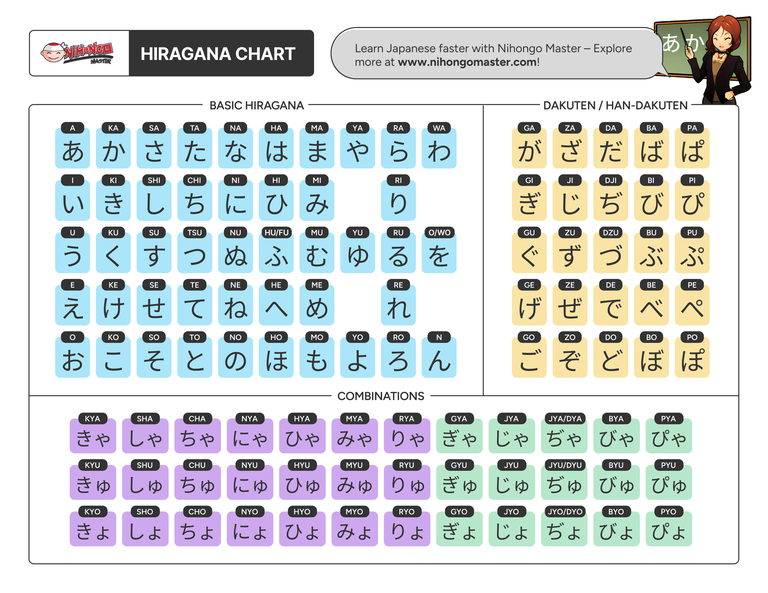
Hiragana consists of 46 characters, and every character is referred to as a mixture of a consonant and a vowel (except the first 5 vowels and the lone n sound), like Ka, which is a character itself か, and not said separately. It sounds very inefficient, but we have to learn this.

Here is a chart of all Hiragana characters: -

Now yes, it may feel overwhelming, but don't worry, I will give visual mnemonics to learn every character.

The column of Vowels

The blog is already long, so for today, let's just learn the vowels, which consist of 5 characters.

Btw, we will learn in the order of A, I, U, E, O; for every character.

  • あ — A — this looks like alpha, crossed by a T, right? So this is The alpha. You may also see it as an apple.
  • い — I — this looks like two lowercase i's together.
  • う — U — this looks like a bent U, or a person getting punched in the belly, saying Uhh.
  • え — E — this looks like an energetic ninja, running right.
  • お — O — this almost looks like an O. Try to remember using the loop that is created.

So these are the five vowels. Try practicing them by writing. I will give some words too for you to practice, along with their English meaning.

  • あおい — Blue
  • いいえ — No
  • あい — Love
  • おい — Way to call someone
  • いえ — House
  • うえ — Up
Answers

Last thing — Japanese characters need not be accurate to write. There are multiple ways to write a character. (This is known as Hentaigana... I won't go deep for now.)

Congratulations! You can now read exactly five Japanese characters. That's approximately five more than the average anime protagonist before Episode 1.

Full text and comments »

  • Vote: I like it
  • +3
  • Vote: I do not like it

By Rynical, history, 3 months ago, In English

In round 1103, I hacked 2 people. I expected my ranking to go up, but it didn't

Full text and comments »

  • Vote: I like it
  • +5
  • Vote: I do not like it

By Rynical, history, 4 months ago, In English

So, I started doing Comp Prog after my summer vacation started, and for now I completed two contests and did like 30 questions, all around 800. But after the spectral cup, I realized I need to do harder questions, especially of DP and greedy, but how many questions should I do of each rating and tag, or is there like a list of questions that is made that I can follow?

Full text and comments »

  • Vote: I like it
  • 0
  • Vote: I do not like it